

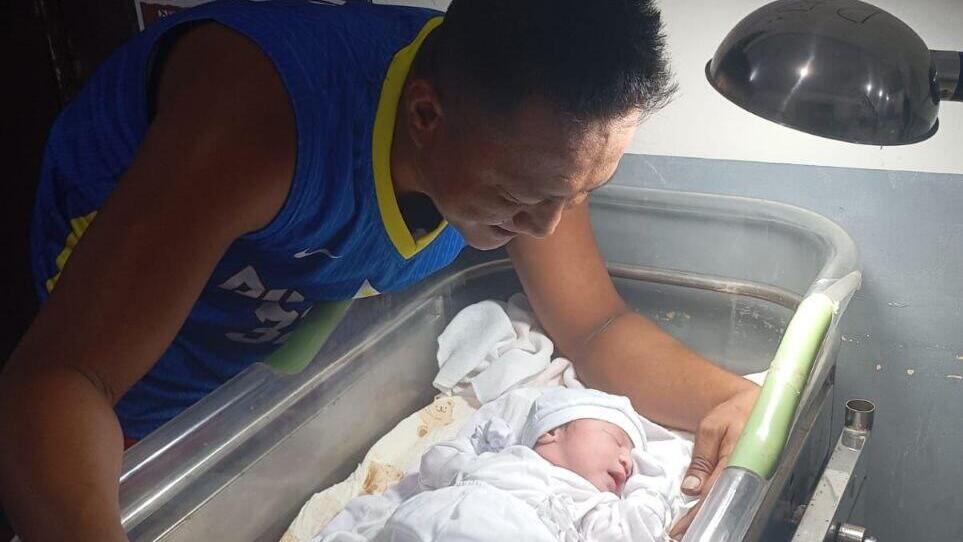
Gelienor "Jimmy" Leano Pacheco, the Filipino caregiver who was abducted from Kibbutz Nir Oz during the October 7 Hamas massacre and released on November 24, 2023, has just welcomed a new baby girl with his wife, Clarice Joy, in the Philippines. In an emotional gesture, Pacheco chose to name their fourth child Israela. She joins her three older siblings: Gian Kyle, Gillian Carlo, and Jean Celine.
Pacheco, 34, had worked for years in Kibbutz Nir Oz, where he was taken captive alongside dozens of Israelis. On the day of the attack, he was caring for 80-year-old Amitai Ben Zvi, whom the terrorists murdered. After his release, Pacheco returned home to the Philippines, where his family and community embraced him.
Shortly after his return, Pacheco spoke with Ben Zvi’s sons, Ido and Gilad, and recounted the harrowing moments of the Hamas assault. “Your father told me to tell you he loves you,” he said. “He shouted at me, ‘Go, run, save yourself!’” The brothers later met Pacheco at Shamir Medical Center.
“It was so moving to hear from Jimmy about our friends and their parents who were held underground with him in Gaza,” one brother said. “It was an emotional reunion—Jimmy is truly like a member of our family. We worried for him just like we did for all the hostages. It was heartbreaking to think that he was kidnapped just for coming to work at Nir Oz.”
“Hugging Jimmy brought us to tears,” he added. “He had a special bond with our dad. He took care of him for four years, and our father trusted him completely. It felt like a family member had come home, not a foreign worker or caregiver.”

According to the Ben Zvi family, Jimmy carries a deep sense of guilt over surviving while Amichai was killed. “He told us, ‘I’m sorry I couldn’t save your father.’ He even managed to notify us that same Saturday that our father had been murdered.”
Get the Ynetnews app on your smartphone: Google Play: https://bit.ly/4eJ37pE | Apple App Store: https://bit.ly/3ZL7iNv
About a week after his release, Pacheco gave an interview to CBN Asia, recounting the morning of his abduction. “I heard gunfire in nearby houses. I left a voice message for my wife, telling her, ‘Take care of our kids. Save the money I earned in Israel for their future.”

Jimmy Pacheco with Amitai Ben Zvi
He also described the harsh conditions of his captivity. “Sometimes there was no gas because of the war, so I got half a pita per day. I didn’t eat it all at once. Every time my stomach growled, I’d eat a little—but it wasn’t enough. The water was salty. I thought there was no way I’d survive, because I have a history of kidney problems.”
He added, “If I needed the toilet, I had to ask the terrorists. They’d give me a small piece of toilet paper each time. I didn’t use it—I put it in my pocket. It seemed like we were 40 meters underground, and the walls were damp. I stuck the paper to the walls until it got wet. Then I put it in my mouth and ate it—so that my stomach wouldn’t be empty.”
Pacheco said he drew strength from thinking about his children: “That’s why I ate the paper. For them. I had to survive. I told God, ‘When I was 12, my father left me. Don’t do that to my kids. Let me live. I’ll stay here even for ten years—just let me live.’”