

Iranian-backed Houthi rebels entered the month-old war in the Middle East on Saturday, claiming a missile launch that Israel said it intercepted, as about 2,500 U.S. Marines arrived in the region.
Pakistan’s government said regional powers are set to meet Sunday to discuss how to end the fighting, while Iran expressed skepticism about diplomatic efforts.

The war has threatened global supplies of oil and natural gas, sparked fertilizer shortages and disrupted air travel. Iran’s grip on the strategic Strait of Hormuz has shaken markets and prices. The United States and Israel continue to strike Iran, whose retaliatory attacks have targeted Israel and neighboring Gulf Arab states. More than 3,000 people have been killed.
The Houthis’ entry could further disrupt global shipping if they resume attacks on vessels in the Bab el-Mandeb Strait off the Red Sea, through which about 12% of global trade typically passes.
There could be limited relief after Iran on Friday agreed, following a U.N. request, to allow humanitarian aid and agricultural shipments through the Strait of Hormuz. U.S. President Donald Trump has given Iran until April 6 to fully reopen the waterway.
Witnesses in Tehran reported heavy strikes late Saturday. The military earlier said it targeted Iran’s naval weapons production facilities and expects to complete attacks on essential weapons production sites within days. Iran fired missiles toward Israel, while the U.S. said it has struck more than 11,000 Iranian targets during the war.
Houthi Brig. Gen. Yahya Saree said on the group’s Al-Masirah television channel that missiles were launched toward “sensitive Israeli military sites” in the south.
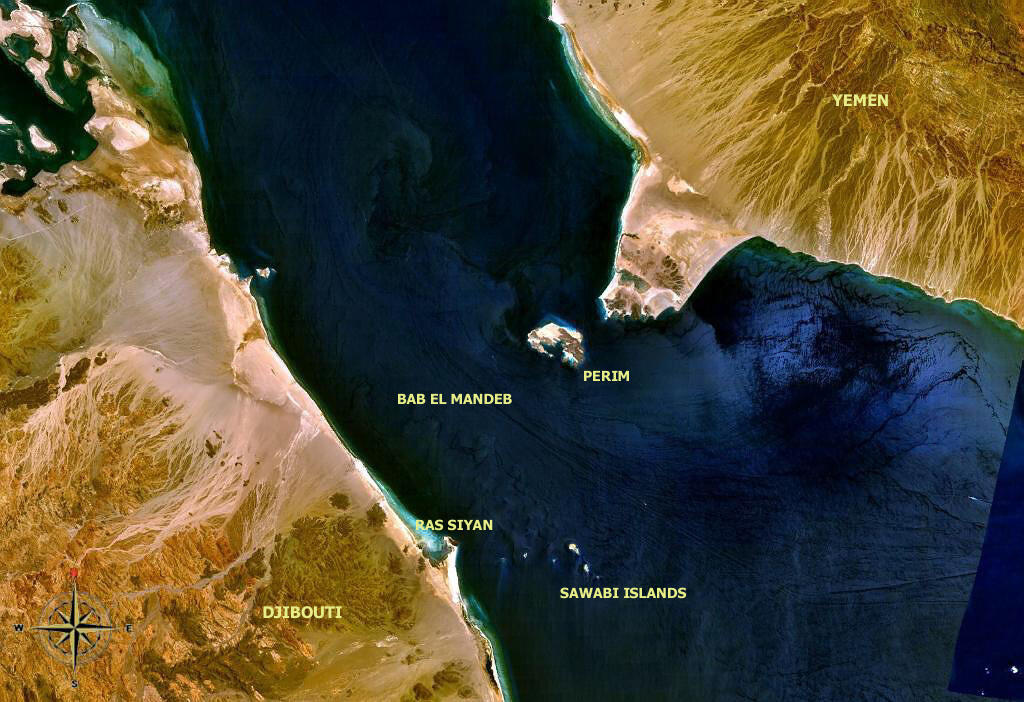
(Photo: NASA WorldWind/Wikipedia)
Analysts warn that increased Houthi attacks on commercial shipping could drive up oil prices and destabilize maritime security beyond the energy sector. “The impact would not be limited to the energy market,” said Ahmed Nagi of the International Crisis Group.
The Bab el-Mandeb, at the southern tip of the Arabian Peninsula, is a crucial route for vessels heading to the Suez Canal through the Red Sea. Saudi Arabia has been sending millions of barrels of crude oil daily through it as the Strait of Hormuz remains effectively closed.
Houthi forces attacked more than 100 merchant vessels with missiles and drones between November 2023 and January 2025, sinking two ships and forcing major shipping companies to reroute traffic. The group said those attacks were carried out in solidarity with Palestinians during the Gaza war.
Their renewed involvement could also complicate military deployments in the region. Sending U.S. naval assets to the Red Sea could expose them to similar attacks seen in recent years.
The Houthis have controlled Yemen’s capital, Sanaa, since 2014. Saudi Arabia launched a war against them in 2015 on behalf of Yemen’s exiled government, and the sides now maintain an uneasy ceasefire.