

Hamas said Tuesday it would postpone the transfer of an Israeli hostage's body, shortly after Israeli forces struck terrorist targets in the southern Gaza city of Rafah in response to a rocket-propelled grenade and sniper fire at an IDF vehicle.
The terrorist group accused Israel of "violations by the occupation" and claimed the remains had been located during tunnel searches in Khan Younis. The delay marks another escalation in the breakdown of the ceasefire agreement and adds to mounting Israeli frustration over what officials see as deliberate stalling tactics by Hamas.
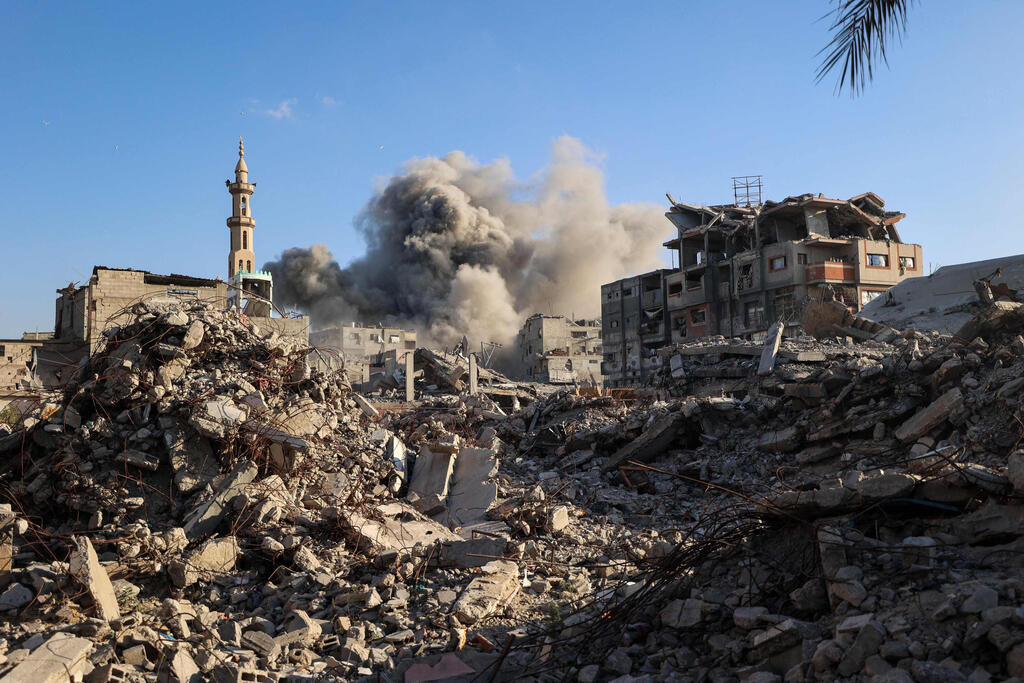
IDF airstrikes in Gaza
(Photo: Eyad BABA / AFP)
The incident comes just over a week after two Israeli soldiers were killed in a similar anti-tank missile attack in Rafah. Prime Minister Benjamin Netanyahu held two high-level security meetings Tuesday, one prior to the latest attack, where he discussed ceasefire violations by Hamas, including delays in returning the bodies of Israeli hostages.
In a statement following the incident, Netanyahu said he had instructed the military "to carry out immediate and powerful strikes" in the Gaza Strip. Palestinian reports later confirmed airstrikes in Rafah by Israeli fighter jets.
The renewed violence follows public outrage in Israel over footage released by the military showing Hamas operatives staging a body handover to the Red Cross. The remains, said to be those of Ofir Tzarfati—already buried in Israel after being recovered in a prior military operation—were reburied by Hamas for dramatic effect and then “rediscovered” in front of international observers.
The video, released Tuesday, shows Hamas fighters digging a pit, placing a body bag inside and then summoning Red Cross staff to the scene in what Israel condemned as a "manipulative and degrading display."
Hamas later claimed it would return another hostage's body Tuesday evening, reportedly recovered from a tunnel near Khan Younis. Footage from international media agencies showed masked Hamas operatives, some carrying oxygen tanks, digging at the site and pulling out what they said was a body bag.
Under the terms of the ceasefire agreement, Hamas was required to return all hostages, dead and alive, within 72 hours. While 20 living hostages were released, only 15 of the 28 deceased hostages held in Gaza have been returned. Israel accuses Hamas of deliberately delaying the returns and lying about its inability to locate the remaining bodies, of which 13 are still believed to be in Gaza.
The U.S. has so far urged restraint, with President Donald Trump—who helped broker the deal—reportedly sending senior officials to Israel to prevent the collapse of the ceasefire. On Friday, Trump issued a 48-hour deadline to Hamas to comply. Monday’s announcement of a body return—later revealed to be additional remains of Tzarfati—was made just before the deadline expired.
Israel had already been weighing its response to repeated ceasefire violations by Hamas, including three options under discussion: cutting humanitarian aid to Gaza, expanding Israeli military control in parts of the enclave or resuming full military operations. Sources say the last option is most politically sensitive, as it risks upending the entire agreement.
Hamas, in a statement Tuesday evening, accused Israel of obstructing recovery efforts by blocking the entry of heavy equipment into Gaza and of using “false accusations” to justify a new round of aggression. The group called on regional mediators to pressure Israel into upholding its commitments.
The IDF, however, rejected Hamas’ claims. “Contrary to Hamas' allegations of difficulty locating the bodies, yesterday its operatives were recorded removing pre-prepared remains from a building and burying them in the ground, only to dig them up shortly afterward and present them as newly found,” said the military spokesperson. “This staged effort was designed to mislead international observers and the Israeli public alike.”
First published: 18:35, 10.28.25