

U.S. President Donald Trump said Wednesday that he expects the war with Iran to end “immediately after the election,” arguing that Tehran is trying to hold out until the November 3 midterms in hopes that Democrats will regain control of Congress.
Trump made the remarks while speaking to reporters before departing for a Republican conference in Dallas, as crude oil prices climbed above $100 a barrel amid renewed escalation with Iran. “I think the war is going to end immediately after the election,” he said. Asked why, Trump replied: “Because they can't hold out any longer. They're desperate to try and affect the election so that we can get a nice weak group of people in there and leave them alone and let them have their nuclear weapon. All they want is a nuclear weapon. And if they had a nuclear weapon, the whole world is in deep trouble.”
Trump says Iran war will end ‘immediately’ after US midterms
(Video: Reuters)


Trump also took responsibility for recent U.S. attacks on Iranian vessels and suggested more strikes were coming. “Well, the attacks are made by us. We've knocked out nine of their ships,” he said. “And you're going to see a lot more.” At the same time, he signaled that Washington’s objectives go beyond another nuclear agreement, saying the U.S. was “not looking for a deal” and was seeking “much more than a nuclear deal,” while adding that negotiations could still take place.
The president also said he would speak with Israel about sanctions imposed on Israeli settlements in the West Bank. Britain announced new economic measures this week targeting companies and individuals involved in settlement activity, while Canada and France have also moved against settlement goods as part of coordinated pressure on Israel. The British move has sparked a diplomatic row with Jerusalem and criticism from leading Jewish communal figures in the UK.
Trump’s remarks came as Tehran faced a separate escalation on the diplomatic front. For the first time in 20 years, the International Atomic Energy Agency’s Board of Governors voted Wednesday to refer Iran to the UN Security Council after determining that Tehran had violated its obligations under the Nuclear Non-Proliferation Treaty. The resolution was backed by 23 of the board’s 35 member states, with Russia, China and Niger voting against, eight abstaining and one not participating.
The referral is not expected to produce immediate sanctions because Russia and China, both Iranian allies and permanent members of the Security Council, could block such measures. Still, sending the issue to the UN’s most powerful body marks a significant diplomatic escalation and follows an IAEA resolution adopted on June 12, 2025, one day before Israel launched its war against Iran, which found Tehran in violation of its nonproliferation commitments.
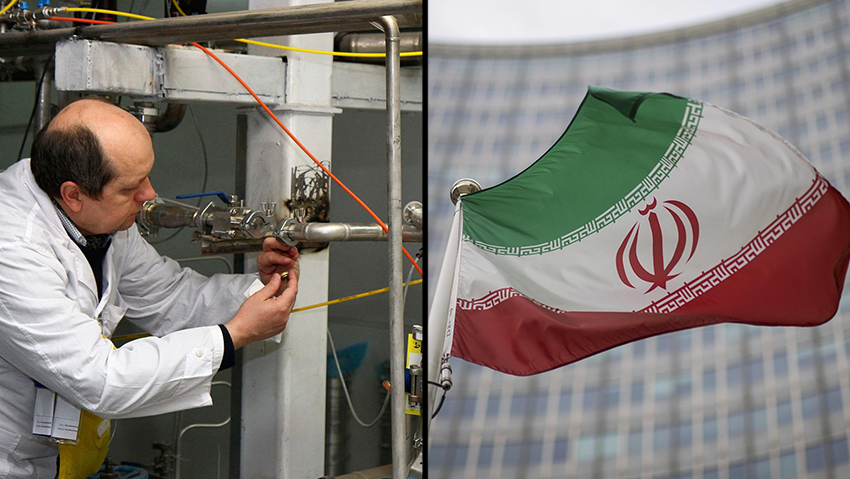
Iranian flag outside the IAEA headquarters in Vienna and an agency inspector
(Photo: AP)
The dispute centers in part on long-running IAEA investigations into uranium traces found at undeclared Iranian sites and Tehran’s refusal to allow inspectors full access to facilities damaged in the war. Iran has consistently denied pursuing nuclear weapons, but since its nuclear sites were bombed in June 2025 it has sharply restricted cooperation with the agency.
A central unresolved question is the fate of Iran’s stockpile of uranium enriched to 60%, close to the 90% level associated with weapons-grade material. Before the 2025 war, Iran possessed 440.9 kilograms of uranium enriched to 60%, an amount estimated to be sufficient for at least 10 nuclear weapons if enriched further. Much of the material was reportedly buried underground near the damaged Isfahan facility, while Iran has denied inspectors access to Isfahan, Natanz and Fordow.
The survival of that stockpile remains a major concern in Israel, where officials fear Tehran could eventually move the material to a secret facility and enrich it rapidly to weapons grade. One site that has drawn particular attention is a deeply buried complex known in Israel as “Pickaxe Mountain,” which Israeli officials fear could be difficult to destroy even with bunker-busting bombs.
Iran had threatened to respond if the IAEA referred the issue to the Security Council, though no concrete retaliatory step had been announced by Wednesday evening. Iranian Deputy Foreign Minister Kazem Gharibabadi accused Western countries of exploiting conditions created by attacks on Iran’s nuclear facilities, while Iran’s mission to the IAEA denounced the decision as political and blamed the United States and Israel for the current crisis.