

The United States is rapidly expanding its military presence across the Middle East as its campaign against Iran intensifies, deploying aircraft carriers, fighter squadrons, bombers, surveillance aircraft, special operations forces and additional medical personnel while warning that the cost to Tehran will continue to rise every night.
U.S. Secretary of State Marco Rubio said Thursday that Iran’s leadership was not serious about reaching an agreement and had repeatedly broken or attempted to revise previous commitments. “These people make deals and then they break them almost immediately, or they decide, ‘Oh, let’s change the deal,’” Rubio told reporters on the sidelines of a Southeast Asian summit in Manila. “That’s not how deals work.”
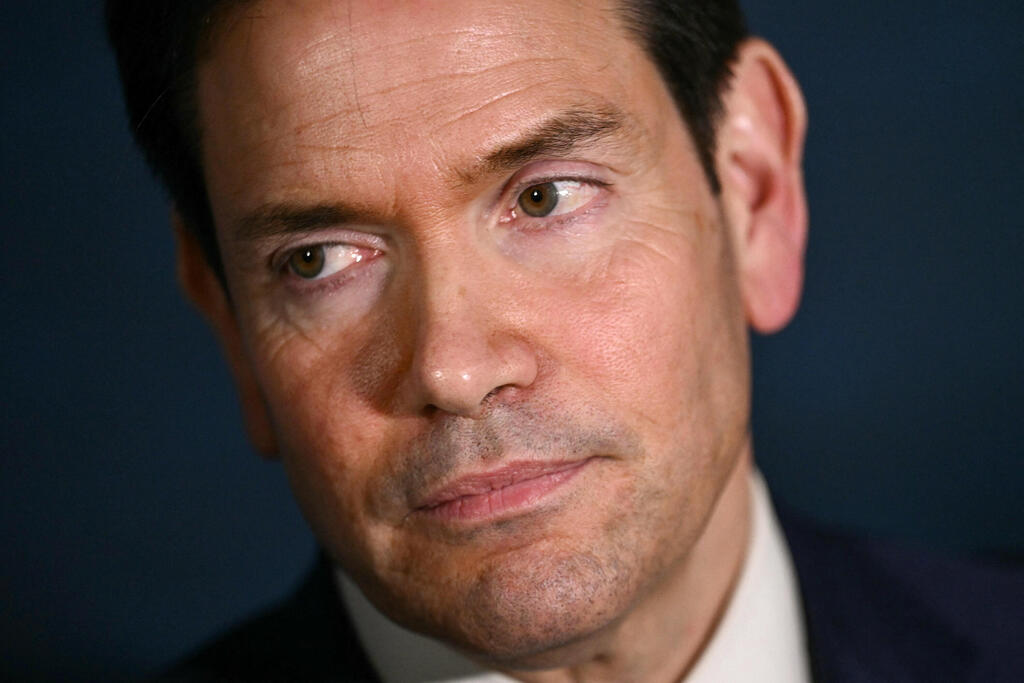
“So now they’re paying the price for it,” he said. “And maybe they’ll change their mind here over the next few days as they continue to suffer great losses.” Rubio said Iran would continue to “pay a very heavy price,” claiming that its defense industrial base had been devastated and that it was losing radar systems and missile launchers in the nightly American attacks. “They are suffering tremendously, and they are going to suffer even more,” he said.
His comments came as U.S. Central Command carried out a 12th consecutive night of strikes against Iranian military infrastructure and as Washington moved additional forces into the region, giving President Donald Trump a wider range of options if he decides to expand the campaign.
Two aircraft carriers and an expanding air armada
The United States now has two nuclear-powered aircraft carriers in the region, the USS Abraham Lincoln and USS George H.W. Bush, each operating with an air wing that includes F/A-18 Super Hornets and F-35C stealth fighters. The carrier groups are supported by more than 25 additional vessels, including guided-missile destroyers and amphibious warships. Two large amphibious assault ships, the USS Tripoli and USS Boxer, have also been operating in or near the U.S. Central Command area.
The United States has reinforced the region with fighter squadrons equipped with F-35A stealth aircraft, F-15E Strike Eagles and F-16s. The F-16 units can carry out suppression of enemy air defenses missions, targeting radar systems and surface-to-air missile batteries to open routes for further strikes.
Additional aircraft deployed or operating in support of the campaign include EA-37B electronic warfare planes, E-11A aircraft that serve as airborne communications relays, E-3G Airborne Warning and Control System aircraft and P-8A Poseidon maritime patrol planes. A growing fleet of aerial refueling aircraft is sustaining the operation, with public reports indicating that the United States has also expanded tanker activity connected to Israel.
The buildup now includes B-1B Lancer bombers, which have begun striking Iran after launching from a base in Britain. The long-range bombers can carry large numbers of precision-guided weapons and cruise missiles, allowing the United States to hit targets without relying exclusively on bases close to Iran.
The Wall Street Journal reported that special operations units had been sent to the region and that more than 150 additional medical personnel had arrived at Landstuhl Regional Medical Center in Germany, the principal hospital treating U.S. troops wounded in Middle East combat. The medical deployment, together with the movement of fighters, bombers and special forces, suggests that Washington is preparing not only to sustain the current campaign but also for the possibility of broader operations and additional casualties.
Rubio: Iran sought protection behind missiles and drones
Rubio said the current confrontation could not be understood solely as a dispute over Iran’s nuclear program. “For nearly 20 years, Iran has not only funded terrorism, but also built long-range rockets, short-range missiles and drones,” he said, adding that Tehran intended to manufacture far more of them.
According to Rubio, Iran planned to double that arsenal and use it as protection while moving closer to a nuclear weapon. His argument was that Tehran hoped to create such a dense missile and drone threat that its adversaries would fear striking its nuclear infrastructure, knowing Iran could overwhelm regional air-defense systems in response.
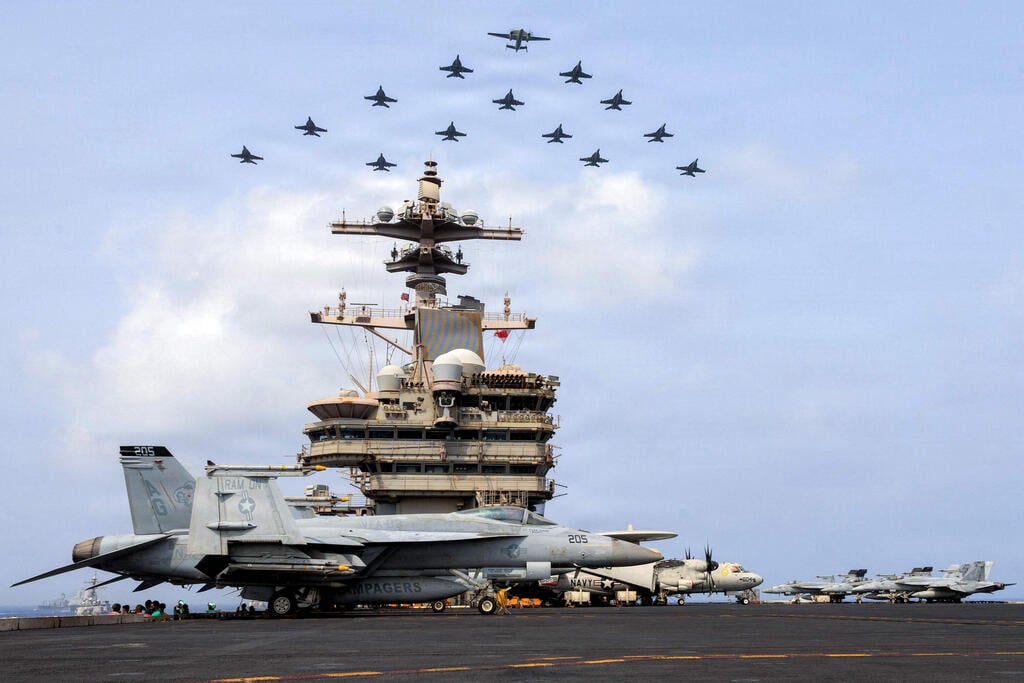
(Photo: AFP PHOTO / US NAVY / NAVCENT PUBLIC AFFAIRS)
The United States says its campaign is intended to degrade the military infrastructure that supports that strategy, including launchers, radar systems, drone facilities, air defenses and elements of Iran’s defense industry. Iran, however, has continued launching missiles and drones at American partners and military facilities across the region.
Jordan’s armed forces said its air defenses dealt with four Iranian missiles and six drones targeting the kingdom over the previous 24 hours. Three missiles were intercepted Thursday morning, while the fourth fell in a remote, uninhabited area. Six drones were intercepted the previous evening, with no casualties or property damage reported.
The continued Iranian attacks have forced U.S. partners including Jordan, Kuwait and Bahrain to maintain heightened air-defense readiness, further broadening the conflict beyond Iran itself.
Houthis drawn into the confrontation
Rubio also addressed the renewed involvement of Yemen’s Iran-backed Houthi rebels, who announced attacks on Saudi vessels in the Red Sea after largely remaining outside the latest phase of the conflict.
“The Houthis largely were smart and stayed out of all this throughout the conflict, but they now apparently have gotten themselves suckered into this, going after Saudi Arabia and their ships,” Rubio said. “I hope they will de-escalate, because I think the Houthis, frankly, got snookered into this thing by the Iranians.”
The Houthi attacks have added a second threat to regional shipping while tanker traffic through the Strait of Hormuz remains severely disrupted. Fears over the security of both the Hormuz and Red Sea routes pushed Brent crude above $95 a barrel before it settled slightly lower, raising concerns about energy prices and global inflation.
Trump threatens Iran’s infrastructure
Trump escalated his threats against Iran on Wednesday, warning that the United States would destroy an Iranian bridge or power plant in response to every attack on a vessel in the Strait of Hormuz.
“From this point forward, every time the Islamic Republic of Iran fires upon a ship in the Strait of Hormuz, whether by missile, rocket, drone or any other device or weapon, the United States will bomb and destroy one bridge or one power plant,” Trump wrote on Truth Social. He said the targets could include infrastructure located near or inside Tehran.
Trump threatens Iran’s infrastructure
(Video: White House)


Iran responded with a warning of its own. A military source quoted by the Tasnim news agency, which is affiliated with Iran’s Revolutionary Guard Corps, said that if Washington attacked Iranian bridges or power stations, Tehran would strike infrastructure and bridges elsewhere in the region, including energy facilities in which the United States has an interest.
The source said Iran possessed an “iron will” to continue asserting control over the Strait of Hormuz and would not allow the waterway to become a threat against it again. The exchange reinforced concerns that the campaign could expand from attacks on military targets to the systematic destruction of civilian and economic infrastructure.
Eighteen US service members killed
At least 18 U.S. service members have been killed since the war began, including troops killed in Iranian missile and drone attacks on bases in Jordan, Saudi Arabia and Kuwait, as well as personnel lost in operational incidents. Three service members were killed following an Iranian attack on a base in Jordan, while another died during the handling of unexploded ordnance from a downed Iranian drone in northern Iraq.
Before departing for a ceremony honoring fallen troops, Trump said Iran would “pay a very heavy price” for its latest deadly attacks. Asked about polling showing that many Americans believe the war was a mistake, Trump rejected the suggestion that the public opposed the campaign.
“The American people are not against the war,” he said. “The American people don’t want high gasoline prices, but they’re not against the war.”
The administration is now attempting to balance those domestic concerns with the military objective of forcing Iran back to negotiations. Rubio maintained that diplomacy remained possible, but only after Tehran understood that the current path would not produce victory.
The expanding American deployment is intended to make that message unmistakable: Washington is preparing to sustain and potentially widen the campaign, while ensuring that the military, economic and strategic price Iran pays increases with every night that passes.