


Iranian school textbooks introduced after last year’s 12-day war with Israel promote hostility toward the United States and Israel, glorify violence and embed military ideology across the education system, according to a new report by research group IMPACT-se.
The London-based institute, which has analyzed curricula for more than 25 years, examined new materials distributed nationwide following the June 2025 war. The program, titled “We Defend Our Iran,” was rolled out across all grade levels, with more than 12 million copies distributed to schools.
Missile launch calculations and blood-stained maps: inside Iran’s school textbooks


The report found that anti-Western ideology — particularly toward the United States — is deeply embedded in Iran’s curriculum, with the U.S. consistently portrayed as a central adversary and frequently labeled the “Great Satan.”
Students are exposed to slogans such as “Death to America,” presented as opposition to what textbooks describe as American aggression and policies, reinforcing a worldview in which confrontation with the United States is depicted as justified and necessary.
Educational materials also depict American forces in degrading ways. One lesson includes images from a 2016 naval incident showing detained U.S. sailors kneeling, presented as evidence of Iranian strength and American submission.
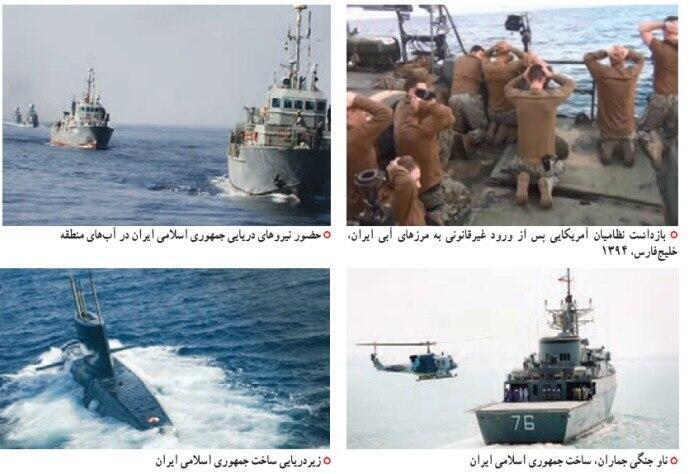
Additional classroom content highlighted by the report includes visual and creative assignments that mock American leadership and promote anti-U.S. sentiment, alongside repeated accusations that the United States seeks to weaken and divide the Islamic world.
The curriculum places strong emphasis on glorifying figures tied to Iran’s military and ideological doctrine, particularly Qasem Soleimani, portraying him as a central figure in a regional “resistance” network spanning Lebanon, Syria, Iraq and Yemen.
Beyond political messaging, the report highlights a broader militarization of education. Defense-related textbooks introduce students to military concepts, including weapon handling, survival skills and wartime preparedness beginning in middle school.
Visual materials reinforce this connection between education and combat. Illustrations show weapons training, while other content links everyday school items with warfare, reflecting an effort to normalize military readiness from a young age.
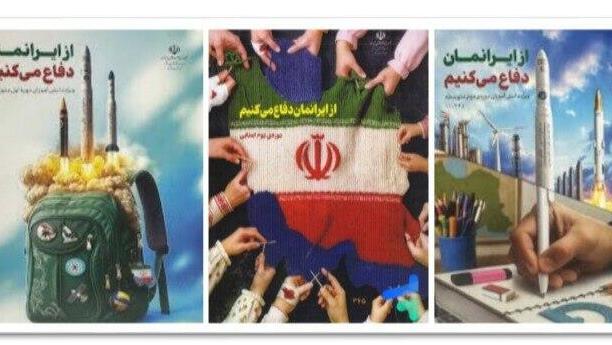
(Photo: IMPACT-se)
Students are also exposed to themes of martyrdom, with textbooks portraying those killed in conflicts as role models and, in some cases, presenting “martyrdom seeking” as a noble act above other forms of sacrifice.
The materials frame Iran as engaged in an ongoing ideological struggle and present regional conflicts as inherently violent and rooted in religious duty, rejecting the possibility of peaceful resolution.
Israel is consistently depicted as a central adversary. According to the report and accompanying materials, textbooks describe Israel in delegitimizing terms and present its destruction as part of the broader ideological struggle. Visual content includes depictions of missile strikes on Israeli cities and imagery of widespread destruction following hypothetical attacks.
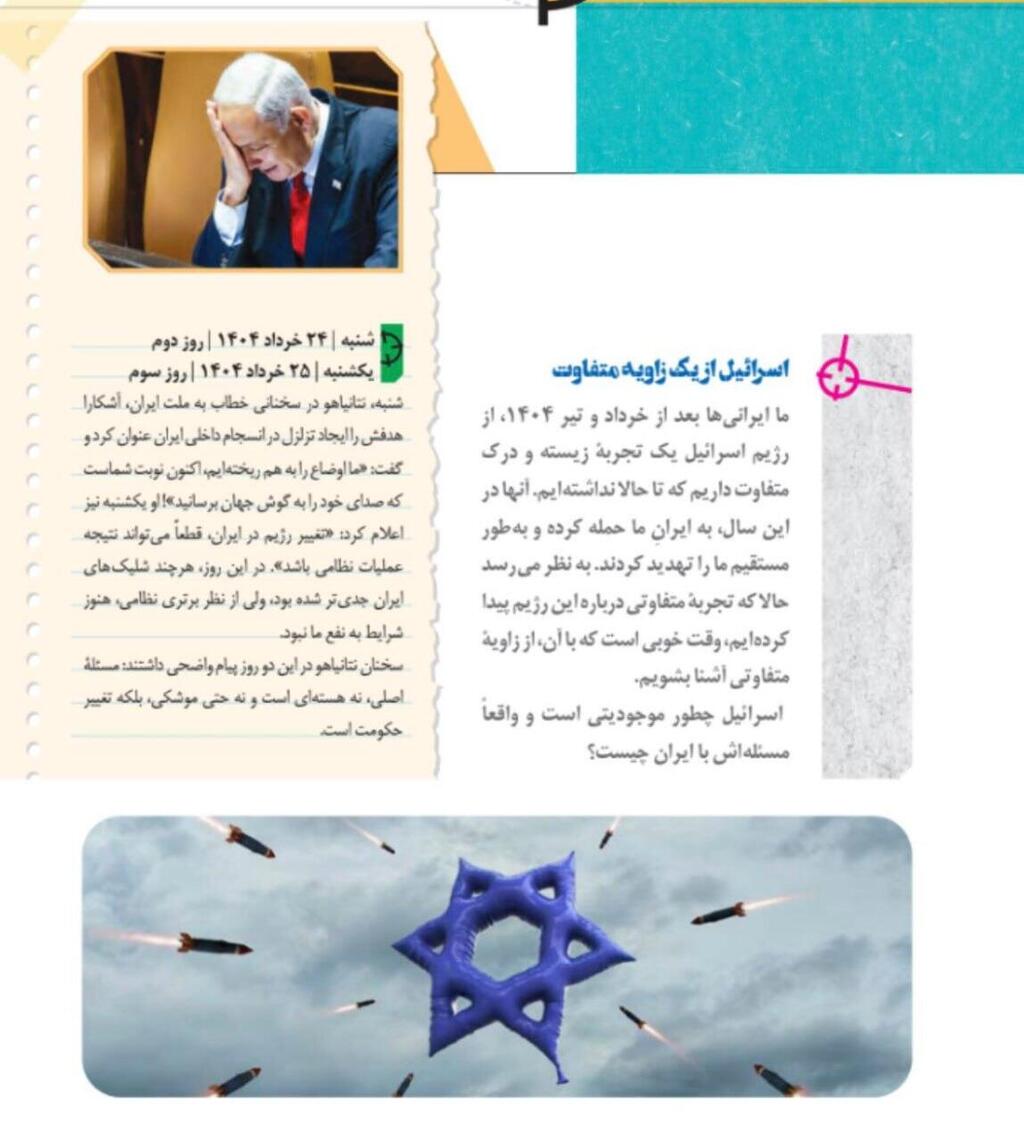
(Photo: IMPACT-se)
In some exercises, students are asked to engage with military scenarios, including calculations related to missile capabilities, further embedding conflict-related thinking into classroom learning.
The report also notes that neighboring countries aligned with the United States or maintaining ties with Israel are portrayed as collaborators or illegitimate actors, reinforcing a broader regional narrative of confrontation.
IMPACT-se said the curriculum promotes a “siege mentality,” portraying Iran as under constant threat and reinforcing a polarized “us versus them” worldview that may make compromise and diplomacy more difficult.
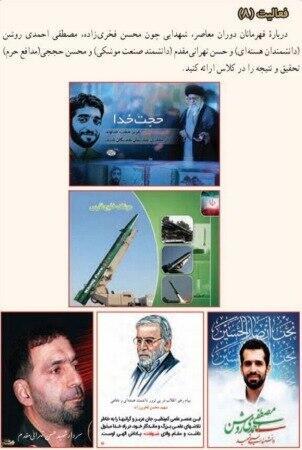
(Photo: IMPACT-se)
IMPACT-se officials said the findings reflect a broader, long-term strategy embedded in the education system.
“As an international research and policy institute that has analyzed curricula for more than 25 years, we have rarely seen this level of violence and incitement in a state education system,” said Arik Agassi, the group’s deputy CEO. “Missiles show what Iran can do — textbooks show what it intends to do. When this is taught systematically to children, it is no longer rhetoric, it is a long-term plan.”
Marcus Sheff, the institute’s CEO, said the materials point to a deliberate and consistent approach.
“These textbooks indicate a systematic effort to promote violence, antisemitism and hostility toward the United States,” he said. “This is not abstract — it is structured. The threat is real, and the evidence is in the classroom.”
“What we are seeing is not incidental content, but a coherent worldview,” he added. “Education is not only about imparting knowledge, it shapes behavior. In this case, it is shaping a generation that sees conflict as inevitable and justified.”