

Prime Minister Benjamin Netanyahu said Thursday evening that Iran is again attempting to rebuild its nuclear capabilities, vowing that Tehran would not obtain a nuclear weapon as long as he remains in office.
“President Trump announced this evening that Iran is trying to arm itself again with nuclear weapons. That is true,” Netanyahu said during remarks at the Western Wall ahead of Rosh Hashanah. “After we destroyed its immediate ability to produce nuclear bombs, both in Operation Rising Lion and Operation Roaring Lion, they are trying again.”

“I promise you here, at the Western Wall, ahead of Rosh Hashanah: As long as I am prime minister, Iran will not have nuclear weapons,” he said.
Netanyahu added that Israel was continuing to strike what he described as the Iranian axis. “At the same time, we are striking the Iranian axis, not only very hard in the Gaza Strip, but also in Lebanon. We destroyed the Beaufort Ridge and are now dealing with the Ali Taher Ridge. More will follow.”
His comments came as The Wall Street Journal reported that Iran has resumed producing ballistic missiles at underground facilities, assembling new weapons from components stockpiled before the war despite extensive damage inflicted by U.S. and Israeli strikes.
According to the report, Tehran is assembling both liquid-propellant missiles, which must be fueled shortly before launch, and solid-propellant missiles that can be stored ready to fire. Intelligence has detected activity at several underground facilities, including the Khojir military complex in southeastern Iran, while Iran is also trying to establish new underground assembly sites to make future production harder to target.
Production is still believed to be considerably lower than before the war. U.S. and Israeli strikes damaged factories and other industrial facilities required to manufacture missiles and their components, while the U.S. naval blockade has complicated Iran’s ability to import parts and materials used to produce solid rocket fuel.
Still, the renewed activity illustrates the difficulty of permanently dismantling Tehran’s missile program and chips away at what Washington and Jerusalem had presented as one of the war’s major military achievements. Defense Secretary Pete Hegseth said in April that Iran’s missile program had been “functionally destroyed” and that Tehran had “no ability to replenish” the weapons it was firing.
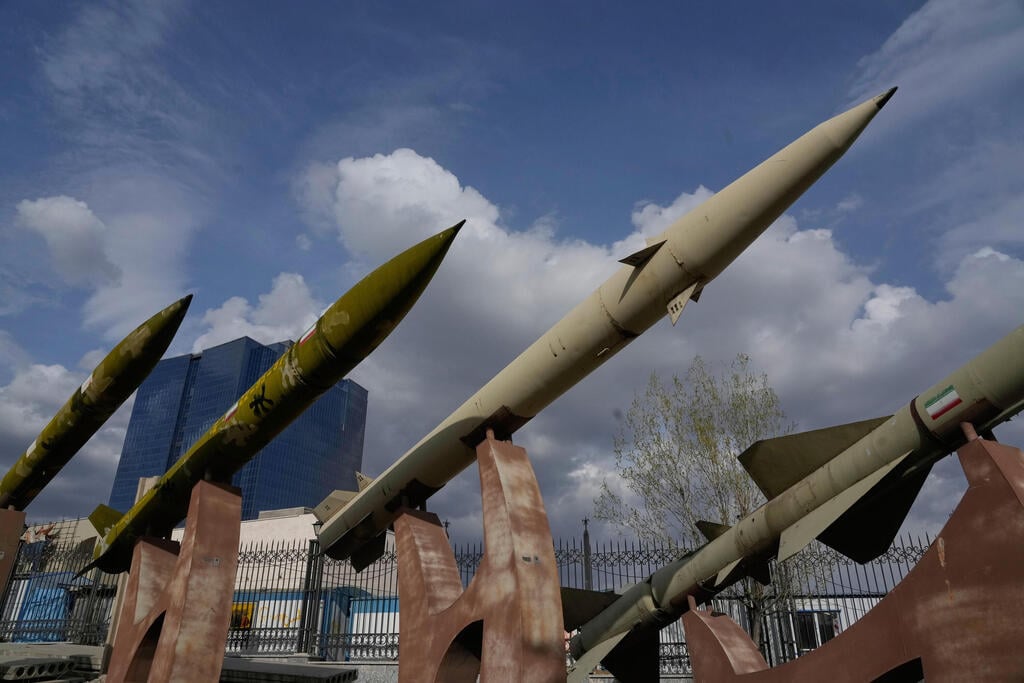
Missile display in Tehran
(Photo: AP Photo/Vahid Salemi)
The Pentagon told the Journal that U.S. forces had destroyed as much as 90% of Iran’s drone, ballistic missile and naval industrial base and had significantly degraded its ability to launch missiles and drones. A White House official did not directly address whether missile production had restarted, but said Iran’s military had been severely weakened.
A U.S. official said Iran likely resumed low-rate production after reaching a preliminary agreement with Trump in mid-June to reopen the Strait of Hormuz and begin negotiations aimed at winding down the war.
Before the fighting, Iran had accumulated stocks of finished warheads, airframes, guidance systems and other components, allowing it to assemble missiles without immediately restoring its entire manufacturing network.
Jim Lamson, a former CIA analyst specializing in Iran’s military, told the Journal that the number of missiles Tehran could assemble depends on the size of those stockpiles and how many underground facilities remain operational.
“We could be talking about hundreds of missiles or possibly thousands of missiles,” he said.
Iran depleted much of its stockpile of completed missiles during the war, forcing it to reduce the size of its barrages, but analysts believe it still possesses thousands of ballistic missiles. Tehran has continued firing missiles at U.S. military positions across the Middle East and has also launched several attacks on U.S. warships in recent days, though none was hit.
Satellite imagery reviewed by the Journal indicates Iran has been rapidly repairing military infrastructure, including roads, production sites and entrances to underground missile bases damaged in earlier strikes. Israeli military assessments cited in the report suggest weapons stored deep inside the tunnels may have survived largely intact.
Iran nevertheless faces substantial obstacles to restoring production to prewar levels, including damage to chemical facilities used to make liquid propellants and industrial mixers needed to manufacture solid fuel.
Experts said Iran deliberately dispersed and buried much of its missile infrastructure because it expected the program to face repeated attacks. The renewed production could help Tehran sustain a prolonged war of attrition, particularly as Iran’s missile stocks are pitted against increasingly strained U.S. and Gulf inventories of air-defense interceptors.
First published: 19:54, 09.10.26