

Iran launched a new round of missile and drone attacks against bases used by U.S. forces in Kuwait and the United Arab Emirates on Thursday, testing President Donald Trump’s threat of retaliation even as Washington touted a sharp rise in oil traffic through the Strait of Hormuz and fresh images highlighted the strain on its naval forces.
Sirens sounded in Kuwait early Thursday, and several hours later the Iranian military said it had targeted Ahmad al-Jaber Air Base, which is used by U.S. forces. Tehran said another attack struck concentrations of American troops and radar systems at Al Minhad Air Base in the UAE. The United States did not announce fresh strikes on Iran overnight, despite Trump warning earlier this week that Washington would respond forcefully to further attacks.
Trump called Wednesday night for renewed protests in Iran
(Video: Reuters)


The current escalation began Sunday when the United States struck launchers on Iran’s Larak Island in the Strait of Hormuz, saying they were preparing to deploy naval mines against passing vessels. Iran responded with missile and drone attacks on Gulf states, prompting a broader U.S. strike Tuesday against around 60 targets in southern Iran and the Hormuz area. Asked Wednesday about another response, Trump said he was “ready,” but added that the confrontation “will not last long.”
A U.S. official told CNN on Thursday that American forces expect operations around Hormuz to continue because Iran still retains the ability to threaten shipping. The official described the expected strikes as “mowing the grass,” aimed at steadily degrading Iranian capabilities. Recent U.S. attacks have targeted radar systems used to track ships, mine-laying capabilities and communications infrastructure.
US touts oil surge through Hormuz
At the same time, the Trump administration is portraying its naval operation in the strait as an increasingly successful effort to restore the flow of oil from the Persian Gulf. Two U.S. officials told CNN that American warships escorted 40 commercial vessels through Hormuz on Tuesday carrying a combined 18 million barrels of oil.
If accurate, that would be close to the roughly 20 million barrels that passed through the strait on an average day before the war. U.S. warships also shot down Iranian drones and intercepted anti-ship cruise missiles during the operation, according to the officials.
Iranian missile launches toward Jordan
Washington says the figures show that Iran is losing leverage over one of the world’s most important energy routes. But maritime experts and industry figures remain skeptical. Shipping trackers still show relatively low traffic, while U.S. officials argue that many vessels are switching off their transponders to make them harder for Iranian forces to target.
A source connected to the maritime industry told CNN that he knew of no one who believed daily traffic had genuinely returned to the levels claimed by Washington.
Trump has meanwhile emphasized economic pressure as his preferred tool against Tehran. The United States continues to restrict Iranian oil exports and has threatened sanctions against countries that maintain economic ties with the regime.
Battered carrier shows toll of deployment
The campaign is also putting pressure on U.S. military resources. The USS Abraham Lincoln arrived this week at Laem Chabang in Thailand after completing 268 days at sea during its Middle East deployment, where it supported operations against Iran before being replaced by the USS George Washington.
Its roughly 5,000 crew members are now receiving a week of rest, but photographs taken after the carrier arrived showed extensive rust across large sections of its exterior.
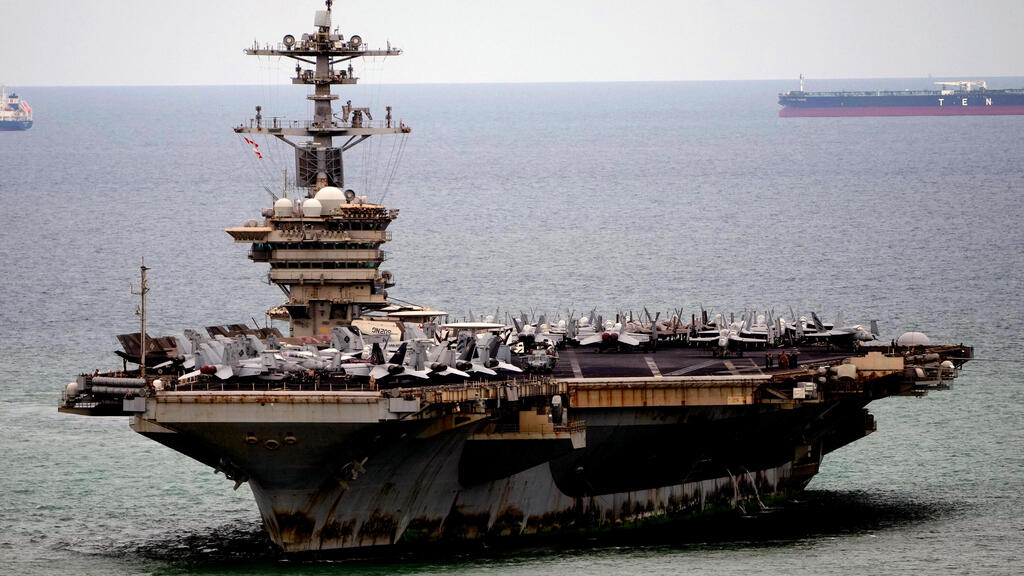
USS Abraham Lincoln arrives at Laem Chabang port in Thailand on September 2 after 268 days at sea as part of the war with Iran
(Photo: AP Photo/Sakchai Lalit)
Former U.S. Navy Capt. Carl Schuster told CNN that rust itself is common on warships, but said the unusually long deployment made regular maintenance difficult and allowed corrosion to spread. Based on the images, he estimated that removing it could require about 30 days of preservation work.
“Rust is like a contagious disease. It spreads,” Schuster said, warning that untreated corrosion can eventually weaken steel structures such as decks, passageways and railings.
The Lincoln’s condition adds to broader concerns over prolonged deployments, ammunition stocks and the strain on U.S. forces as Washington tries to keep shipping moving through Hormuz while maintaining pressure on Iran.
For Trump, the latest Iranian attacks sharpen that tension: Tehran is still testing Washington militarily even as the administration argues that its economic and naval strategy is beginning to work.