


U.S. President Donald Trump again said overnight Wednesday that Iran “wants to make a deal” to end the war, which has lasted more than six months. At the same time, Axios reported that Trump plans to meet next week with leaders from Gulf states on the sidelines of the United Nations General Assembly to discuss the war and plans for the day after it ends.
Trump attended a campaign event in North Carolina overnight ahead of the U.S. midterm elections in November. Asked by reporters about Iran, Trump said, “hopefully we are towards the end of the war.”
US President Trump on Iran: 'Hopefully we are towards the end of the war'
(Video: X)


“They want to make a deal. We'll see how that works out,” he said. Asked specifically whether he had heard from the Iranians recently and whether the communication had been “direct or through intermediaries,” Trump replied: “Yes, we’ve heard directly.”
Trump has repeatedly said recently that the war will end after the midterm elections or around that time.
According to Axios, citing three sources with direct knowledge of the matter, the planned meeting will focus on “postwar ideas” as Trump and his team prepare a plan for the day after the conflict. Trump is expected to meet with leaders or foreign ministers from Saudi Arabia, the United Arab Emirates, Qatar, Bahrain, Kuwait and Oman, the report said.
Axios also reported that the U.S. State Department has already sent invitations to those expected to attend. One source said the meeting could be expanded to include other Arab and Muslim leaders.
Meanwhile, the United States announced overnight that it would extend visa sanctions against senior Palestinian Authority officials and members of the Palestine Liberation Organization after the State Department determined that they continued to fall short of commitments made to Washington.
The announcement came as a visa request by Palestinian Authority President Mahmoud Abbas was denied, preventing him from traveling to New York to address the General Assembly in person.
It is the second consecutive year Abbas has been barred from attending the gathering. The United States also refused to grant him a visa in 2025, forcing him to address the General Assembly by video.
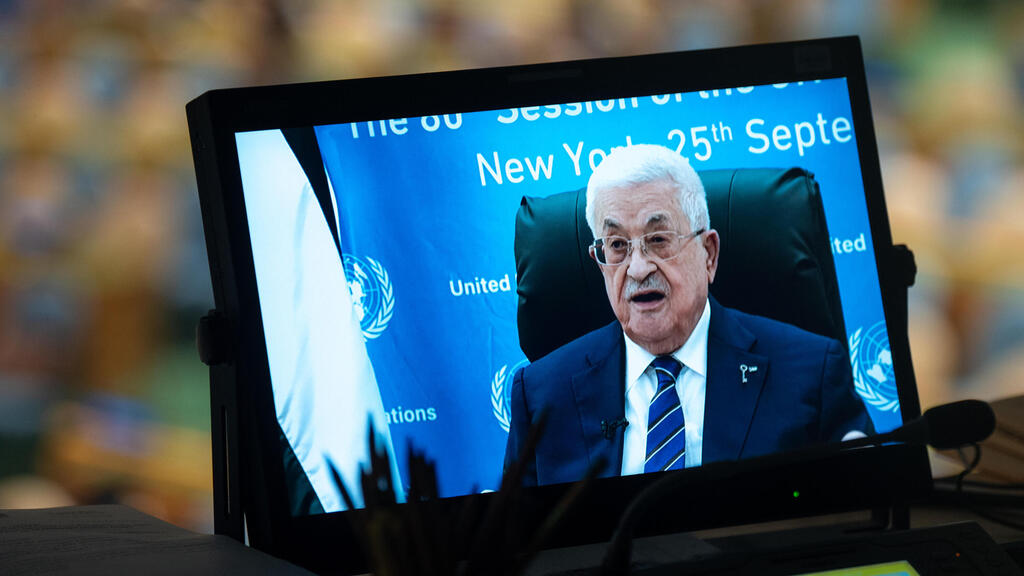
Abbas to address the UN by video again; Mahmoud Abbas speaks at last year’s session
(Photo: Angelina Katsanis/AP)
The State Department statement did not explicitly name Abbas, but a U.S. source familiar with the matter confirmed to Agence France-Presse that the sanctions also apply to him.
Reuters, meanwhile, reported that the 193-member General Assembly was expected to vote during the day on whether to allow Abbas to submit a prerecorded statement, as it did last year.
In its official statement, the State Department accused the Palestinian Authority and the PLO of pursuing actions against Israel at the courts in The Hague — the International Criminal Court and the International Court of Justice — seeking unilateral recognition of a Palestinian state and continuing payments to terrorists while, in Washington’s view, promoting terrorism in official statements and school textbooks.
Washington also said the Palestinian Authority had failed to carry out reforms it had committed to undertake with the United States and continued taking steps that, according to the State Department, undermine prospects for peace.
At the same time, the State Department said an existing waiver for personnel assigned to the PLO Observer Mission to the United Nations would remain in effect.
Last month, amid reports that the decision was imminent, Abbas appealed to Turkish President Recep Tayyip Erdogan and asked him to intervene and persuade Trump to reverse it. Even then, however, U.S. officials indicated that the administration did not intend to change its position, despite Trump frequently describing Erdogan as a “good friend” whenever the Turkish leader’s name comes up.