

U.S. Treasury Secretary Scott Bessent announced new measures Monday evening aimed at further isolating Iran’s economy, in the hope that the sweeping pressure campaign he has described as the “largest economic offensive ever” will force the ayatollahs’ regime to yield and compromise in stalled talks on ending the war. At a special news conference, Bessent unveiled what he called “Operation Economic Outcast” and announced new sanctions intended to “tighten the noose” around Iran.
In practice, for now the move amounts primarily to a threat to countries around the world, demanding that they halt all business and commercial ties with Iran. Bessent said those that fail to do so could themselves face sanctions.
“The clock starts ticking,” he said, calling on world leaders to “make a decision” and choose between Iran and the United States. Bessent added that President Donald Trump is holding phone calls with leaders around the world and demanding that they sever trade ties with Iran, but when asked whether there was a deadline, he said only that U.S. patience “is not unlimited.”
Gallery
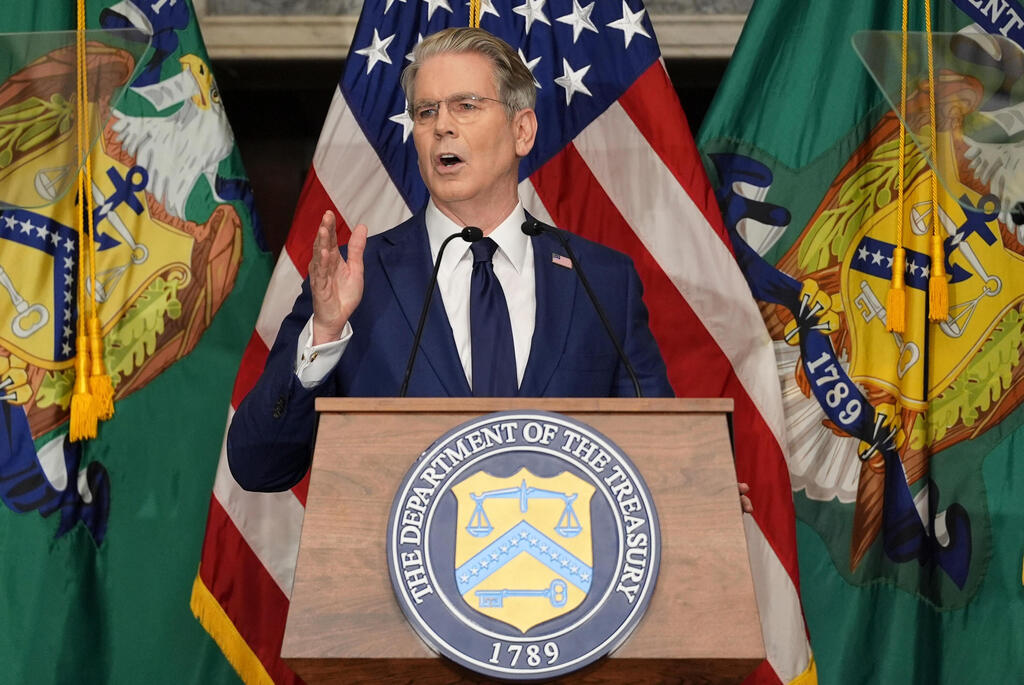
U.S. Treasury Secretary Scott Bessent announced new measures aimed at further isolating Iran’s economy
(צילום: AP Photo/Julia Demaree Nikhinson)
It remains unclear whether Trump actually intends to follow through on the threat against Iran’s closest allies, chief among them China, since imposing sanctions on Beijing could risk reigniting a trade war. Analysts believe he would currently prefer to avoid such a confrontation, especially ahead of Chinese President Xi Jinping’s planned visit to Washington in a month.
“Iran now faces a very clear choice, and there are only two paths open to it: total global isolation and a survival economy, or a return to normalcy with an opportunity to rejoin the global economy,” Bessent said.
“Today we are launching Operation Economic Outcast to block every other option available to the Iranian regime. The Treasury Department has mapped every node, every facilitator and every network Iran has used to smuggle oil and evade sanctions. Beginning today, actions by the Treasury Department and other agencies will tighten the noose and block every potential source of revenue that funds the Revolutionary Guards and the evil Iranian regime. We are enforcing a zero-leakage approach. There will not even be the slightest breathing room for the regime to rebuild its ability to carry out terrorism against America and the world.”
A source familiar with the details told Reuters earlier Monday evening that the measures include an expansion of secondary sanctions that the administration could impose on countries or other entities that violate restrictions on ties with Iran.
The source described the move as a “final warning” to countries to sever their ties with the Islamic Republic, saying that if they fail to do so, their companies or other affiliated entities could risk being cut off from the U.S. dollar-based financial system.
A senior administration official added that the Treasury Department had “mapped Iran’s oil smuggling and sanctions-evasion network,” and that the information would be presented to countries helping Iran circumvent sanctions as part of the warning issued to them.
A source familiar with the matter told Reuters that they will expand the use of secondary sanctions the administration can impose on countries or other entities that violate restrictions on ties with Iran. The source described the move as a “final warning” to countries to sever their ties with the Islamic Republic, adding that failure to do so could result in their companies or other affiliated entities being cut off from the U.S. dollar-based financial system.
The source did not specify which new activities or sectors of Iran’s economy could be targeted, but said that in some Iranian sectors any activity, even in a third country, could also be subject to secondary sanctions. A senior administration official added that the Treasury Department had “mapped Iran’s oil smuggling and sanctions-evasion network,” and that the information would be presented to countries helping Iran circumvent sanctions as part of the warning issued to them.
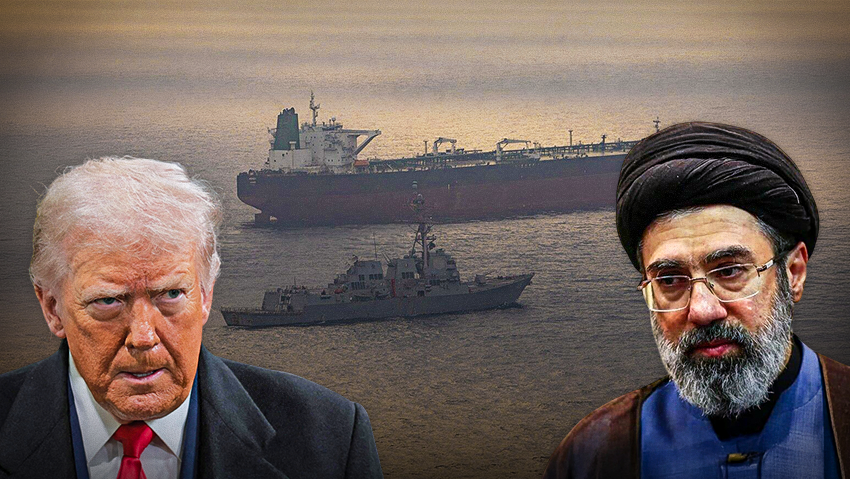
US President Donald Trump, Iranian Supreme Leader Mojtaba Khamenei
(Photos: Anna Moneymaker / AFP, CENTCOM, Vantor/Handout via Reuters)
Trump has shifted strategy in recent weeks following the deadlock in talks with Iran and Tehran’s refusal to allow the reopening of the Strait of Hormuz, the “oil artery” of the global economy, unless it receives U.S. recognition of its control over the strategic waterway. Rather than resume the war, Trump chose a policy of a suffocating economic blockade and last week promised to launch what he called an “economic D-Day,” invoking the Allied invasion of Normandy in World War II. He also threatened to punish countries that continue doing business with Iran.
So far, only the United Arab Emirates, which had been an important hub for Tehran’s efforts to evade sanctions, has formally announced that it is cutting all trade ties with Iran. But many analysts doubt whether economic pressure, even if additional countries join the effort, can force Iran into submission quickly.
Iran, which has already shifted to what has been described as a “survival economy” aimed at minimizing the effects of sanctions, has been dealing with them for decades. But its economic crisis has worsened significantly following the two most recent wars.
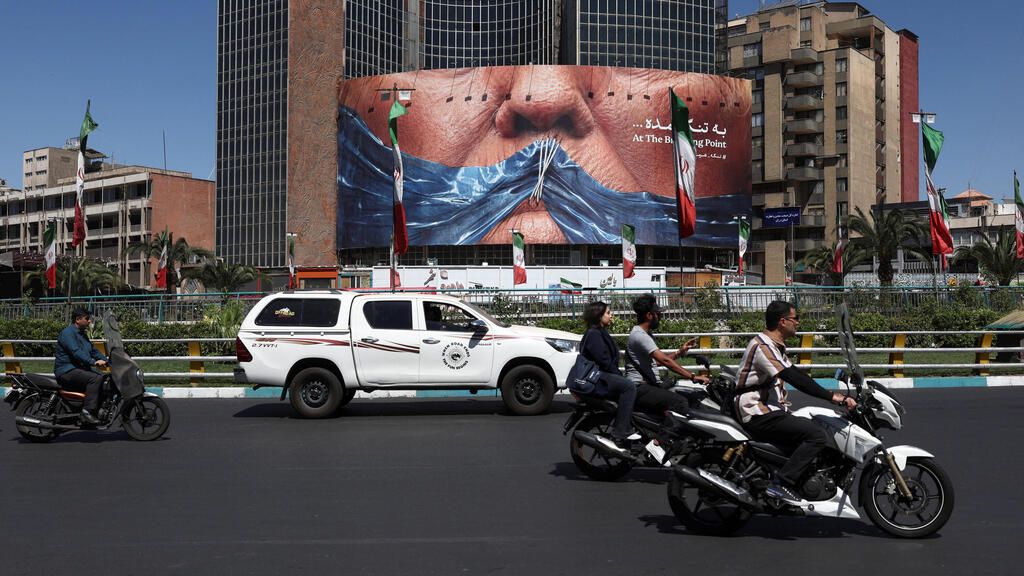
On a road in Tehran, in front of a giant billboard mocking Trump
(Photo: Majid Asgaripour/WANA (West Asia News Agency) via REUTERS)
According to the International Monetary Fund, inflation in Iran is expected to approach 70% this year. Since the latest war, prices of some food products, such as meat, have risen by far more, as much as 150%, while the economy as a whole is expected to contract by a steep 5.4%.
Unemployment has surged, with at least 1 million people losing their jobs since the war broke out in late February. The Iranian currency, the rial, fell to a new record low of 1.9 million to the dollar at the beginning of the month and continued to slide ahead of the expected announcement of the new measures. On Sunday, it crossed the threshold of 2 million to the dollar, and on Monday it fell further to 2.02 million.
Against that backdrop, and just hours before Bessent’s news conference, Trump wrote in a brief post on Truth Social: “IRAN IS COMPLETELY COLLAPSING!!!”
New testimony is also emerging from frustrated Iranian residents who describe growing difficulty affording basic food products.
“We have basically given up on a lot of things,” 52-year-old taxi driver and father of two Ahmad Karimi told The Associated Press. Karimi said he works 15 hours a day to make ends meet. “We give up fruit, we give up protein, we have given up leisure time, and we even work on weekends.”
Karimi said he believes Iran’s leaders will eventually have to act soon to ease the hardship he and many others are experiencing.
“People can't keep living like this,” he said. “We’re just breathing, surviving and trying to get through one day at a time.”
Sadeq Mahmoudi, a 73-year-old Tehran resident, expressed pessimism that a solution could be found that would lead to the lifting of sanctions.
“There is no hope for an agreement and peace,” he told AP while waiting in line to buy U.S. dollars with the last of his savings.
Although senior officials in Tehran repeatedly say they are aware of the severe crisis and the hardship facing citizens, they insist that the Islamic Republic will not surrender and are now threatening renewed escalation, including attacks on countries that join the U.S.-led economic blockade.
Mohsen Rezaei, secretary of Iran’s Supreme National Security Council, warned Sunday: “If the economic war continues, not a single drop of oil will leave the Persian Gulf and the Strait of Hormuz. If Trump takes new aggressive steps, we will respond with force. If neighboring countries cooperate with the economic war, we will attack their interests. Any cooperation or support on their part will be interpreted as war."
First published: 19:14, 08.24.26