


A significant development has emerged in the case of the “Ashkelon hacker,” Michael Ron David Kedar, who was extradited from Norway to the United States in June: An official affidavit filed in a U.S. court by a senior official in the Justice Department’s Office of International Affairs, or OIA, provides the first detailed account of U.S. efforts to bring Kedar from Israel and confirms that a request for his provisional arrest pending extradition was submitted to Israel as early as April 2017.
The affidavit was filed as part of the U.S. government’s opposition to Kedar’s motion to dismiss the indictment against him in a case pending in federal court in the Middle District of Florida.
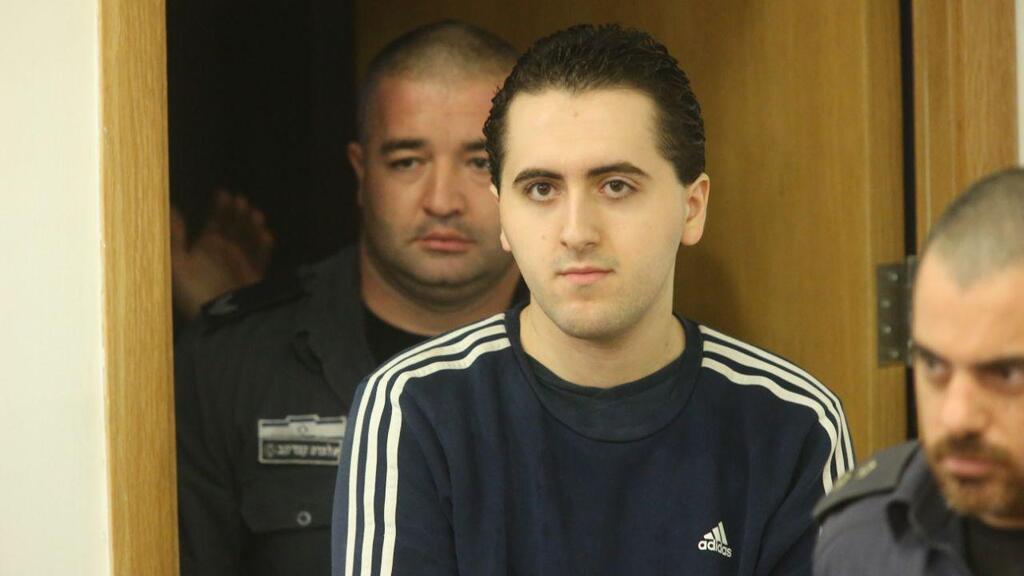
The proceedings against him in the US are ongoing; Michael Ron David Kedar
(Photo: Moti Kimchi)
Kedar, an Israeli who also holds U.S. citizenship, was arrested in 2017 and convicted in an Israeli court in 2018 on a series of charges including extortion, computer offenses and spreading false information. From his home, he made about 2,000 hoax bomb threats targeting Jewish institutions, kindergartens, embassies and aircraft. After his release, Kedar moved with his family to Norway and applied for political asylum there. He was arrested in Oslo in October 2024 on an international arrest warrant issued by U.S. authorities.
The affidavit was filed this week by Jeffrey M. Olson, who handles extradition and international legal assistance matters for the OIA. In the document, Olson says that on April 21, 2017, after a criminal complaint was filed against Kedar in the United States, his office worked with prosecutors to complete a request for Kedar’s provisional arrest in Israel ahead of extradition proceedings. The request was sent that same day to Israel’s Justice Ministry. According to the affidavit, the ministry confirmed receipt on April 22, 2017.
One of the key details in the document is that, according to Olson, Israel never carried out the provisional arrest request and never formally notified the United States that it was rejecting it. The affidavit thus provides official confirmation from the U.S. official handling the case that Washington sought Kedar’s arrest in Israel for extradition purposes in 2017.
The U.S. request was submitted while criminal proceedings against Kedar were also underway in Israel. On April 26, 2017, Israel’s Justice Ministry sent the OIA the Israeli indictment against Kedar. According to the affidavit, the ministry told U.S. officials that the indictment concerned 2,688 threatening calls attributed to Kedar against institutions around the world, including 1,672 calls to the United States. Kedar was convicted in Israel in 2018 and sentenced to 10 years in prison.
In January 2020, Israel’s Supreme Court upheld the conviction but reduced his sentence to seven years. Meanwhile, the U.S. criminal case continued to advance. In February 2018, a 32-count federal indictment was filed against him in Florida, including charges of transmitting interstate threats, obstructing the free exercise of religious beliefs and making bomb threats.
One of the affidavit’s most significant points concerns contacts between Israel and the United States in late 2019. According to Olson, during meetings between U.S. Justice Department officials and their Israeli counterparts in Jerusalem in December of that year, the Americans pressed Israel to act on the provisional arrest request.
Israeli Justice Ministry representatives, however, said there was little chance Israel would extradite Kedar to the United States, citing, among other factors, his age at the time some of the offenses were committed, the fact that he was in Israel when the acts took place and the criminal proceedings already conducted against him in Israel.
According to Olson, Israeli Justice Ministry officials explained that they interpreted the “prior prosecution” provision in the U.S.-Israel extradition treaty as a barrier to Kedar’s extradition because he had already been prosecuted in Israel for conduct similar to that underlying the U.S. charges.
In other words, according to the U.S. account, Israel did not merely decline to execute the arrest request. It also presented the Israeli criminal proceedings as a central factor that could prevent extradition.
A continuing effort
The U.S. effort did not end after Kedar’s conviction in Israel. According to the affidavit, OIA officials tried between 2017 and 2019 to reach a comprehensive arrangement between Israel and the United States. Contacts resumed in 2020, and in 2021 Israel’s Justice Ministry said Kedar’s family was not interested in discussing such an arrangement.
Also in 2021, U.S. officials asked to send a letter to Israel’s parole board urging that Kedar remain in custody. Israel’s Justice Ministry told the OIA that it had forwarded the letter to the board.
In March 2023, during meetings in Jerusalem, U.S. officials again pressed Israel to act on the provisional arrest request submitted in 2017. As Kedar’s release in 2024 approached, U.S. officials examined whether the “prior prosecution” obstacle could be overcome through U.S. charges involving acts that had not been included in the Israeli case.
The 'Ashkelon hacker' in an Israeli court in 2018
(Video: Lihi Krupnik)


On Aug. 28, 2024, Israel’s Justice Ministry said, according to the affidavit, that four “swatting” incidents included in the U.S. indictment had not been part of the Israeli indictment. Swatting is a dangerous criminal hoax in which someone falsely reports a severe emergency, such as a hostage situation, murder or bomb threat, at another person’s home in order to trigger the deployment of a special police unit such as a SWAT team.
The Americans sought further clarification, and in October 2024 the FBI confirmed that evidence supporting those four charges had been obtained in Israel. But before the review was completed, it emerged that Kedar had already left Israel.
On Nov. 4, 2024, Israel’s Justice Ministry informed U.S. officials that Kedar had left Israel on June 27, 2024, and had not returned. At that point, Olson said, the ministry had still not provided a final position on which of the U.S. charges were extraditable.
Attorney Nir Yaslovitzh, who previously represented Kedar and specializes in international law, said the affidavit “provides, for the first time, official confirmation of the argument I made throughout: The United States asked Israel to arrest Mr. Kedar for extradition as early as April 2017.”
“Israel did not execute the request and later made clear that his extradition was barred because he had been prosecuted in Israel over the same factual circumstances,” Yaslovitzh said. “Accordingly, this amounted in practice to a rejection of the extradition request.”
He added: “The continued pursuit of Mr. Kedar after he served his sentence in Israel is, in my view, contrary to basic principles of justice, legal fairness and respect for proceedings conducted in a sovereign state.”