

On the 690th day since Oct. 7, Israel was transformed into a stage of defiance and mourning. From dawn until late evening, families of hostages and their supporters turned intersections into protest sites, Hostages Square into a hunger installation, and Tel Aviv’s streets into rivers of yellow ribbons and flags.
The national strike called “Israel Stands Together” was more than a demonstration — it was a deliberate suspension of normal life, meant to remind the nation and its leaders that 50 hostages remain in Gaza and time has stretched into almost two years.
“There are two kinds of human rights: one for everyone else, and another for the Jews. It is time to expose this,” Itzik Horn, father of two sons — one freed from Hamas captivity and one still held in Gaza — said. His words echoed through Hostages Square, setting the tone for a day of rallies, marches, and anguish transformed into collective action.
From the earliest hours, symbolism defined the protest. At 6:29 a.m., giant flags were unfurled outside the US Embassy in Tel Aviv, marking the precise time when Hamas terrorists crossed into Israel on Oct. 7, 2023. “This is the time our lives changed,” the families said. “People of Israel, stand by our side today.” By midmorning, Hostages Square was already alive with mothers circling the hunger installation table with strollers, declaring in unison: “A mother will never give up.”

(Photo: AP Photo/Ohad Zwigenberg)
“It is deeply disappointing that on the very day when masses of Israelis take to the streets demanding the return of all hostages and an end to the war, the government continues to delay progress on the agreement, contrary to the people’s will. The government lacks a public mandate to continue this prolonged conflict while our loved ones remain captive. There is only one answer: people filling the streets — until everyone comes home,” read a statement by the Hostages and Missing Families Forum.
Hagit Chen, whose son Itay remains in captivity, delivered one of the most intense messages of the day: “There is an offer on the table! We demand that our leaders sit at the negotiation table and not get up until there is an agreement that guarantees when the last hostage will return. This is about one courageous decision that can be made today. The struggle to return the hostages is not just the struggle of hostage families. This is the struggle for the character of Israeli society as a whole — for redeeming captives, for the prohibition against leaving the dead unburied, for mutual responsibility, for human dignity.”

(Photo: Tal Shahar)
Einav Zangauker, mother of Matan, echoed that urgency while lashing out at the government’s paralysis: “For 690 days the government has been conducting a war without a clear objective — how will the living hostages and the bodies return, who will rule Gaza the day after, how do we rebuild our country. We have wonderful people, but no government. I call on the public: take to the streets with us. Only through our strength can we achieve a comprehensive deal and end the war. The government has abandoned, but the people will bring them back.”
As the morning turned into afternoon, Hostages Square became a rotating assembly of groups: security forces, Holocaust survivors, artists, returnees, and families. Holocaust survivor Colette Avital framed the day in stark historical continuity: “We know what the Holocaust means, what hunger means, and what fear means. We are here calling on the public: in 50 years, you will ask yourselves where you were and why you didn’t act. We all need to come forward, and we all need to bring this nightmare to an end and bring everyone home.”
The hunger installation — an empty dining table set in the middle of the square — was a visual wound. Around it, the families placed placards, portraits, and ribbons. Horn expanded on his criticism and called on the Argentine government, his country of origin, to intensify its involvement, stressing that four Argentine citizens remain among the hostages. He also addressed Israelis directly: “It is not enough to say ‘We are with you’ or ‘Poor people, what happened to you.’ Show that you care. Come to the square, join us in the streets. This government only understands popular pressure. There is no other way.”
(Photo: Tal Shahar)
For days, the public had been invited to write messages to Cabinet members, urging them to act. Families then carried the box to the gates of the base as the Security Cabinet convened without addressing the mediators’ deal. Ruby Chen, father of Itay, stood outside Shaul Gate and said: “We asked the people of Israel to write down what they would like Cabinet members to consider when discussing the fate of our loved ones. We are waiting here outside the gate for someone to acknowledge us. We hope someone will understand that this is the moral, ethical, and Jewish thing to do — to take the notes and place them in the room where decisions are made.”
Beside him, Yael Adar, mother of Tamir, underscored the point: “This is a way to listen to the will of the people. Take time to read what the people are asking for, so there can be a better future here that begins with returning the hostages. We have been waiting over a week for the prime minister to respond to the mediators’ proposal — whoever doesn’t respond doesn’t want a deal, and whoever doesn’t want a deal doesn’t want to return the hostages.”
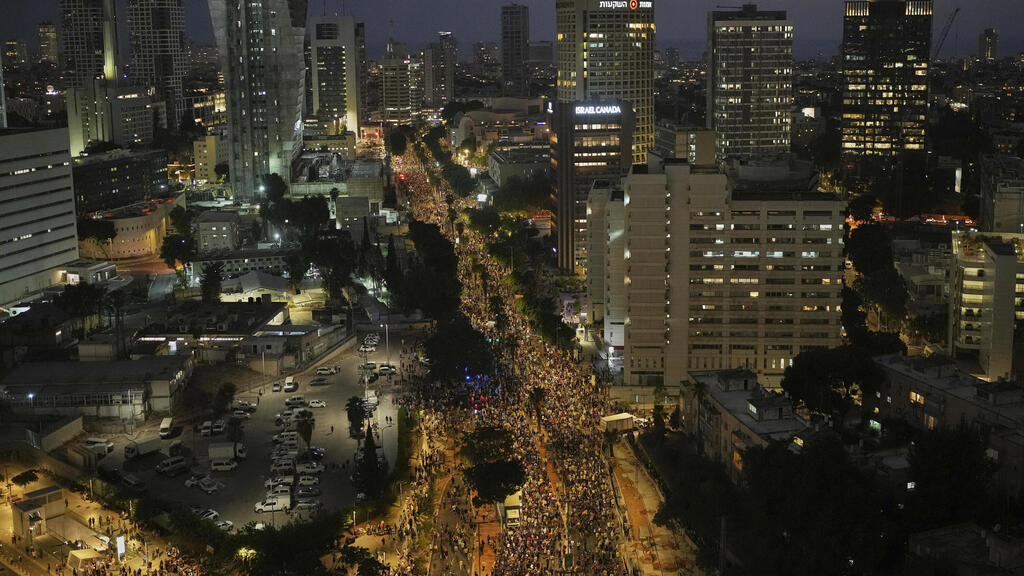
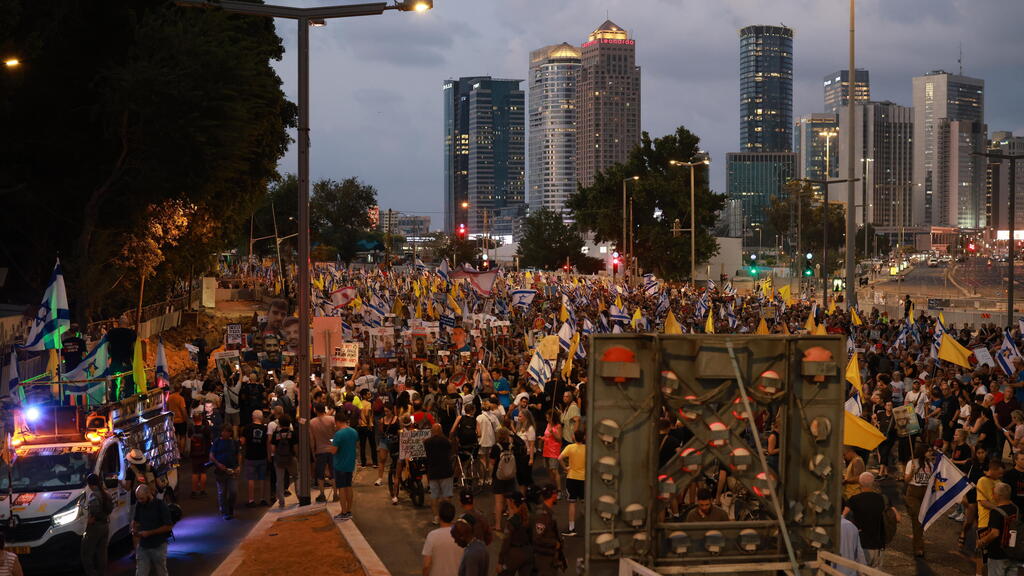
By evening, Tel Aviv’s streets were flooded in yellow and blue. Organizers estimated that hundreds of thousands marched from Savidor Central Station to Hostages Square, one of the largest rallies since the beginning of the war. The marchers carried portraits of hostages, Israeli flags, and yellow banners calling for their return. From above, the city looked like it was cut in two — one half wrapped in silence, the other half roaring with chants of “Bring them home.”
For Raz Ben Ami, who endured 54 days of captivity before her release, the protest was both personal and political. Her husband, Ohad, was freed only after 491 days. “My husband is here because of President Trump,” Ben Ami told The Media Line, crediting the US president with decisive involvement. “I believe he is doing everything to bring all the hostages back. But the Red Cross has failed. They never visited us. They can get into Gaza if they want, to give medicine and food, to see how the hostages are. If not by the Red Cross, then by whom?”
Asked whether she places more hope in the American or the Israeli government, Ben Ami admitted: “I want it to be the Israeli government, but it is more the American one. Because the Israeli government must tell us how many hostages are still alive — not Trump.”
This article is written by Gabriel Colodro and republished with permission from The Media Line