

An alliance of rabbis serving Jewish communities from Morocco to Iran met with three European commissioners in Brussels on Monday and convened its board inside the European Parliament, asking the European Union (EU) to help Jewish life across the Muslim world survive and grow.
Iran’s chief rabbi sat among them on the same day Britain proscribed Iran’s Islamic Revolutionary Guard Corps (IRGC) and identified a Tehran-backed group as being behind attacks on Jewish sites across Europe. The communities these rabbis serve range from a handful of families to tens of thousands of people, and public Jewish life has grown more difficult for many since October 2023, from the Gulf to the Caucasus.
Gallery

(From left): Rabbi Mendy Chitrik, Chief Rabbi Albert Guigui of Brussels, Mohamed Ismail Al Sahlawi, Rabbi Levi Banon of Casablanca, Ahmed Reda Chami; and Rabbi Levi Matusof of Paris, in Brussels, July 13, 2026
(Photo: Gabriel Lelievre)
The Alliance of Rabbis in Islamic States (ARIS), founded in 2019 by Rabbi Mendy Chitrik, the Ashkenazi rabbi of Istanbul, presented a survey. Titled “Jewish Communities and Heritage in the Muslim World,” the survey covers communities from the Balkans to Southeast Asia and reads as both an inventory and an appeal: synagogue registration, rabbinic visas, protection for cemeteries and safe passage for religious articles at borders.
ARIS describes its work as practical and its posture as nonpolitical. Chitrik reached back to Jeremiah’s charge to the exiles in Babylon: Seek the welfare of the city and pray to God on its behalf. “We pray for the welfare of our countries and our governments,” Chitrik said. “We are loyal citizens, deeply rooted in the societies we call home. We are not political actors.” Their presence itself carries a message, he added: Jews and Muslims are not fated to live in conflict, and the coexistence they sustain across the Muslim world can serve as an example for Europe.
Much of the alliance’s work is the plumbing of Jewish life in places with almost no Jews: kosher supervision, mikvahs (ritual baths), marriages, burials and schooling. In 2021, it helped get Zebulon Simentov, long described as Afghanistan’s last openly practicing Jew, out of the country.
“Before ARIS, every rabbi was often working alone,” Chitrik told The Media Line. “Today, when a community needs help, whether rebuilding a mikvah in Tunisia, strengthening Jewish education in Nigeria, or resolving practical challenges in Central Asia, that rabbi is no longer on his own. We share experience, mobilize partners, and, when needed, engage governments together. The alliance gives even the smallest Jewish community the confidence that it is part of something larger.”
Three commissioners sat with the rabbis: Dubravka Šuica, commissioner for the Mediterranean; Magnus Brunner, commissioner for internal affairs; and Olivér Várhelyi, commissioner for health and animal welfare. Katharina von Schnurbein, the European Commission’s coordinator on combating antisemitism, joined them, along with members of the European Parliament and diplomats.
Two other guests attended the dinner: Nikolay Mladenov, the Board of Peace’s high representative for Gaza, and Aryeh Lightstone, a senior adviser to the board. Neither addressed the group. Chitrik said both have long-standing ties to the alliance.
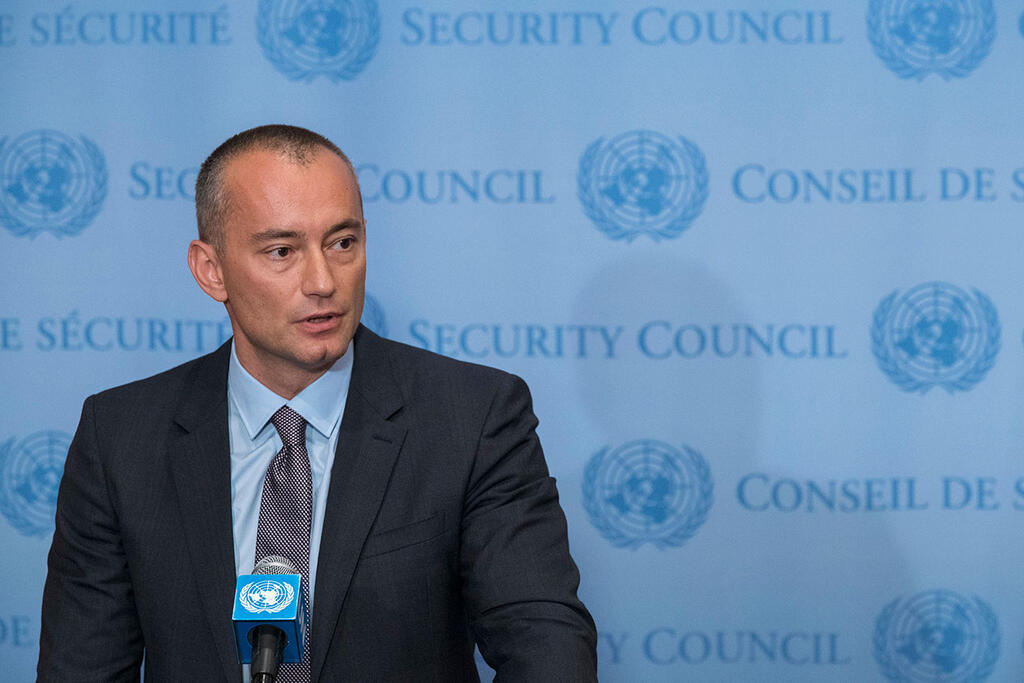
Nikolay Mladenov
(Photo: AP)
The hardest case
The rabbi everyone watched was Yehuda Gerami, Iran’s chief rabbi since 2011.
ARIS provided The Media Line with his remarks to Brunner. “When tensions rise in the region, we also feel the consequences, both as Iranians and as Jews,” Gerami said. “Our community is not political. Our concern is to preserve our religious life, our institutions, and this ancient heritage for future generations.” He said the Jewish community has maintained a presence in Iran for more than 2,500 years and asked the EU for understanding, cooperation and practical support.
Gerami also told Brunner, Chitrik said, that close to 20,000 Jews live in Iran, that the community maintains about 60 synagogues and six kosher restaurants, and that Iranian synagogues need no guards at their doors.
That same Monday morning, Britain said an Iran-backed group had directed a wave of arson and vandalism against Jewish sites in the country. London banned the group, the Islamic Movement of the Companions of the Right, and proscribed Iran’s IRGC as a threat to national security. Security Minister Angela Eagle said the group had claimed responsibility for seven attacks in Britain and that the IRGC’s Quds Force had almost certainly directed its attacks across Europe. The foreign secretary summoned Iran’s ambassador. The group has also claimed responsibility for attacks on synagogues in Belgium and the Netherlands.
None of Gerami’s assertions were new. He told a U.S. audience in 2021 that Iran is the only place where synagogues need no guards, that Jews there must be careful because they are guests, and that stressing they are not political is sometimes very hard.
The alliance’s survey is more measured. It describes Iran’s Jewish community as religiously active but living in a sensitive political environment marked by emigration, limits on travel to the U.S. and Europe, separation from relatives in Israel, and the strain of military service and movement restrictions on young men.
Jewish life in the United Arab Emirates grew rapidly after the 2020 Abraham Accords. The alliance describes the country as tolerant and accepting, and the survey counts a few thousand Jewish residents and as many as half a million Jewish visitors a year. Public Jewish life there has become more discreet since October 2023, it reports, particularly after the killing of Chabad Rabbi Zvi Kogan in late 2024. In Dagestan, a Muslim-majority Russian republic, the survey records a mob storming Makhachkala airport in October 2023 after a rumor spread that Israelis were landing there, followed the next summer by attacks on synagogues and churches in Derbent and Makhachkala.
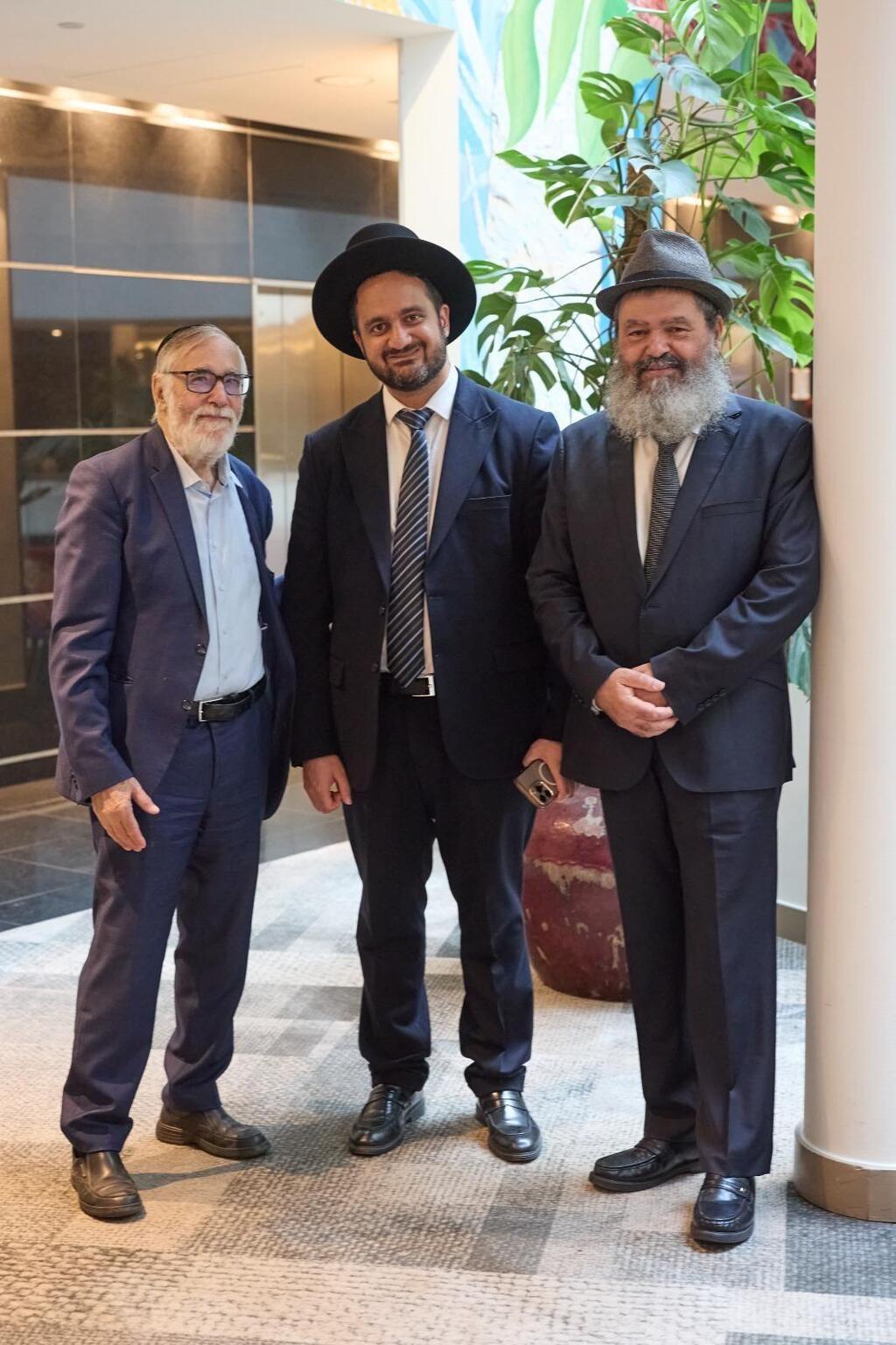
(From left): Chief Rabbi Albert Guigui of Brussels, Chief Rabbi Yehuda Gerami of Iran, and Rabbi Beto Hattab of Tunisia at the Alliance of Rabbis in Islamic States gathering in Brussels, July 13, 2026
(Photo: Gabriel Lelievre)
Again and again, the survey describes communities exposed to events they had no part in starting.
Yoram Meital has watched the changing place of Jewish heritage in the region up close. A historian of Egyptian Jewry at Ben-Gurion University and author of Sacred Places Tell Tales: Jewish Life and Heritage in Modern Cairo (University of Pennsylvania Press), which will be released in paperback in the US next month, Meital traces an unprecedented shift in Egypt between 2011 and 2021: synagogues and cemeteries were restored, and Jewish characters returned to film and fiction, all against steady opposition in the media and security services. The broader regional reengagement, he said, gathered pace after the Arab uprisings.
Wars since October 2023 have slowed that process, Meital said, folding local Jewish history back into debates over Israel and Zionism, with heritage projects postponed or shelved. “Yet I would not describe this as a return to the past,” Meital said. In Egypt, Morocco and elsewhere, much of society still treats Jewish heritage as part of its own national story rather than something foreign, and that view has held up better than many expected. What is happening now, he said, is “a significant setback, but not necessarily the collapse of a longer-term transformation that has been unfolding for nearly three decades.”
The survey also points to countries where Jewish heritage has become part of the national identity. Morocco, which it describes as the clearest example of a Muslim-majority country incorporating Jewish heritage into its national story, has between 2,000 and 3,000 Jews and receives as many as 350,000 Jewish visitors a year. Azerbaijan has one of the largest and most active Jewish communities in the Muslim world, numbering between 20,000 and 30,000 people, and incorporates Jewish life into its national story, honoring Albert Agarunov, a Jewish Azerbaijani soldier, as a national hero.
Azerbaijan is also one of Israel’s closest partners in the Muslim world, with a Jewish community that is visible, officially recognized and central to how the state presents itself.
Rabbi Shneor Segal, the chief Ashkenazi rabbi of Azerbaijan and an ARIS board member, said the alliance had enabled his community to share its knowledge with Jews living in far more difficult circumstances. “It also allows us to present a positive example of Jewish life flourishing in a Muslim-majority country,” he told The Media Line.
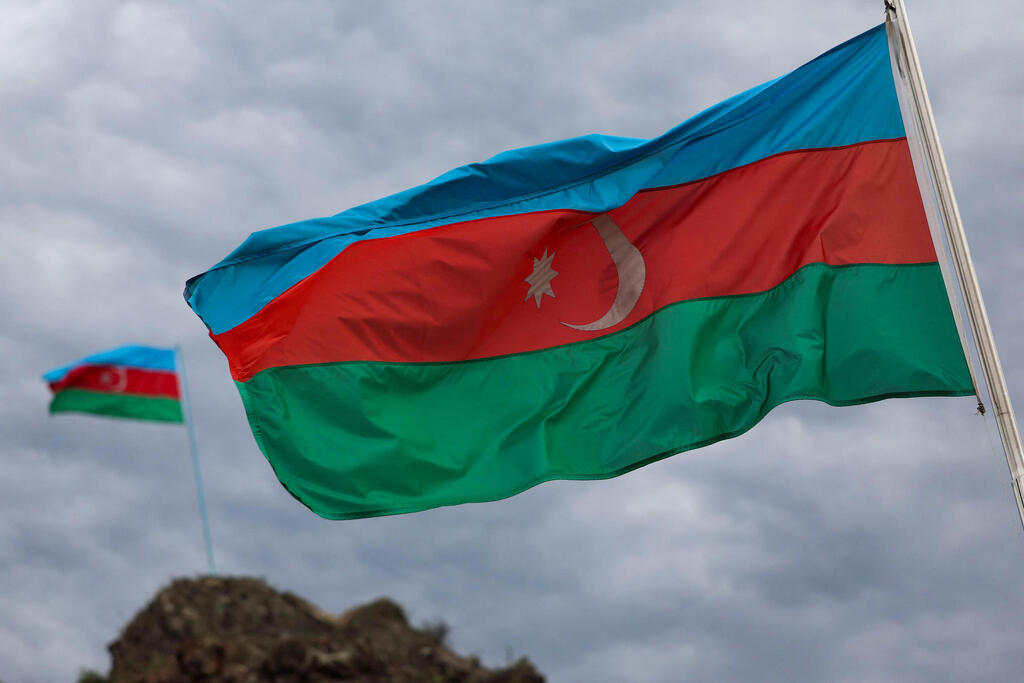
Azerbaijan is also one of Israel’s closest partners in the Muslim world
(Photo: AFP, EMMANUEL DUNAND)
Morocco’s ambassador to the EU, Ahmed Reda Chami, and the UAE’s ambassador, Mohamed Ismail Al Sahlawi, joined the rabbis in Brussels. Their attendance gave the gathering visible support from two governments that have normalized relations with Israel. Kazakhstan’s ambassador also attended.
A positive example, Meital noted, can serve more than one purpose. Governments have their own reasons to promote Jewish heritage: A restored synagogue or an honored figure can support diplomacy, project tolerance, strengthen the national story and attract tourists. The surer sign of genuine pluralism, he said, lies elsewhere. Over the past two decades, Arab and Muslim filmmakers, novelists and scholars have increasingly portrayed Jews not as the enemy but as part of their own heritage. “Governments can fund restoration projects, but they cannot easily manufacture a broad cultural shift in the ways people write, teach, film, and think about the Jewish past,” he said. That shift, Meital said, goes deeper than anything a state can arrange.
Other communities continue to face a more precarious reality. In Tunisia, the survey counts between 1,000 and 1,500 Jews, most of them in Djerba and Tunis, and describes Djerba as one of the last strongholds of indigenous Jewish life in the Arab world. It is a guarded life. Police stand at the entrances to the Jewish quarter of Hara Kbira, and the community lives under President Kaïs Saïed, who routinely denounces Israel and Zionism. The danger has also been physical: At the 2023 Lag BaOmer pilgrimage, a national guardsman opened fire near the Ghriba synagogue, killing five people, including two Jewish pilgrims. The following year’s pilgrimage went ahead without festivities. Yet the community continues to build: The alliance has completed the rebuilding of a mikvah in Tunis and continues to work with Jewish schools there.
Šuica arrived from the Foreign Affairs Council and the Palestine Donor Group, where the EU had launched what she called its Team Gaza Initiative earlier that day. A former mayor of Dubrovnik, she began by describing the Sephardic synagogue in her old city, built by Jews expelled from Spain and still standing after an earthquake, a world war and the siege of the 1990s. A place is stronger, she told the rabbis, when every faith within it is free to live.
Coexistence, she said, is precious and, in the region she oversees, fragile. She discussed Syria, Lebanon, Yemen and Iraq before turning to Israel. There are “serious threats to freedom of religious belief in Israel as well,” she said, pointing to images of Christians being assaulted. The European Union could not accept the persecution of any minority anywhere.
Šuica listed what the EU already does across the region: interfaith dialogue in Syria, a project in Egypt that trains scholars of Islamic studies to counter extremism, and a peace initiative bringing faith communities together in Israel and Palestine. She then asked: Where, among the countries the alliance covers, could Europe be of greatest use?
How help takes root
Europe has a long and uneven history of speaking up on behalf of minorities, and Meital described the issue as delicate. Across much of the Arab and Muslim world, he said, memories persist of colonial powers that justified intervention partly by claiming to protect local minorities. Circumstances today are entirely different, but those memories have not disappeared, and a project run by foreign organizations, however well-intentioned, can be portrayed as interference.
Small communities benefit from international support, Meital said, yet governments and the communities themselves remain wary of political red lines, and many have lowered their profiles since the war began. “History suggests that the most durable progress usually comes when international actors work quietly with local institutions rather than appearing to lead the process themselves,” he said. The most useful contribution, he added, lies less in speaking for these communities than in supporting the local universities, museums, heritage workers and civil society groups already at work, allowing the Jewish past to become part of the national story rather than something imposed from abroad.
“If I had stopped believing coexistence was possible, I would have resigned years ago,” Chitrik said. “Instead, every week I witness quiet acts of friendship and cooperation that never make the headlines. Those stories deserve to be told too, because they remind us that Jews and Muslims are not destined for conflict. They are capable of building a shared future.”
-The story is written by Jacob Wirtschafter and reprinted with permission from The Media Line.