

Israel is moving to expand its naval fleet and accelerate investment in autonomous vessels as threats from Iran and its regional allies increasingly target offshore infrastructure and shipping routes, Bloomberg reported.
Israeli officials told Bloomberg that the country has concluded it needs a larger navy after years in which the maritime arm received less attention than the air force, ground forces and intelligence services. In 2024, the Defense Ministry announced plans to order five new missile ships for about $780 million to replace aging vessels.
The push is also focused on unmanned systems. Yaron Sarig, head of the AI and Autonomy Program Executive Office at the Defense Ministry’s Directorate of Defense Research and Development, confirmed to Bloomberg that the navy is increasing investment in autonomous sea drones, though he did not disclose budget figures.
The navy said in May 2024 that it had already deployed autonomous vessels to help protect offshore economic assets. According to the International Institute for Strategic Studies, Israel currently operates 10 small unmanned surface vessels and one large unmanned underwater vehicle.
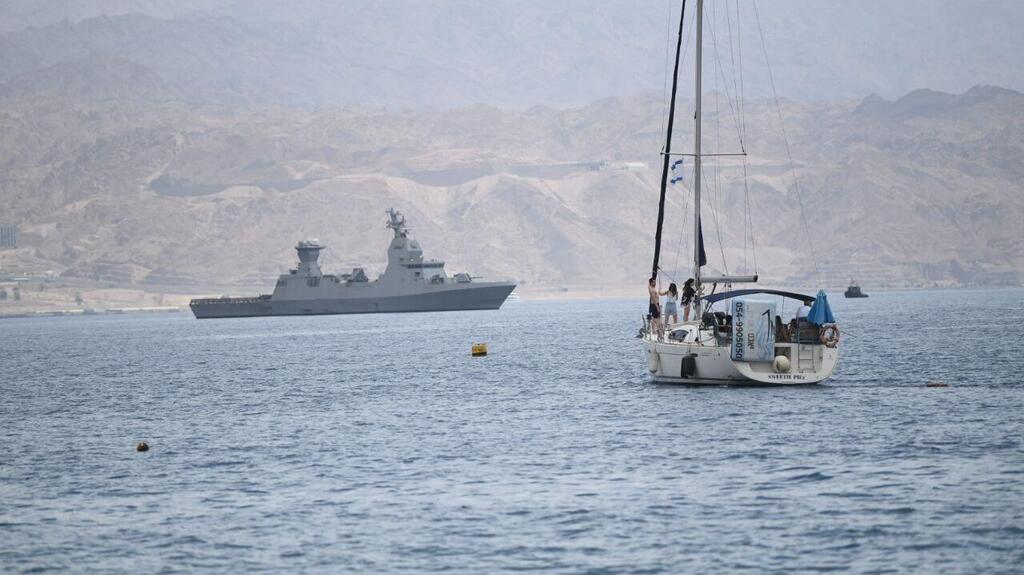
The shift comes after unusually intensive naval operations over the past three years. The INS Independence, a Saar 6 corvette, has spent thousands of hours guarding offshore gas fields and shipping routes, its commander told Bloomberg. The 90-meter vessel would normally log about 1,500 hours at sea annually, but exceeded 4,000 hours in 2024.
Its commander, identified only as O. under Israeli military policy, described the mission as “Sisyphean.” During attacks by Iran or Hezbollah, he said, the crew has sometimes had only seconds to activate the ship’s air-defense systems.
Bloomberg reported that Israel’s defense establishment is increasingly looking to unmanned vessels as a way to expand maritime coverage more quickly and at lower cost than conventional warships.
Elbit Systems is among the Israeli companies developing such technology. Its 12-meter Seagull autonomous surface vessel is designed to patrol offshore infrastructure for up to four days and can also be used for mine-clearing, anti-submarine missions and deep-sea reconnaissance.
Saar Koursh, a senior vice president at Elbit Naval Systems, told Bloomberg that recent developments in the Strait of Hormuz had increased demand for anti-mine capabilities. “A mine costs a few hundred bucks or maybe a few thousand bucks, and it can hurt a commercial or a combat ship that costs tens or hundreds of millions of dollars,” he said.
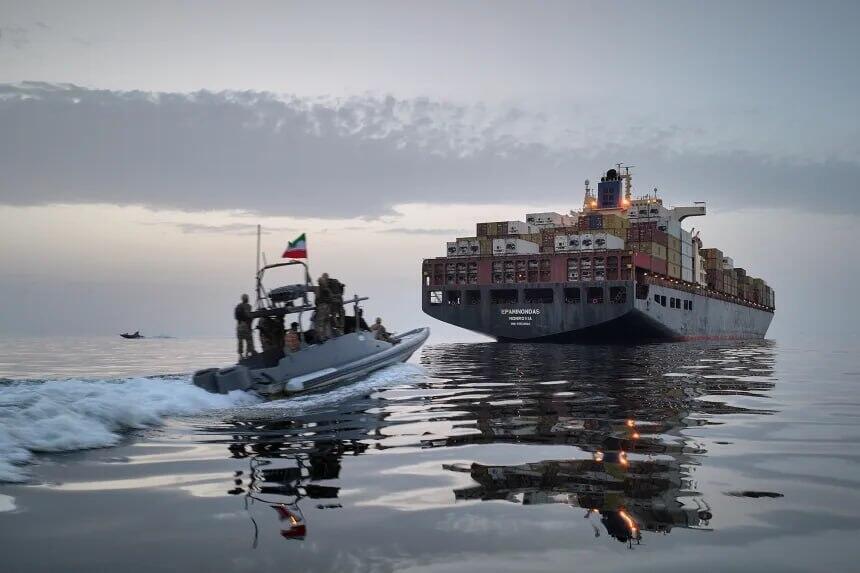
IRGC speedboat approaches a vessel in the Strait of Hormuz
(Photo: CNN)
The navy’s reassessment also follows operational setbacks. It has acknowledged failing to prevent Hamas militants from reaching Israel by sea during the October 7 attack, while it has also been unable to fully counter Houthi disruption of Israel-linked shipping through the Bab al-Mandeb Strait.
Analysts cited by Bloomberg said unmanned platforms are particularly attractive for a relatively small navy because they require less manpower, can be procured faster and allow wider coverage at a lower cost.
The main technological challenges remain endurance, communications and navigation under electronic warfare and GPS jamming.
Those challenges are becoming more urgent as adversaries adapt. The commander of the INS Independence told Bloomberg that projectiles targeting offshore infrastructure have become faster, more precise and increasingly difficult to counter, with Iran and its allies continually probing for gaps in Israel’s defenses.
The result, according to Bloomberg’s reporting, is a broader Israeli effort to reshape a navy that for years played a secondary role, with more ships, more autonomous systems and greater emphasis on defending critical assets at sea.