


Prime Minister Benjamin Netanyahu publicly rejected the Board of Peace’s 15-point Gaza document on Sunday, saying Israel would not carry out any IDF withdrawal from the Strip before Hamas is fully disarmed.
Speaking at the opening of the weekly Cabinet meeting, Netanyahu addressed criticism that he had not personally stated Israel’s opposition to the plan.
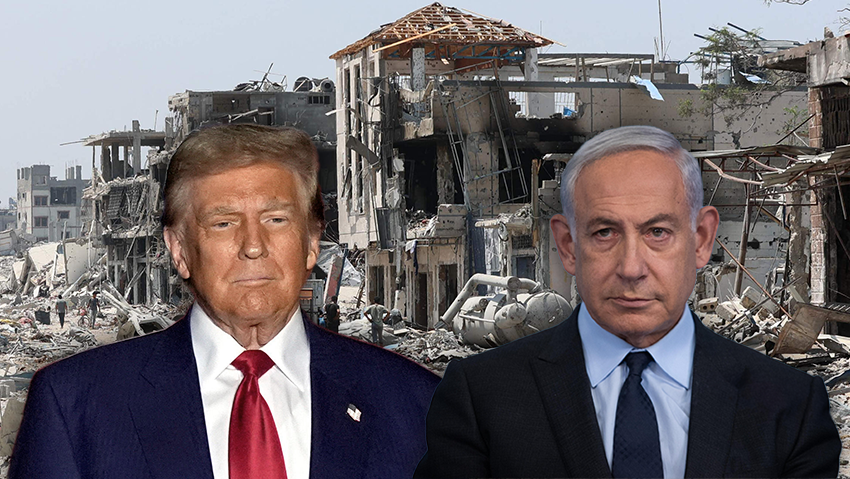
(Photo: Omar AL-QATTAA / AFP, AP Carlos Osorio, Alex Kolomoisky)
“Israel rejects the 15-point document,” he said. “I heard people saying, ‘You didn’t say it.’ So here I am saying it again: Israel rejects the 15-point document. The IDF will not carry out any withdrawal until Hamas is disarmed.”
The Board of Peace and the broader Gaza framework are backed by U.S. President Donald Trump. Meanwhile, Israel has refrained since last Monday from carrying out strikes and targeted killings in the Gaza Strip.
Netanyahu also spelled out what Israel considers Hamas disarmament.
“When I say disarming Hamas, that means the heavy weapons, the less heavy weapons, all the weapons,” he said. “And we are talking about real disarmament, not fake disarmament.”
“We are talking with the Americans about this,” Netanyahu added. “They have ideas, some of them are acceptable to us and some are not acceptable to us, and we know how to stand our ground on these matters. We proved that in the past and we are proving it today as well.”
He added that the IDF would continue acting against threats to Israeli troops and civilians.
“The IDF will continue to thwart threats against our forces and against our citizens,” he said.
The dispute over phased withdrawal
The agreement with Hamas calls for a gradual process in which Hamas and other terror organizations in Gaza would be disarmed alongside a full Israeli withdrawal from the Strip.
The process is meant to take place in stages. At the outset, the IDF would withdraw back to the “yellow line” established under the first hostage deal, after Israeli forces subsequently seized additional territory and expanded their control to roughly 70% of Gaza.
Nikolay Mladenov, the Board of Peace’s high representative, presented the 15-point implementation plan for the “Comprehensive Peace Plan” in May.
At the center of his presentation was a new roadmap which he said had been developed together with Egypt, Turkey, Qatar and the United States, incorporating feedback from Palestinian factions.
According to Mladenov, the plan is based on reciprocity: each move by one side triggers a corresponding step by the other, with an independent verification committee approving each stage before the process advances.
That mechanism is at the heart of Israel’s objection.
Cabinet ministers said last week that the roadmap calls for a gradual Israeli withdrawal in parallel with partial stages of Hamas disarmament, rather than requiring Hamas to fully disarm before any withdrawal begins.
“The Israeli position was that withdrawals begin only when Hamas disarms, and now they are saying that every time Hamas gives up part of its weapons, we have to withdraw a little,” ministers said.
They also sharply criticized the proposed disarmament mechanism.
“All the demilitarization is fake,” they said. “There is no disarmament, but rather the transfer of weapons into Palestinian hands, and they will operate according to Palestinian law that applies in Ramallah.”
The ministers argued that such an arrangement would fail to meet Israel’s demand for the complete dismantling of Hamas’ military capabilities.