


For nearly two weeks, the Middle East has lived under the assumption that a direct confrontation between the United States and Iran was no longer theoretical.
It began about a week after protests erupted across Iran, when President Donald Trump issued a blunt warning that immediately reverberated across the region. In a post on his Truth Social platform, Trump said that if Iranian authorities used lethal force against peaceful demonstrators, the United States would intervene. “If Iran shoots and violently kills peaceful protesters, which is their custom, the United States of America will come to their rescue,” he wrote, adding: “We are locked and loaded and ready to go.”
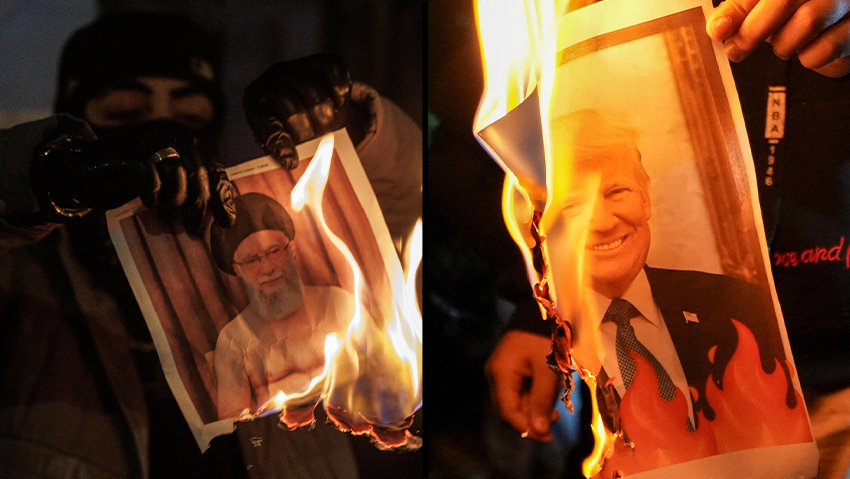
(Photo: REUTERS/Mohammed Aty, Dan Kitwood/Getty Images)
The statement marked a sharp escalation. It went beyond rhetorical support for protesters and introduced an explicit threat of American action tied directly to events unfolding inside Iran. Tehran’s response was swift and hostile. Iranian officials accused the United States and Israel of standing behind the protests and warned that American interference would spread chaos throughout the region and harm U.S. interests.
From that moment on, the clock appeared to start ticking.
Trump did not retreat from his warning. In subsequent public remarks, he described Iran as being “in big trouble” and reiterated that if protesters were harmed, “we’ll hit them very hard.” The repetition mattered. Each statement reinforced the sense that Washington was edging closer to action and that the president was deliberately keeping pressure at a boil.
Across the Middle East, and particularly in Israel, the implications were clear. Israeli defense officials monitored developments closely, preparing for potential Iranian retaliation. Scenarios involving missile fire, attacks by Iranian proxies and broader regional escalation were reviewed. Shelters were opened in some areas and public messaging emphasized vigilance.
At the same time, the information environment grew increasingly chaotic. Reports of an imminent American strike surfaced repeatedly, often contradicting one another. Analysts debated whether Trump was signaling genuine intent or engaging in strategic intimidation. The atmosphere recalled earlier moments of brinkmanship, when sustained media noise preceded decisive military action.
By midweek, expectations peaked. Iran closed its airspace. U.S. military movements in the region drew intense scrutiny. In capitals around the world, officials waited for the signal that would confirm whether the United States was about to cross the threshold from threats to action.
Then, abruptly, the trajectory shifted.
At the White House, Trump told reporters he had received information from what he described as “very important sources” indicating that Iranian authorities had stopped killing protesters and would not proceed with executions. The tone was noticeably different. Instead of threats, Trump sounded cautious, saying, “We’ll see what happens,” and emphasizing that the situation was still being examined.
When asked whether military action was still on the table, he refused to clarify, responding: “I’m not going to tell you.”
Trump on Iran
(Video: White House)


Hours later, in an interview with NBC News, Trump said the pause had already had an effect. “We saved a lot of lives yesterday,” he said, referring to the reported halt in executions. The White House underscored that the administration was monitoring developments closely and that all options remained available.
Behind the scenes, diplomacy appeared to accelerate. Iranian officials claimed Trump had conveyed that he did not intend to attack. A senior Saudi official said Saudi Arabia, Qatar and Oman had urged Trump to give Iran a chance, warning that a strike could have severe consequences for the region.
In Israel, officials continued to walk a careful line. Publicly, they reiterated that Israel would not allow Iran to pose a strategic threat to its security. Privately, concerns persisted about miscalculation — that a single move, misread or mistimed, could trigger a wider conflict neither side fully controlled.
U.S. media reports suggested that Trump had been briefed on assessments from Israel and Arab states indicating that Iran’s leadership, while under pressure, was not yet weak enough for American military action to deliver a decisive blow. Even a large-scale strike, he was told, could fail to bring about regime change and instead ignite a broader regional war.
That calculation may help explain the pause. But it did not signal an end to the crisis.
U.S. military assets were reportedly repositioned closer to Iran, underscoring that the option of force remains on the table. Allies of the president cautioned that it was too early to describe the moment as a de-escalation.
Trump has continued to pair warnings to Tehran with expressions of support for Iranian protesters, maintaining deliberate ambiguity about his next steps. His remarks have left open the possibility that diplomacy could falter — and that pressure, including military pressure, could quickly intensify.
For Israel and the wider region, the past two weeks have illustrated how rapidly rhetoric can translate into readiness. While the sense of imminent confrontation has eased, it has not vanished. Instead, it has shifted into a fragile holding pattern, in which the next move by Tehran or Washington could again drive the region toward escalation.