

A policy paper released Friday by the Trump administration outlining a new national security strategy is expected to unsettle U.S. allies around the world, including Israel. The document formally codifies the approach President Donald Trump has long promoted — a sharp pullback from American involvement overseas, including in the Middle East — under the guiding principle of “America First.”
According to the Associated Press, despite Trump’s deep engagement in Israel’s war in Gaza, as well as in Iran, Lebanon, Syria and Yemen, and despite his extended tour of the Gulf states, the United States plans to shift its strategic focus away from the region. The stated reason is Washington’s declining dependence on Arab oil.
Gallery
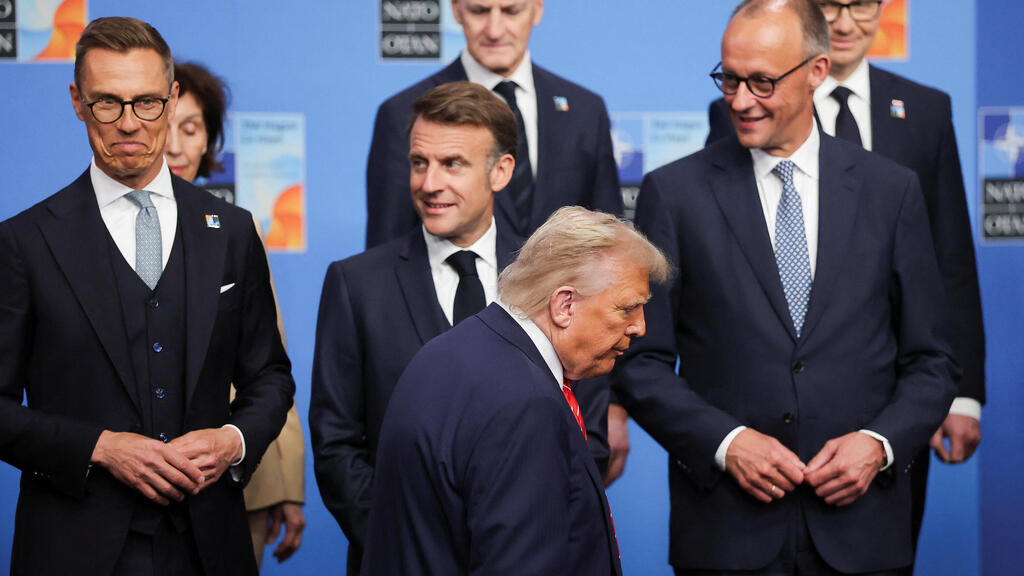
Trump between German Chancellor Mertz and French President Macron
(Photo: REUTERS/Christian Hartmann/Pool)
The paper sharply criticizes previous U.S. administrations for efforts to shape political systems in the region or judge them. It says the U.S. must abandon what it calls the “misguided experiment” of lecturing Middle Eastern governments — especially Gulf monarchies — about their traditions and forms of rule. Trump views them as ripe for economic opportunity, and therefore the U.S. should “encourage and applaud reform when and where it emerges organically, without trying to impose it.”
The document, which the administration is required by law to publish, is the first since the Republican president returned to the White House in January. Its contents mark a sharp departure from the strategy set by his predecessor, Joe Biden, who sought to rebuild alliances strained during Trump’s 2016–2020 term and counter Russia under Vladimir Putin.
Rep. Jason Crow, a Colorado Democrat on the intelligence and armed services oversight committees, called the new strategy “catastrophic to America’s standing in the world,” arguing that retreating from alliances will make the world — and Americans — less safe.

Right-wing demonstration against immigrants in Germany
(Photo: Reuters)
Beyond its Middle East implications, the paper portrays U.S. allies in Europe as socially and economically weakened, citing migration, declining birthrates, “censorship of free speech,” “suppression of political opposition” and “loss of national identities.” As a result, the document warns, they could face “civilizational erasure.”
Consequently, the Trump administration raises doubts about the long-term reliability of European allies. At the same time, the paper states the U.S. seeks improved relations with Russia after years of hostility, saying that ending the war in Ukraine is a key American interest for restoring strategic stability with Moscow.
“Should present trends continue, the continent will be unrecognizable in 20 years or less,” it reads. “As such, it is far from obvious whether certain European countries will have economies and militaries strong enough to remain reliable allies.”
The strategy also addresses the rise of far-right parties in Europe that advocate restricting immigration and halting climate legislation. “America encourages its political allies in Europe to promote this revival of spirit,” it says. “The growing influence of patriotic European parties indeed gives cause for great optimism.”
The document further states that the United States under Trump seeks to “rebalance” its relationship with China. The administration wants to prevent a war over Taiwan — the island claimed by Beijing and supported militarily by the U.S. under domestic law — and expects other regional allies to shoulder more responsibility in countering China’s pressure. “The American military cannot, and should not have to, do this alone,” it says.