


Israel is maintaining close coordination with the United States on Iran, and the prevailing assessment is that a military strike remains on the table and could still take place. Until then, the United States is building both defensive and offensive capabilities, deploying cargo aircraft and an aircraft carrier to the region.
Ahead of Operation Rising Lion, the United States gave Iran a diplomatic window, setting a 60-day deadline. Iran dragged its feet, and the Israeli strike, carried out in coordination with and with a US green light, came on the 61st day.
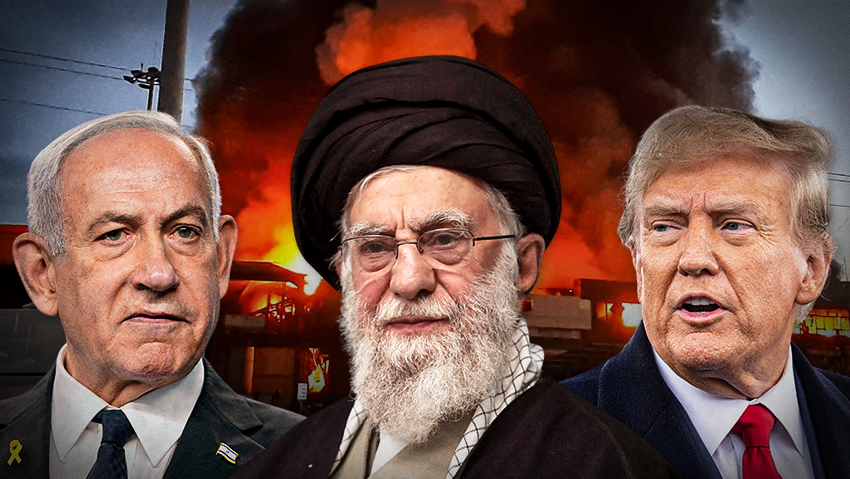
Meanwhile, Prime Minister Benjamin Netanyahu convened a restricted security meeting Sunday evening on Iran and the Gaza Strip, attended by IDF Chief of Staff Lt. Gen. Eyal Zamir, Mossad chief David Barnea, Shin Bet chief David Zini and other senior security officials. They were also set to discuss a proposed “Board of Peace” for Gaza, whose reported composition, including senior figures from Turkey and Qatar, prompted an unusual Israeli statement critical of the United States.
This time, Trump appears to have concluded that an attack at the current moment would not achieve the desired outcome of toppling the ayatollahs, and therefore instructed the military to build capabilities and prepare. Dan Shapiro, a former US ambassador to Israel and a senior official in the Biden administration, has assessed that Trump could order the killing of Supreme Leader Ayatollah Ali Khamenei as early as this week. It is unclear what he is basing that assessment on, but it is worth recalling that ahead of the “12-day war,” Israel planned to assassinate Khamenei, a move Trump vetoed.
It is possible that Trump, who has called Khamenei “a sick man” and said “it’s time for new leadership in Iran,” now believes that veto was a mistake. On Sunday, Iranian President Masoud Pezeshkian warned that any attack on Khamenei would be considered a declaration of all-out war against the Iranian nation and that the Islamic Republic’s response to any military aggression would be severe and deeply regrettable.
The threats against Khamenei may also be a tactical step aimed at forcing the supreme leader to do what he has so far refused: to “drink the poisoned chalice” and agree to US demands for an agreement that includes four conditions: halting the nuclear program and uranium enrichment; removing enriched uranium to a third country; curbing the ballistic missile program; and ending Iran’s terror campaign. In Iran, such an agreement is seen as capitulation, and there is widespread doubt it would be accepted.
Trump: No one convinced me not to strike Iran, I convinced myself
(Video: Reuters)


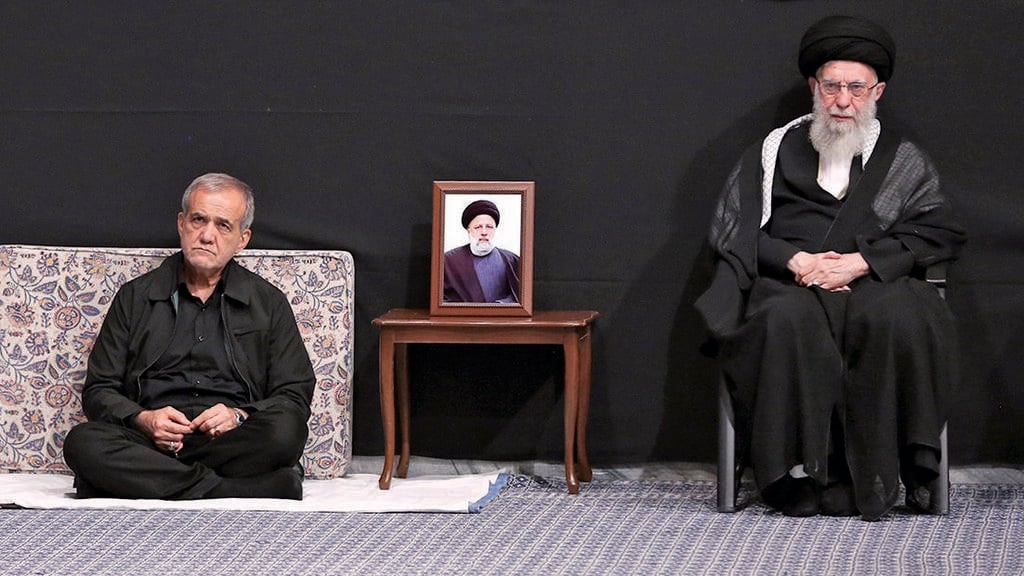
Supreme Leader Ayatollah Ali Khamenei (right) and President Masoud Pezeshkian
(Photo: AP)
Before Operation Rising Lion, American and Israeli officers coordinated every stage, including the US strike and the use of strategic bombers against nuclear facilities, which completed the Israeli operation. Israel also prepared the ground by destroying air defense systems to ensure a clear path for US bombers. Everything was coordinated down to the smallest detail. Even if Trump was angry with Israel on the final day, reportedly cursing and ordering Israeli aircraft to turn back, that was viewed as an isolated incident rather than indicative of the broader relationship.
Trump may be unpredictable, but when it comes to Israel’s security, he is not expected to take risks. His position is that the ayatollah regime must be toppled, but at the right moment. Sen. Lindsey Graham, who supports regime change in Iran, visited Israel and met Sunday with Netanyahu, Foreign Minister Gideon Saar and Mossad chief Barnea.
Graham said Netanyahu outlined ideas for expanding existing partnerships to secure future weapons systems, an approach he described as highly convincing. He said the prime minister persuaded him that Israel is developing capabilities that could transform modern warfare and is eager to cooperate with the United States, calling such cooperation the most meaningful form of assistance Washington could provide. Graham said joint weapons development would greatly strengthen the security of both countries, adding that he intends to return to Washington and treat the potential collaboration as a kind of “Manhattan Project” for the 21st century.

Republican Sen. Lindsey Graham meets with Mossad chief David (Dadi) Barnea
(Photo: Section 27A under the Copyright Law)
Graham also said he believes Iran would use a nuclear weapon if it obtained one, describing the regime in harsh ideological terms. He said the United States and Israel have worked together for years to counter the ayatollahs’ ambitions and praised Trump and Netanyahu for taking what he called necessary steps to protect Israel and improve the security of the United States and its allies. Graham said the two countries share both enemies and values and expressed confidence that the partnership would continue to yield historic results.
After meeting with the Mossad chief, Graham wrote: “Just met with my good friend David Barnea, Director of Mossad. Wow, these people are clever. God Bless America. God Bless Israel.”
Separately, according to a report whose reliability remains unclear, the Palestinian ambassador to Tehran, Salam al-Zawawi, and members of the Palestinian Embassy staff were injured when the ambassador’s residence was attacked during protests against the regime last Thursday. The report said about 200 people attacked the home, chanted slogans, threw Molotov cocktails and managed to enter the residence.
According to a report by the opposition outlet Iran International, Alireza Jairani Hokmabad, Iran’s deputy permanent representative to UN institutions in Geneva, has defected and requested political asylum for himself and his family in Switzerland. The report said the senior diplomat took the step due to the political situation and fears of the regime’s collapse. Jairani joined Iran’s mission in Geneva in 2017 as an adviser, later rose through the ranks and represented Iran in UN-affiliated economic bodies dealing with trade, development and investment. The report added that other Iranian diplomats have recently contacted authorities in several European countries to explore or submit asylum requests, and that the cases are under review.