


Egypt may join the defense alliance signed by Saudi Arabia, Pakistan and Turkey. Turkish Foreign Minister Hakan Fidan said Saturday night that Cairo could join the new defense alliance “after certain technical issues are resolved.”
Fidan noted in an interview with the state-run Anadolu news agency that the mutual defense agreement is effectively identical to NATO’s Article 5, under which an attack on one member state is considered an attack on all member states. He said that, as in NATO, the alliance would have a ministerial committee as well as a general secretariat based in Saudi Arabia.
Gallery
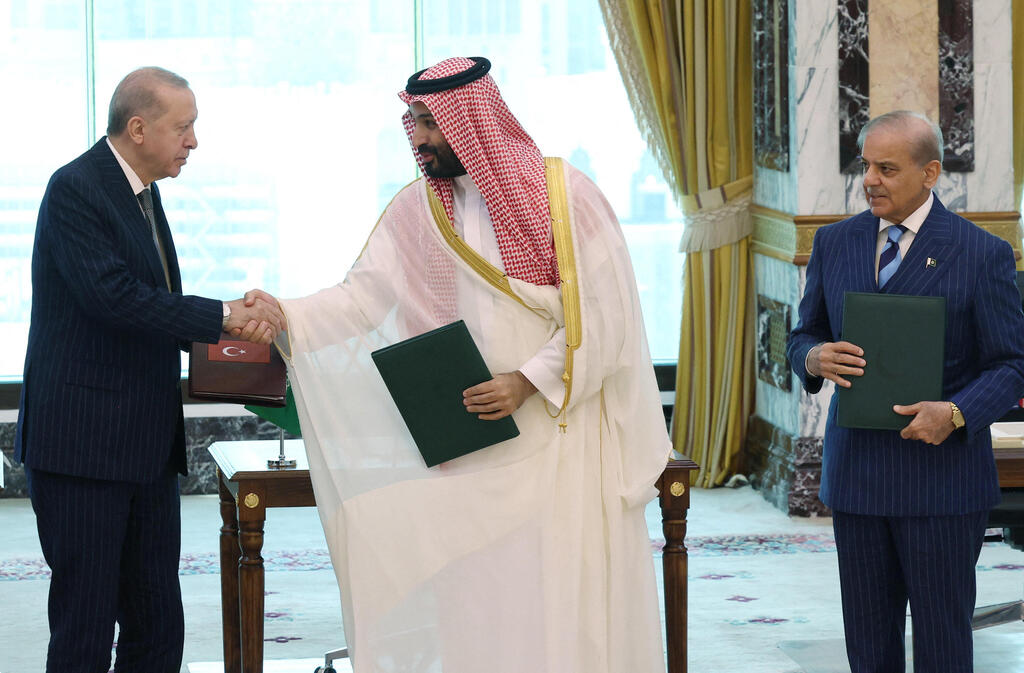
The signing of the agreement between Saudi Arabia, Pakistan and Turkey,
(Photo: Murat Cetinmuhurdar/Turkish Presidential Press Office/Handout via Reuters)
In his remarks Saturday night, Fidan claimed that the agreement, signed Friday, is not directed against Iran. “Iran is not the target of the defense alliance. No one is a target as long as they do not attack member states of the alliance,” he said. He said that “the safety of navigation in the Red Sea concerns our interests, and therefore Turkey must be involved in Saudi Arabia’s international coalition.”
He also noted that “Saudi Arabia, Pakistan and Turkey are not countries with expansionist ambitions. Our president’s vision is not to limit the agreement to these three countries alone, but to expand it and, if necessary, bring all nations under its umbrella.” He added that “cooperation in the defense industry and defense technology is the most important clause in the defense agreement. Talks on the defense agreement in Mecca have been underway for two years and eight months with our partners and with the regional countries with which we signed agreements.”
The agreement was signed Friday during a meeting in Saudi Arabia between Saudi Crown Prince Mohammed bin Salman, Turkish President Recep Tayyip Erdogan and Pakistani Prime Minister Shehbaz Sharif. The agreement, named the “Mecca Joint Defense Agreement,” is the result of nearly a year of contacts among the three countries.
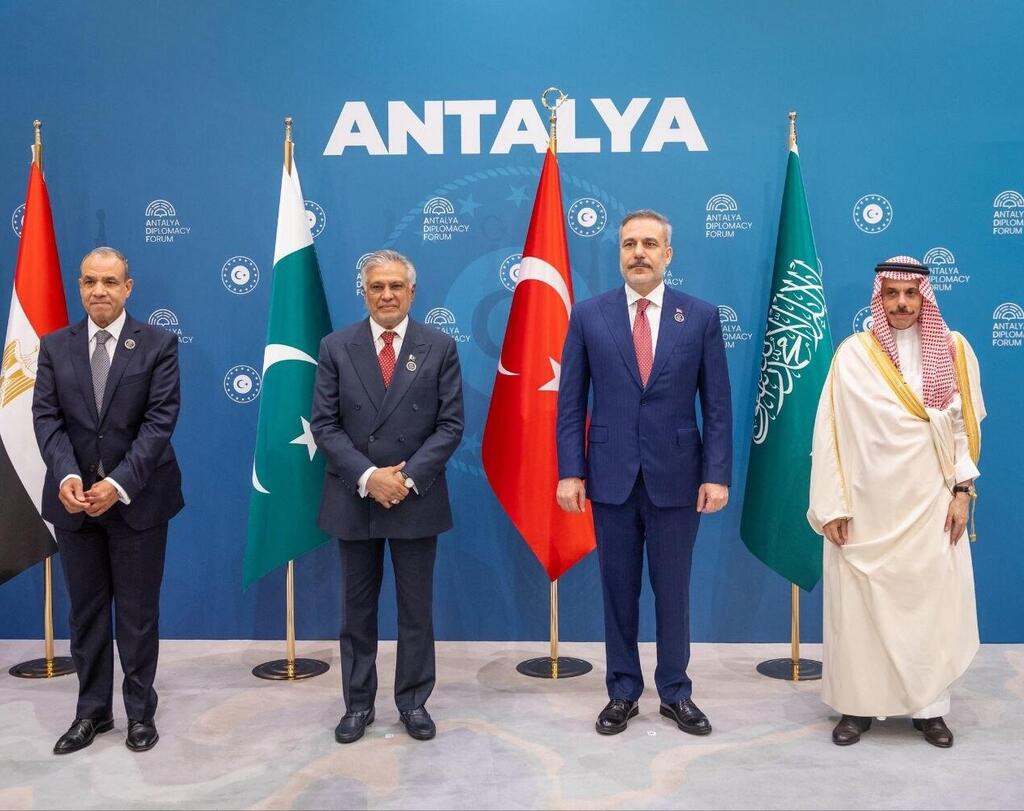
Quadrilateral meeting of the foreign ministers of Saudi Arabia, Turkey, Pakistan and Egypt in April
The signing comes at a time when the three countries are seeking to strengthen their ability to act more independently amid upheaval in the Middle East. Reuters noted Friday that, alongside growing concern over Iran and its proxies, the three countries are also worried about Israel’s military policy in the region, along with increasing doubts about the ability of the U.S., their longtime ally, to contain the escalation.
On Saturday, Pakistani Defense Minister Khawaja Muhammad Asif spoke out against Israel and called on the Islamic world “to unite to confront the shared threat posed by Israel.” Against the backdrop of the new defense agreement, he added: “Israel poses a threat to all of us. Islamic countries must adopt a coordinated approach to confront this threat.”
Signing of the agreement between Saudi Arabia, Pakistan and Turkey
(Video: Reuters)


According to Pakistan, the agreement also stipulates improving all aspects of security cooperation among the three countries — one rich in oil, Saudi Arabia; one a nuclear power, Pakistan; and the third, Turkey, which has the second-largest military in NATO and a rapidly growing defense industry. Turkish media said the agreement is likely to lead to joint military exercises and training among the three countries, as well as intelligence sharing and technological information exchanges.
CNN reported Saturday that, amid the exchange of blows with the Houthis, Iran’s proxies in Yemen, the ayatollah regime sent Saudi Arabia a threatening message that its defense alliance with Turkey and Pakistan would not be able to guarantee its security. The American network quoted a senior Houthi official as saying they are not waiting for instructions from Tehran regarding escalation against Saudi Arabia.
“The instructions against Saudi Arabia do not come from Iran,” the senior Houthi official said. According to him, “the economic and air blockade imposed by Saudi Arabia on the territory controlled by the Houthis created the world’s worst man-made humanitarian crisis. This reason alone is enough to require us to act with great determination.” He later said the Houthi attacks over the past week against the Saudis were preventive, since Riyadh, he claimed, was preparing for a ground invasion of rebel-held territory.