

IDF soldiers and lookouts and security officials are warning that some of the failures that preceded the October 7 attack are resurfacing, according to a new report compiled by families whose relatives were killed, abducted or otherwise affected in the massacre.
The extensive report, published by the October Council and based on testimony from active-duty and reserve soldiers, IDF lookouts, former senior security officials and residents of communities near Gaza, identifies seven warning signs that its authors say could return Israel to what they describe as the mindset of October 6, 2023.
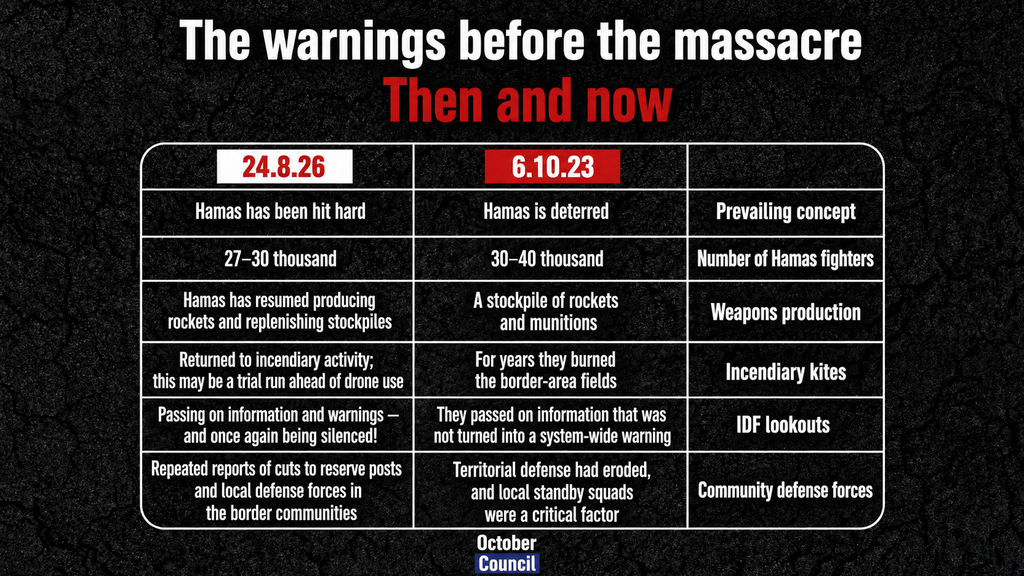
“If even today those who see danger are afraid to speak, that is a security failure in itself,” the report says.
The families argue that while the strategic assumptions have changed since 2023, the underlying tendency to manage rather than eliminate threats remains. Before October 7, Israel relied heavily on the belief that Hamas was deterred. Today, the report argues, a similar dependence has shifted toward arrangements such as the yellow line in Gaza and international mechanisms.
“Hamas has not been disarmed and continues to recruit, manufacture, rebuild and reestablish governing mechanisms,” the report says.
‘They are testing us’
According to testimony from IDF lookouts serving along the Gaza border, Hamas terrorists have repeatedly approached and crossed the yellow line to test how quickly the IDF responds.
The October Council said it obtained footage from August showing crossings of the line, attempts to gather intelligence and what it described as the planting of explosive devices beyond it. The report also cites an IDF document disclosed this month recording 14 violations in a single day, 11 of which were classified as a “developing threat to our forces.”
“Soldiers who spoke with the October Council describe a sense that Hamas is systematically testing the boundaries and the IDF’s response,” the report says.
One reserve officer serving in Gaza said operational restrictions were preventing troops from acting decisively.
Hamas terrorists operating inside the ceasefire line in Gaza


“Don’t tell people stories and don’t beautify reality again in the television studios,” he said. “We are meters from the enemy, we see them with our own eyes, and the orders tie our hands. Instead of defeating them, we ‘contain’ them. Instead of dealing with the root of the problem, we continue managing the failure.”
A soldier in a special unit gave a similar account, saying Hamas operatives could be seen near the yellow line examining the ground and testing IDF behavior.
“They are looking for exactly where we are weak,” he said. “We see everything and we have no authorization to respond.”
Another soldier said Hamas personnel approach the markings, cross them and collect intelligence, while troops are often instructed to contain the incident.
Manpower concerns along the border
The report also warns of strain on IDF manpower, particularly among reserve forces reinforcing border communities.
“In recent months, plans have repeatedly been raised to reduce the reserve forces reinforcing defensive formations in border communities,” the report says, arguing that any reduction should receive particular scrutiny after local security teams and civilian security coordinators became the first line of defense in many communities on October 7.
One soldier described units operating with minimal manpower and struggling to fill gaps.
“We are searching desperately for people to come and fill holes,” he said. “They explained to us that if one incident happens, we have a problem, and if two incidents happen in two communities, one of them will have to manage alone, at least for some time.”
He dismissed assurances that the yellow line provided sufficient protection, calling it “a fiction.”
IDF lookouts say warnings are still being silenced
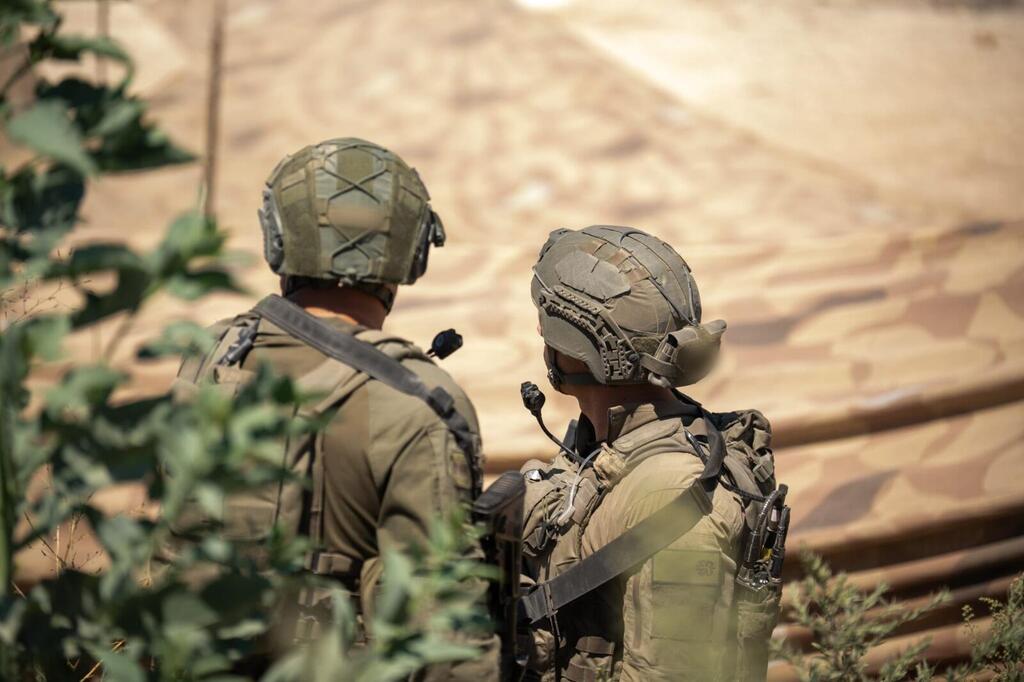
The report places particular emphasis on IDF lookouts, whose warnings about unusual Hamas activity before October 7 were later found to have gone largely unheeded.
The mother of a current IDF lookout in the Gaza sector said Hamas repeatedly tests Israeli reactions by crossing the yellow line.
“Only after a long time is authorization to fire received, and then they disappear for several hours or days and try somewhere else,” she said.
Another mother said her daughter returns home describing both the dangers she sees and the pressure placed on her.
(Photo: IDF)
“The thought that she sits for hours in front of screens, sees the danger approaching and receives threats and silencing simply breaks me,” she said. “History is repeating itself before my eyes, and this time it is my daughter who is there.”
The mother of a former IDF lookout from the Mount Hermon sector said she never felt she could trust the system during her daughter’s service. She said the lookouts had repeatedly been told they would be transferred to a rear base, but remained on the border.
The mother of another former IDF lookout, who served in the West Bank, said her daughter would call for forces that arrived late or sometimes not at all.
“I kept asking, ‘Why is she there if nobody listens?’” she said.
‘The fear of speaking reaches the top’
The October Council said the reluctance to raise warnings is not limited to junior personnel.
Former senior security officials interviewed for the report claimed that criticism and doubts are often expressed privately but softened once formal discussions begin.
“People speak much more freely in the corridors than they do in meeting rooms,” one former senior official said. “Outside you hear doubts, criticism and warnings. When the door closes and the ranks sit around the table, suddenly everyone is much more cautious. The safest place to say ‘you are wrong’ should be the decision-making room.”
(Photo: IDF)
Another former official said security professionals had repeatedly warned before October 7 that Israeli deterrence was eroding but were ignored or silenced.
“The fear of speaking reaches from the bottom all the way to the most senior levels,” he said.
According to the report, another former senior security official said Prime Minister Benjamin Netanyahu had received more than 10 warnings before October 7, some focused specifically on the Jewish holiday period, but dismissed them as exaggerated.
The report also cites criticism that Israel’s longstanding focus on Iran diverted resources and attention from Gaza while Hamas continued strengthening itself. One current senior security official quoted in the report argued that billions were spent on what he described as unrealistic projects while Hamas was allowed to grow stronger.
The October Council argues that the central question is not whether Israeli intelligence and security agencies now possess more information than they did before October 7, but whether the system is capable of confronting uncomfortable information when it appears.
The report closes with a warning from a current senior security official, who said Israelis should ask whether a combination of political leaders who do not present the full picture, weak parliamentary oversight and officers afraid to speak could once again recreate the conditions that existed before October 7.