

Under an agreement reached this week, Israel is expected to release five Lebanese detainees, while the government in Beirut will search Lebanon for the remains of missing Jewish community leaders.
The arrangement brings renewed attention to a campaign of kidnappings and murders carried out by Hezbollah between 1984 and 1986, attacks that dealt a devastating blow to what remained of Lebanon’s Jewish community.

The Prime Minister’s Office said that “as part of the negotiations with Lebanon, Prime Minister Netanyahu instructed officials to advance efforts to locate and return the bodies of the leaders of Lebanon’s Jewish community, martyrs who were abducted and murdered in the mid-1980s by terrorist organizations.”
In the early 1960s, Lebanon was home to about 9,000 Jews. Their situation was still relatively stable at the time, but conditions gradually deteriorated, accelerating emigration and flight from the country.
In 1971, Prof. Albert Elia, 69, secretary of Lebanon’s Jewish community, was abducted in Beirut by Syrian agents. He was held in Damascus alongside Jews who had tried to leave Syria and was later executed there.
By the outbreak of Lebanon’s civil war in 1975, only about 1,800 Jews remained in the country. Many believed their relationships with Muslim and Christian neighbors would protect them and were careful to avoid, as much as possible, any connection with Israel.
On Aug. 15, 1984, about a month before Hezbollah’s formal establishment, the group abducted Lebanese Jewish leader Salim Murad Jamous, 45, a married father of three and secretary-general of the Lebanese Jewish community.
Three gunmen pulled him from his car near the synagogue and Jewish community center in Beirut’s Wadi Abu Jamil district, historically known as the city’s Jewish quarter. The IDF, which had controlled the area during the 1982 Lebanon War, had withdrawn from it about a year earlier. Jamous’ body was never found. He was officially recognized as having been murdered only about 13 years later.
On March 29, 1985, at least four or five prominent members of the Jewish community were abducted in a single night. None returned home alive, though only some of their bodies were eventually recovered.
Among them was Isaac Sasson, 65, president of the community, who was abducted while traveling home from Beirut International Airport. Dr. Elie Hallak, 52, a pediatrician, vice president of the community and lecturer at Beirut’s medical school, was taken from his home in west Beirut. Known as “the doctor of the poor,” Hallak was particularly respected for treating the children of Shiite refugees.
Also abducted were Elie Srour, 68, a member of the community’s burial society; Haim Cohen Halala, 39, an accountant and businessman who was kidnapped at the entrance to his home; and Clement Dana. There may have been several additional victims.
‘The Jews are Mossad agents’
About a month after that night of abductions, Isaac Tarab, 70, an emeritus professor of mathematics at the École des Lettres Françaises de Beyrouth, also disappeared. The precise circumstances and date of his disappearance remain unclear.
In July 1985, Raul Mizrahi, who had replaced Sasson as acting president of the community, was abducted. His body was found 10 days later.
The first known contact between the kidnappers and the families came in September 1985, when Hallak’s wife received a phone call from her husband and Sasson. They told her that they and several other abducted Jewish leaders were being held together and were still alive.
In November 1985, a Hezbollah front organization calling itself the Organization of the Oppressed on Earth claimed responsibility for the kidnappings. It sent a letter to the Lebanese newspaper An-Nahar, along with photographs of four of the Jewish captives.
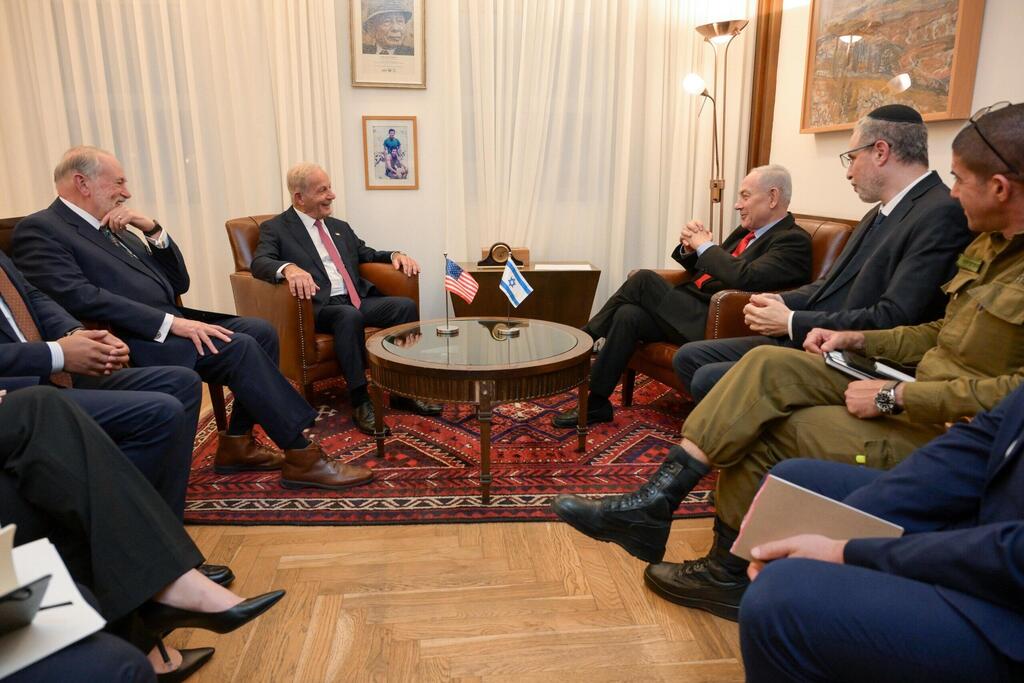
Prime Minister Benjamin Netanyahu meets US Ambassador to Lebanon Michel Issa and US Ambassador to Israel Mike Huckabee, who are leading talks between Israel and Lebanon
(Photo: GPO)
The group accused the Jews of being Mossad agents and demanded that Israel complete its withdrawal from Lebanon and release 300 prisoners being held at the time by Israel and/or the South Lebanon Army.
The four hostages pictured were Sasson, Srour, Cohen Halala and Tarab. The other abducted Jews were not mentioned.
Israel’s national unity government, still led at the time by Prime Minister Shimon Peres, refused even to enter negotiations, much less release the prisoners. Hezbollah then began killing the Jewish captives it was still holding alive. Haim Cohen Halala was the first of the four to be murdered. In December 1985, his body was dumped on a Beirut street corner with a gunshot wound to the head.
Soon afterward, on Dec. 31, 1985, Tarab’s body was also found. On Feb. 15, 1986, Hezbollah abducted Yehuda Benisti, 68, a former manager at Safra Bank in Beirut, and his son Ibrahim Benisti, a 34-year-old Jewish physician, in west Beirut. Another son, Yusuf Benisti, had been kidnapped earlier at an unknown date.
The fate of only one of the three, Ibrahim, is known with certainty. His body was found several days later. He had been severely beaten and tortured before being strangled and shot dead. About a week later, still in February, the kidnappers announced that they had carried out their threats and murdered Dr. Hallak as well.
They sent newspapers a photograph of his body after he had been shot in the head, although the body itself was never recovered. The kidnappers demanded the release of prisoners held by Israel in exchange for returning his remains.
Accounts from other hostages, including Americans and French nationals, indicated that Hallak had served as their doctor while in captivity. He was reportedly killed only after Hezbollah abducted another physician to replace him.
None of the other missing captives were ever found, and their fate has never been established with certainty. Under the new arrangement, the Lebanese government is now expected to search for their remains.