


More than 3.5 million people visited an Israeli government website documenting the atrocities of the Hamas-led October 7 attacks in the four months following Prime Minister Benjamin Netanyahu’s address to the United Nations in September, according to newly released data.
The figures were disclosed by the Prime Minister’s Office in response to a Freedom of Information request filed by the Movement for Freedom of Information and obtained by ynet.
Gallery
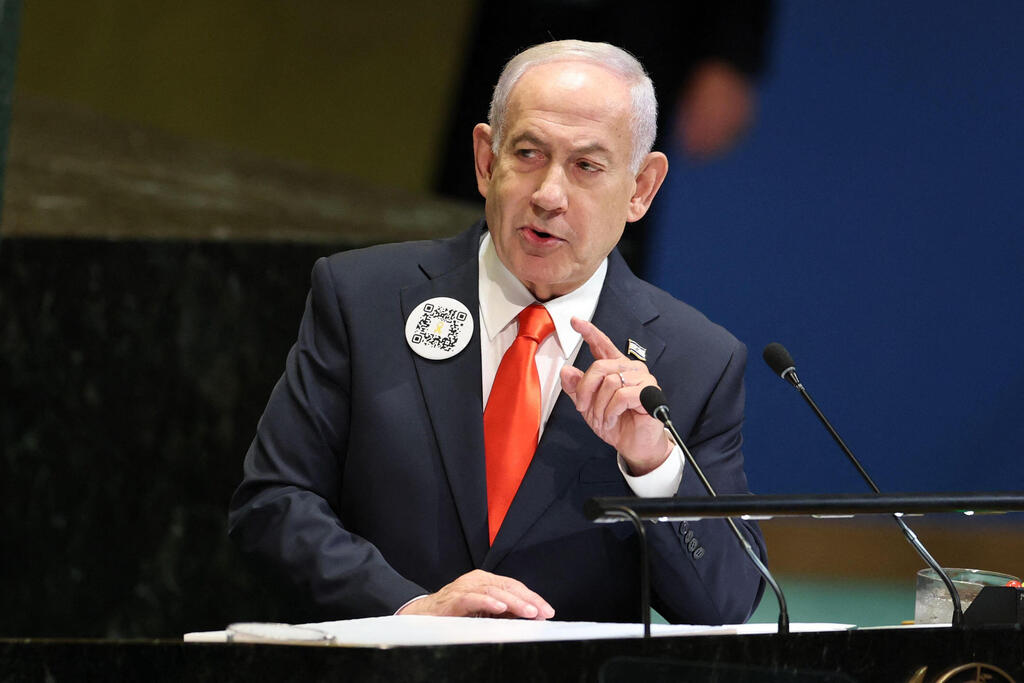
Prime Minister Benjamin Netanyahu wears a QR code pin leading to a government website documenting the atrocities of the Hamas-led October 7 attacks during his United Nations address
(Photo: ANGELA WEISS / AFP)
During his UN speech, Netanyahu urged the international community to scan a QR code pinned to his lapel—a badge symbolizing the hostages taken during the attack. The code linked to what the Prime Minister's Office dubbed the “atrocity site,” part of Israel’s global public diplomacy campaign. The site was made available only outside of Israel.
According to the data, the website saw 3.5 million users between Netanyahu’s speech and late January. Of those, around 1.7 million were first-time visitors. Collectively, users generated 51 million page views, with an average visit lasting 3 minutes and 40 seconds—about 14 pages per user.

From the website
That marked a significant uptick from pre-speech figures. Between the site’s launch and the September UN address, it had received 4 million visitors who generated 19.2 million page views—averaging 1 minute and 19 seconds per visit, or roughly 5 pages per user.
The new data also includes a breakdown of traffic by country. Brazil topped the list with approximately 522,000 users, followed by the United States (185,000), Italy (152,000), China (122,000) and Germany, Spain and Argentina with tens of thousands each.
From the website
Surprisingly, Iran appeared on the list with an estimated 53,000 visits, while roughly 10,000 visits originated from Israel, despite the site being officially inaccessible from within the country. Other notable entries include the Palestinian Territories (2,249 visits), Russia (9,500), Iraq (6,900), Turkey (nearly 5,000) and several thousand users from South Africa, Thailand, the UAE and Ukraine.
Even countries with tightly restricted internet access showed up in the data: around 1,000 visits came from Qatar, several hundred from Syria and Saudi Arabia, two from North Korea and just one from Vatican City.
 Attorney Yaara Winkler-Shalit
Attorney Yaara Winkler-Shalit of the Movement for Freedom of Information said the data raises questions. “The information we received from the Prime Minister’s Office raises several issues, such as the classification of some countries under ‘Other’ and the sharp differences in viewership before and after the speech,” she said. “These questions warrant further investigation, and we will continue to act in accordance with the law to promote full governmental transparency.”
Still, she added, the released figures are “of great importance to the Israeli public and to Israel’s interests abroad, and it is good that the Prime Minister’s Office has disclosed them.”