

An end to decades of conflict? After four days of negotiations in Washington, Israel and Lebanon signed a framework agreement Friday night that will be closely overseen by the U.S. military. The timetable for the agreement remains unclear, as does the exact scope of the enclaves or pilot areas from which the IDF is expected to withdraw. But the full text released by the White House emphasized that Israel and Lebanon declare their aspiration to begin a process that would end decades of armed conflict and establish peace.
Unlike the agreement reached in November 2024, this deal will be closely accompanied by the U.S. military, which will also train and strengthen the Lebanese army. For that reason, Israeli officials argue, the new agreement has a better chance of success than the previous one. It should be noted that after the 2024 agreement, an oversight command was also established with the participation of American, French, Lebanese and Israeli officials.
The signing of the framework agreement between Lebanon and Israel
(Video: Reuters)



The text of the agreement
The agreement stresses that Israel has no territorial ambitions in Lebanon and is operating militarily on Lebanese territory only because of the need to remove threats posed by Hezbollah and other terrorist organizations. At the same time, while the agreement effectively rejects Tehran’s effort to turn Lebanon into an inseparable arena under its influence, Iran is not mentioned in the document at all. Lebanon’s government, however, “rejects the claims of any state to use force on its behalf.”
The document also states that Israel and Lebanon, with the full support of the United States under President Donald Trump, affirm their shared goal of achieving lasting peace and security. The agreement includes 14 clauses, the first of which clarifies that each side recognizes the other’s right to peaceful existence and their shared desire to live securely as neighboring sovereign states.
The second clause explains that the process will be reciprocal, phased and based on clear conditions, under which the Lebanese Armed Forces will restore effective sovereign authority over all Lebanese territory, subject to the verified disarmament of nonstate armed groups and the dismantling of their related infrastructure. This would allow the IDF to gradually redeploy its forces outside Lebanese territory. The following clause states that the Lebanese army will gradually assume full and effective security responsibility in pilot areas, which will serve as a mechanism for the phased and verified redeployment of IDF forces and the deployment of Lebanese army forces.
The next clauses address Lebanon’s commitment to restore full sovereignty over all its territory and disarm armed groups, as well as Israel’s clarification that its military operations in Lebanon are solely the result of attacks, threats and hostile intentions by nonstate armed groups, especially Hezbollah.
The agreement states that Israel believes removing the threat through the disarmament and dismantling of these groups across Lebanon, along with additional security arrangements to be agreed upon by the two countries, would eliminate any future need for IDF military action or presence in Lebanon. It also says Israel has no territorial ambitions in Lebanon.
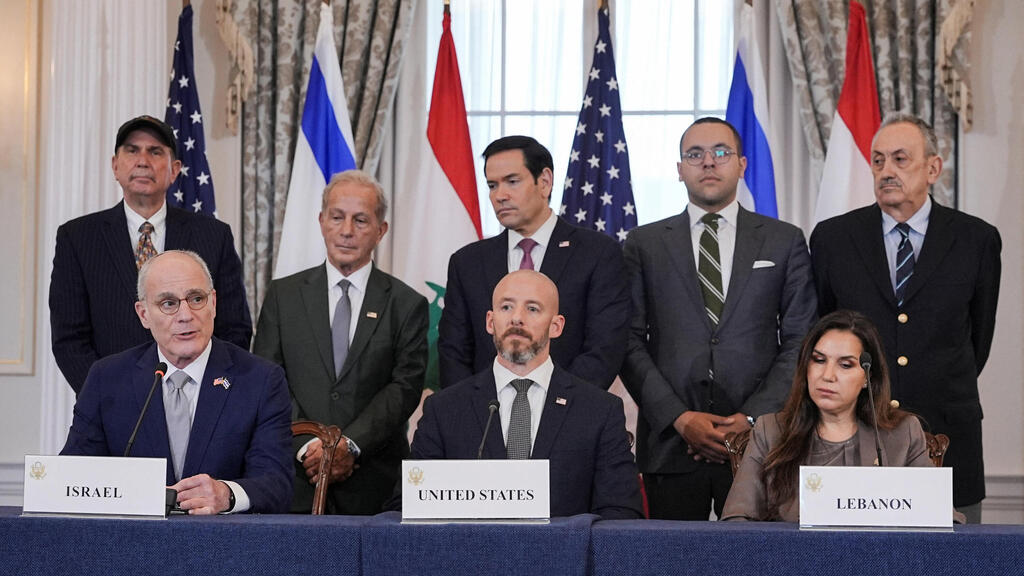
The signing of the agreement between Lebanon and Israel
(Photo: REUTERS/Ken Cedeno)
Later in the document, Lebanon rejects the claims of any state or nonstate actor to use force on its behalf without its explicit authorization, and reaffirms that any claim by a state or nonstate actor to play a military or security role is illegal under decisions of the Lebanese government and contrary to Lebanon’s national interests. The sides also agreed to establish a military coordination group, with U.S. support and participation, to ensure the overall implementation of the framework.
The agreement also states that the United States will mobilize international partners to actively support Lebanon’s government in rebuilding the country, repairing infrastructure, restoring the economy and creating opportunities for prosperity. In addition, Lebanon and the United States pledge to prevent the flow of funds to any entity, organization or individual affiliated with nonstate armed groups, and to take all legal measures at their disposal to outlaw the activities of any such entity, organization or individual. Lebanon’s government explicitly commits to preventing reconstruction funds from reaching nonstate armed groups or entities linked to them.
The diplomatic significance
The document signed by Israel and Lebanon, with U.S. mediation, is not yet a peace agreement. Rather, it is a framework agreement that defines the principles and road map for a future peace accord. For the first time, Lebanon commits in an international document to the full dismantling of all armed organizations not subordinate to the state. Israel, for its part, declares that it has no territorial claims in Lebanon and that its withdrawal will depend on the removal of the Hezbollah threat. At the same time, both countries declare an aspiration to formally end the state of war between them and move toward peaceful neighborly relations.
The withdrawal areas and the points where the IDF will remain
According to Israeli officials, the IDF will remain for now along the yellow line, will not withdraw from Beaufort Castle and Lebanese residents will not return to their homes. As in the past, the Lebanese army is again committed to dismantling terrorist infrastructure in those pilot areas. If implementation succeeds to Israel’s satisfaction, additional areas will be added.
One of the areas from which the IDF will withdraw is north of the Litani River and north of the yellow line. As for the second area, it may be one of the areas the IDF recently captured beyond the yellow line, as part of an effort to expand the territory under Israeli control and use it as a bargaining chip in negotiations, namely territory from which Israel can later withdraw. In any case, if the agreement succeeds and the Lebanese army takes control of areas that become demilitarized zones without Hezbollah operatives, the IDF will also withdraw from areas along the yellow line.
The economic incentive and the mechanism
U.S. Secretary of State Marco Rubio announced Friday night that the United States will provide Lebanon with $130 million.
Rubio said the United States praised both governments for taking what it described as a courageous step toward ending the cycle of violence. He said Washington would remain fully involved and commit significant resources, including $100 million in immediate humanitarian aid coordinated with the United Nations.
He added that the United States intends to strengthen the Lebanese army’s capabilities and readiness so it can more effectively assert sovereignty across Lebanon. To that end, he said the War Department is prepared to reimburse the Lebanese Armed Forces with more than $30 million under existing authorities and appropriations, as part of the president’s vision for lasting peace in Lebanon.
Under the new agreement, a trilateral Israeli-Lebanese-American military coordination mechanism will be established to enable implementation. However, this is not the first time an international mechanism has tried to bring about the demilitarization of southern Lebanon, and this time, too, no one is under the illusion that the Lebanese army will act against Hezbollah. Even if the United States strengthens it, the Lebanese army remains very weak, and its chief of staff is not interested in a confrontation with the terrorist organization.
On paper, this is a better agreement than the previous one in the sense that it includes a firmer American commitment. On the other hand, Rubio appears to have been eager to show an achievement, and once again the Americans did not truly get into the details. Against the backdrop of negotiations with Iran, the United States may be trying to present a framework agreement that signals to Tehran that it is seeking to preserve the cease-fire in Lebanon.
Reactions in Lebanon and Israel, and Hezbollah’s rejection
Shortly after the agreement was signed, Lebanese Prime Minister Nawaf Salam said Friday night that the framework reached with Israel “aims to achieve an Israeli withdrawal from all Lebanese territory and restore the sovereignty of the state.” Lebanese President Joseph Aoun also thanked the United States for its efforts in hosting and sponsoring the negotiations, and for “supporting Lebanon’s position in reaching the step announced today.” Lebanon’s presidency said he also thanked the countries that accompanied the talks, the Lebanese team and the Lebanese people, adding that the framework agreement signed was the first step toward “realizing the fruits of the people’s sacrifice, toward their return to their land.”
Prime Minister Benjamin Netanyahu issued a statement after the agreement was signed, after repeatedly pledging in recent weeks, along with Defense Minister Israel Katz, that “the IDF will not withdraw from the security zone in Lebanon.” Netanyahu called the agreement “a major achievement for the State of Israel” and said the prolonged negotiations in Washington “bore fruit.”
“The most important thing is that Israel remains in the security zone in southern Lebanon. This is a major achievement, and we will maintain it as long as Hezbollah is not disarmed, as long as there is a danger to the State of Israel,” he said.
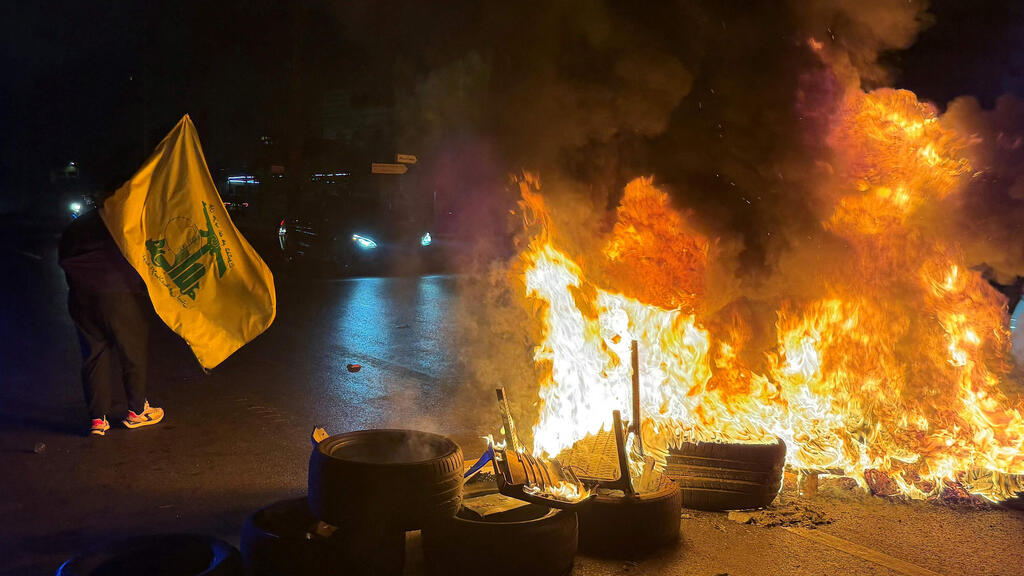
The riots in Beirut
(Photo: Ibrahim AMRO / AFP)
Hezbollah supporters riot in Beirut overnight
As part of the memorandum of understanding signed between the United States and Iran in France, Tehran pressured Washington and forcibly created the “unity of fronts” that Israel had sought to avoid, leading to a cease-fire in Lebanon as well. Netanyahu now argues that the agreement signed Friday night in Washington is “a major blow to Iran, which is trying to force us to withdraw from southern Lebanon by force. In effect, Israel, Lebanon and the United States are telling them: This is none of your business. You have no role in Lebanon. Neither you nor Hezbollah nor any terrorist organization.”
“The additional thing, of course, is that we are enabling the Lebanese army to begin organizing to take control of territory,” Netanyahu said. “We are creating two pilot areas. Both are based on the IDF’s recommendation. One is entirely outside the security zone, south of the Litani, and the other is north of the Litani, a small part of it in the expanded security zone we obtained in the past two weeks, and which the IDF does not need. It says that in the clearest way.”
Netanyahu concluded: “We are constantly preserving the original security zone outside anti-tank missile range. We are not allowing Hezbollah to enter there, nor the population. That is being maintained. And the most important thing is that Israel says: Our security comes before everything.”
Hezbollah has yet to officially comment on the agreement, but Hassan Fadlallah, a Lebanese lawmaker from the terrorist organization, said Friday night that Hezbollah remains opposed to direct negotiations with what it calls the Israeli enemy. He warned that the political and security track of the talks undermines Lebanese sovereignty and risks creating dangerous internal divisions, and called on the authorities to abandon direct negotiations and reverse what he described as decisions made against the people.
Al Mayadeen, a network affiliated with Hezbollah, published additional remarks by Fadlallah, who said Netanyahu had effectively negotiated with himself. He argued that the Lebanese authority behind the agreement lacks constitutional legitimacy and the means to impose its terms, and would therefore be unable to enforce the deal. Fadlallah said the decisive factor would be control on the ground, which he claimed Hezbollah holds. He also said Iran’s position was clear and that it would not sign any agreement before an Israeli withdrawal from Lebanon. He accused the government of giving Israel a gift that, in his view, would have no effect on the ground.