

President Isaac Herzog continued consultations Thursday with the newly elected parliamentary factions ahead of deciding who will be tasked with forming the country's next government, with Yashar! party leader Gadi Eisenkot expected to secure more endorsements than Prime Minister Benjamin Netanyahu.
Eisenkot, a former IDF chief, is projected to receive the backing of 56 lawmakers in the 120-seat Knesset, compared with 46 for Netanyahu, whose Likud party is seeking to retain power despite the election results.
Gallery
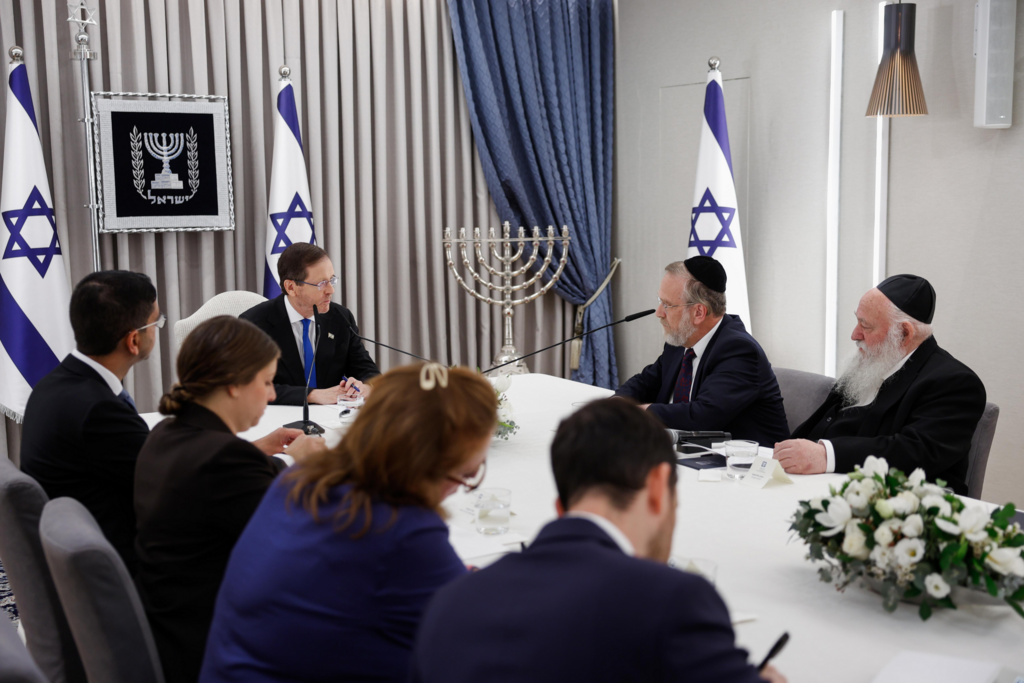
President Isaac Herzog meets with United Torah Judaism representatives for consultations at the President's Residence in Jerusalem
(Photo: GPO)
The consultations, which began Wednesday, are expected to conclude Thursday evening, after which Herzog will determine which candidate has the best chance of assembling a governing coalition.
Under Israel's parliamentary system, the president consults representatives of the parties elected to the Knesset before assigning a lawmaker the task of forming a government. The decision is not automatically determined by which candidate receives the most endorsements. Instead, the president must assess who is most likely to secure the support of a parliamentary majority.
A governing coalition generally requires the backing of at least 61 lawmakers.
Unlike previous rounds of consultations, Herzog began Wednesday with representatives of smaller parties and scheduled the largest factions for the final meetings Thursday.
Most parties had announced their preferred candidate before arriving at the President's Residence in Jerusalem, leaving United Torah Judaism and the Joint List as the principal uncertainties.
Eisenkot leads endorsements, but coalition remains elusive
Wednesday's consultations established the initial balance of support between the two leading candidates.
Netanyahu received endorsements from the Religious Zionist Party, Zehut and Shas, while Avigdor Liberman's Yisrael Beytenu endorsed Eisenkot.
Among the parties scheduled to meet Herzog Thursday, Ra'am, the Democrats, Beyachad and Yashar! have announced their support for Eisenkot.
Otzma Yehudit and Likud are expected to endorse Netanyahu.
The Joint List, an alliance representing predominantly Arab voters, has not announced which candidate it intends to recommend.
United Torah Judaism, meanwhile, decided not to endorse either candidate, despite efforts by Netanyahu to secure support from lawmakers associated with the party's more right-wing faction.
The ultra-Orthodox alliance consists of two factions, Agudat Yisrael and Degel HaTorah, both of which had initially announced they would refrain from recommending a candidate.
However, speculation intensified Wednesday that two former Agudat Yisrael lawmakers, Meir Porush and Eliakim Stark, would break ranks and endorse Netanyahu after being approached by the prime minister.
The two are considered part of United Torah Judaism's right-wing wing and were seen as potential supporters of Netanyahu's bid to remain in office.
Despite the pressure, the party ultimately decided as a whole not to recommend any candidate.
The decision leaves Eisenkot on course to finish the consultations with a significant advantage in endorsements, although his projected 56 supporters would still fall short of the 61 seats needed for a parliamentary majority.
Ultra-Orthodox party refuses to back either candidate
United Torah Judaism's representatives were the first to arrive at the President's Residence on Thursday morning.
The delegation included lawmakers Yitzhak Pindrus, Yitzhak Goldknopf and Moshe Rosenthal, along with party secretary Amitai Shulman and Goldknopf's aide, Moti Babchik.
Opening the meeting, Herzog emphasized the importance of dialogue across political divisions.
"In this building, everyone is allowed to say anything and meet with anyone," the president said.
The discussion quickly turned to one of Israel's most divisive domestic issues: military conscription for ultra-Orthodox Jewish men.
The question has become increasingly contentious amid a severe shortage of soldiers in the Israel Defense Forces following years of war.
For decades, many ultra-Orthodox men studying full time in religious seminaries, known as yeshivas, have been exempted or granted deferments from compulsory military service.
The arrangement has faced growing legal challenges and public criticism, particularly as the military seeks additional personnel.
Pindrus raised concerns about what he described as incitement against the ultra-Orthodox community and the treatment of religious students amid demands to expand military recruitment.
Asked by Herzog what United Torah Judaism expected from the next government, Pindrus said any administration would need to address what he called "a reality in which Torah scholars are persecuted."
Herzog pressed the delegation on whether it would support a framework requiring ultra-Orthodox men who are not engaged in religious study to enlist.
"Do you have a conscription framework? Do you agree that those who are not studying should enlist?" Herzog asked.
Pindrus responded that United Torah Judaism's longstanding position was based on the principle of Torato Umanuto, a Hebrew phrase meaning that Torah study is a person's full-time occupation.
"The traditional position of United Torah Judaism is that the arrangement applies to those whose Torah study is their occupation," Pindrus said.
Goldknopf later emphasized that the party was not committed to either political camp.
"We are not obligated to any bloc," he said.
The declaration reinforced the party's decision to withhold an endorsement and suggested that its eventual coalition position could depend on negotiations over religious and other policy issues.
Herzog challenges party over military exemptions
Herzog continued questioning the ultra-Orthodox representatives about whether they were prepared to support a new conscription law capable of winning broader public and political acceptance.
"Do you have a framework that differs from what existed until now, meaning the possibility of legislating a conscription law that could achieve broader agreement?" Herzog asked.
He also sought a clear answer on whether the party believed ultra-Orthodox men who do not study Torah should be required to serve.
Pindrus insisted that the party's position had remained consistent since Israel's establishment in 1948.
"United Torah Judaism's position has not changed since the establishment of the state, that the arrangement concerns those whose Torah study is their occupation," he said.
Pindrus added that the legislative framework governing the issue had previously been established in law and subsequently changed following the Tal Law, legislation that sought to regulate military service deferments for ultra-Orthodox yeshiva students.
Herzog challenged that account, pointing to an earlier expansion of exemptions under the government of former prime minister Menachem Begin.
"It changed under Begin's government, when the coalition agreement determined that everyone would be exempt instead of having a quota," Herzog said.
The exchange reflected the longstanding dispute over the historical basis and scope of military exemptions for ultra-Orthodox men.
The issue has repeatedly destabilized Israeli coalition governments, with ultra-Orthodox parties demanding protections for religious study while other political factions seek to expand military service obligations.
President points to existing ultra-Orthodox military units
Herzog argued that the military already offers models designed to accommodate the religious requirements of ultra-Orthodox soldiers.
He cited a visit to the IDF's Hasmonean Brigade, a military formation established specifically for ultra-Orthodox recruits.
"On the eve of Tisha B'Av, I visited the Hasmonean Brigade and saw a fully ultra-Orthodox brigade operating under General Staff orders," Herzog said.
Tisha B'Av is an annual Jewish day of mourning commemorating the destruction of the ancient temples in Jerusalem and other tragedies in Jewish history.
"There are models in which ultra-Orthodox soldiers can find their place as ultra-Orthodox Jews," Herzog said.
During the discussion, Herzog also raised the importance of planning for future generations and the issue of core curriculum studies in ultra-Orthodox educational institutions.
Many ultra-Orthodox schools place heavy emphasis on religious instruction, and the extent to which they teach subjects such as mathematics and English has long been a subject of political debate.
Pindrus expressed reservations about the prospect of what he called "social change," saying his party was instead hoping for "economic change," highlighting the party's preference for addressing economic challenges within the ultra-Orthodox community without fundamentally altering its religious and social structure.
Otzma Yehudit endorses Netanyahu, alleges election fraud
Representatives of the far-right Otzma Yehudit party were next to meet Herzog, with lawmakers Limor Son Har-Melech, Yitzhak Wasserlauf, Yitzhak Kroizer and Amichai Eliyahu attending the consultations.
Wasserlauf opened with a political statement highlighting the party's achievements in the outgoing government before formally endorsing Netanyahu to form the next government, as expected. He then demanded that Herzog require every party attending the consultations to explicitly recognize Hamas as a terrorist organization.
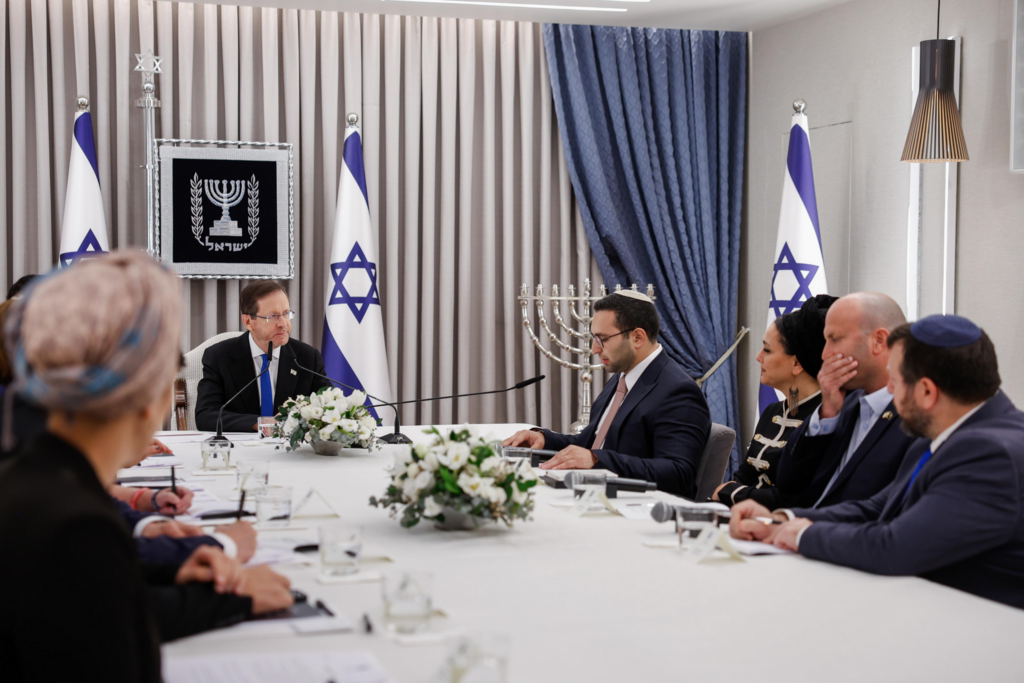
President Isaac Herzog meets with Otzma Yehudit representatives for consultations at the President's Residence in Jerusalem
(Photo: GPO)
Against the backdrop of an investigation into suspected foreign interference in the election, Wasserlauf repeated unsubstantiated allegations of election fraud and accused Arab parties of benefiting from purchased votes.
"We speak on behalf of our voters and many others who have no confidence in the election results because some of the votes were bought with money to benefit lists that do not recognize Hamas as a terrorist organization," he claimed, presenting the allegations as fact without providing evidence.
Herzog pushed back sharply. "All of this is speculation. There is no evidence or proof," the president said. "In the legal system, suspicions must be substantiated. We must be careful because people make assertions that sometimes end up amounting to nothing. A team of leading legal experts has been established, and the matter must be investigated thoroughly."
Son Har-Melech also questioned the election's legitimacy, claiming that "the public does not believe the election results."
Herzog urged the lawmakers not to generalize about Israel's entire Arab population. He also questioned whether Otzma Yehudit's allegations were intended to shift attention away from another possible explanation for the high Arab voter turnout: opposition to the policies of party leader Itamar Ben-Gvir during his tenure as national security minister.
Kroizer rejected the suggestion, arguing that the turnout reflected Ben-Gvir's effectiveness.
"That is a badge of honor for Minister Ben-Gvir," he said. "For 40 years, they lived in lawlessness and the law was not enforced. Finally, Minister Ben-Gvir came along and enforced the law."