


President Isaac Herzog began consultations with political parties Wednesday to determine who should be tasked with forming the next government, launching a crucial stage in the coalition-building process after an election that left neither of the leading candidates with a clear parliamentary majority.
Herzog will meet representatives of all parties elected to the 120-seat Knesset through Thursday evening before deciding which candidate has the best chance of assembling a governing coalition.
Gallery
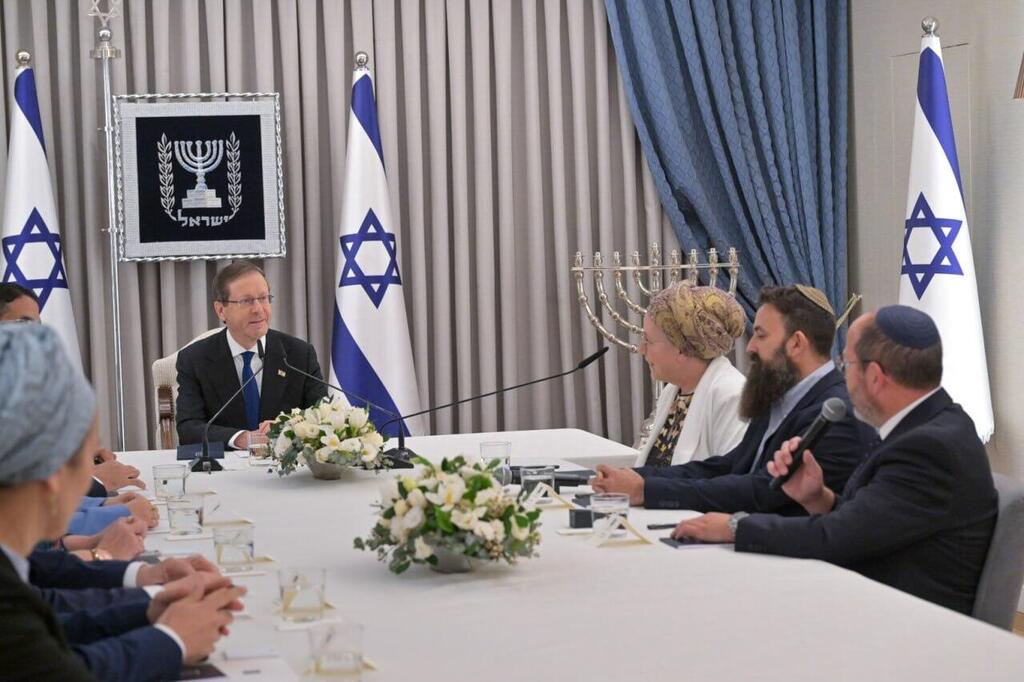
President Isaac Herzog meets with representatives of the Religious Zionist Party in the President's Residence in Jerusalem
(Photo: GPO)
Under Israel's parliamentary system, the president consults party leaders following an election and assigns the task of forming a government to the lawmaker considered most likely to secure the support of a parliamentary majority. The mandate does not automatically go to the leader of the largest party or the candidate receiving the most recommendations.
Former military chief Gadi Eisenkot, who leads the centrist Yashar! party, is currently expected to receive recommendations from 48 lawmakers representing Yashar!, Beyachad, the Democrats and Yisrael Beytenu.
Prime Minister Benjamin Netanyahu, who leads the Likud party, is projected to receive 46 recommendations from Likud, the far-right Otzma Yehudit and the Religious Zionist parties and the ultra-Orthodox Shas party.
The Joint List, the Islamist Ra'am party and the ultra-Orthodox United Torah Judaism party have yet to announce whom they will recommend.
The outstanding recommendations could prove decisive in determining which candidate receives the mandate. Neither Eisenkot nor Netanyahu currently has the 61 seats needed for a parliamentary majority, raising the prospect of difficult coalition negotiations.
In a departure from previous consultation rounds, Herzog began Wednesday's meetings with smaller parliamentary factions and will conclude Thursday evening with the largest parties.
Representatives of the Religious Zionist Party were the first to meet the president Wednesday, followed by Shas, Yisrael Beytenu and Zehut. Thursday's consultations will include United Torah Judaism, Otzma Yehudit, the Democrats, Ra'am, the Joint List and Beyachad, before concluding with Yashar! and Likud.
The talks began against the backdrop of an increasingly contentious investigation into suspected foreign interference in the election, including allegations involving the Palestinian Authority and senior Arab political figures.
Herzog clashes with right-wing lawmakers over Arab parties
Religious Zionist Party representatives confirmed at the start of their meeting that they would recommend Netanyahu for prime minister.
Orit Strock, a senior figure in the party, expressed concern over allegations being investigated by the Shin Bet domestic security agency and police, calling for a thorough investigation without restrictions.
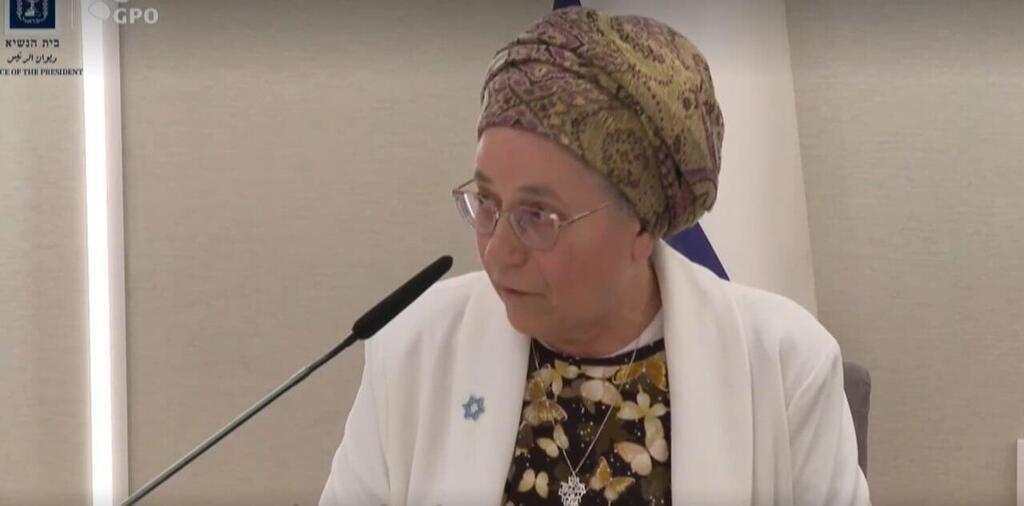
Orit Strock
(Photo: GPO)
"We are concerned about the suspicions being investigated by the Shin Bet and the police, and we call for the investigation to be fully pursued without obstacles," Strock said.
She also argued that Arab nationalist parties should not be considered legitimate partners in forming a government or removing the Knesset speaker.
Strock insisted her objection was not based on the parties' Arab identity but on what she described as their nationalist ideology and attitudes toward Israel's establishment.
Herzog challenged her remarks, asking: "How do you distinguish between racism and what you're saying?"
Strock responded by pointing to the election results, arguing that Arab voters had rejected candidates who supported Israel's national character, including Yoseph Haddad, an Arab Israeli who served in the IDF.
Herzog pushed back against the generalization, pointing to the background of a senior Ra'am figure who had served in a senior police position.
"We need to understand that we live with Arab citizens in Israel," Herzog said. "This generalization deeply troubles me."
The exchange grew more heated when another Religious Zionist Party representative, Zvika Mor, suggested that Arab political leaders were seeking to gain control of the country from within.
Herzog warned that such accusations were dangerous.
"Claiming that the other side is taking over the country from within is a very dangerous statement. It casts suspicion on them," the president said.
Mor denied making an unfounded accusation and cited statements by Ra'am leader Mansour Abbas that he interpreted as expressions of Palestinian nationalist aspirations.
"We need to remind ourselves of the obvious: This country is first and foremost a Jewish state," Mor said, adding that Israelis also had a responsibility to respect those living among them.
Herzog welcomed that acknowledgment but said it also required condemning racism.
Mor argued that some Arab political leaders were advancing nationalist goals incompatible with Israel's Jewish identity.
The president countered that Arab political figures had demonstrated a willingness to participate in Israeli society and politics.
"You can see an attempt to extend a hand, a desire to integrate," Herzog said.
Mor questioned the motivations behind that integration, accusing Abbas and other Arab leaders of promoting Palestinian nationalism rather than genuine participation in Israeli society.
Strock went further, accusing Arab political leaders of seeking to undermine Israel through what she described as "civil jihad."
Herzog again intervened. "God forbid that a racist message should emerge from here," he said. "This is being broadcast to the entire world, and that is not who we are."
Strock rejected the characterization, insisting that her remarks were not racist.
The discussion also touched on demands for a state commission of inquiry into the failures that led to the October 7, 2023, Hamas-led attack on southern Israel, a politically contentious issue in Israel.
Mor argued that changes in the Supreme Court over the past three decades and the country's deep political divisions made it necessary to reconsider the existing framework for appointing such commissions. He said any inquiry should be structured so that citizens across the political spectrum felt represented.
Herzog responded that his concern was precisely the involvement of politics in the process.
Shas backs Netanyahu amid heated debate over military service
Representatives of the ultra-Orthodox Shas party recommended Netanyahu during their meeting with Herzog, while sharply criticizing what they described as years of incitement against the ultra-Orthodox community.
Shas lawmaker Michael Malkieli said the previous government's four-year term had been marked by hostility toward Torah scholars.
"Suddenly we're no longer parasites. Suddenly those same politicians are talking about a new dialogue," Malkieli said, referring to recent suggestions that ultra-Orthodox parties could join an alternative coalition.
He argued that Shas had never belittled IDF soldiers and said any reconciliation must begin with recognition of the value of religious study.
Herzog challenged the party's position, questioning whether its electoral setbacks reflected more than what Malkieli described as incitement.
"Perhaps there were other factors? Is there any soul-searching?" Herzog asked.
The president also raised the burden borne by families whose members serve on the front lines, arguing that Shas had failed to adequately confront the tension between military service and religious exemptions.
Shas lawmaker Yinon Azulai acknowledged the hardship facing military families but said those studying Torah should be allowed to continue, while the military should establish suitable service arrangements for others.
Asked about reports that Shas chairman Aryeh Deri had sought to resign, Malkieli said the party's Council of Torah Sages continued to give him its full backing and expected him to lead the movement for years to come.
Herzog also asked why Shas was not advocating a unity government. Malkieli replied that Netanyahu should be given the mandate and expressed hope that he could assemble a coalition of at least 61 lawmakers.
Shas lawmaker Yoav Ben Tzur, meanwhile, defended the rights of Arab citizens, saying they were an integral part of Israeli society and deserved equal treatment.
Ra'am backs Eisenkot as some ultra-Orthodox factions withhold endorsements
The Islamist Ra'am party announced that it would recommend Eisenkot to form the next government, strengthening his position in the contest with Netanyahu for the presidential mandate.
Shortly afterward, Rabbi Dov Landau, a leading ultra-Orthodox spiritual authority, instructed the Degel HaTorah faction not to recommend either candidate. The party later formally confirmed its decision.
Agudat Yisrael chairman Yitzhak Goldknopf also announced that he would refrain from endorsing a candidate. However, Meir Porush and Eliakim Stark, who broke away from Agudat Yisrael to establish a new faction within United Torah Judaism, are expected to recommend Netanyahu. The two are considered part of the alliance's right-wing bloc.
Yisrael Beytenu endorses Eisenkot but rules out reliance on Arab parties
Yisrael Beytenu formally recommended Eisenkot during its consultations with Herzog, with party representative Oded Forer arguing that the former IDF chief had the best chance of forming a government.
"If I look at who has the greatest chance of forming a government, it's Gadi Eisenkot," Forer told Herzog. "Give him that opportunity. We will help him out of a desire to establish a government."
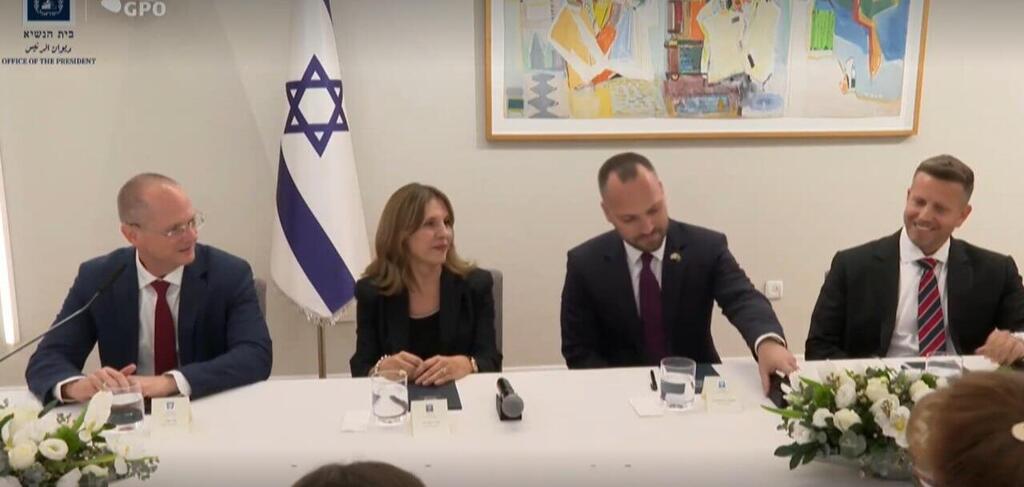
Yisrael Beytenu at a round of consultations with President Isaac Herzog in the President's Residence in Jerusalem
(Photo: Alex Kolomoisky)
However, Forer reiterated the party's opposition to forming a government dependent on Arab parties, highlighting a potential obstacle to Eisenkot's coalition efforts.
"You cannot form a government with the Arab parties," he said.
Herzog challenged the distinction between cooperating with Arab lawmakers in parliament and relying on their support in a coalition.
Forer replied that parliamentary cooperation on individual legislation was possible, but a government requiring a dependable 61-seat majority could not rely on their votes.
He also rejected the possibility of compromising on key security and economic priorities to bring ultra-Orthodox parties into a coalition.
Forer said increasing military enlistment was essential, arguing that Israel could not continue requiring reservists to serve hundreds of days while other sectors remained outside the military.
He also praised the administration of the election, describing it as a highly charged contest that had nevertheless been conducted properly.
Zehut backs Netanyahu but calls for another election
Zehut chairman Moshe Feiglin said his party would recommend Netanyahu, honoring its preelection commitment, but questioned the legitimacy of the election results and called for another vote.
"We will recommend Netanyahu because that's what we promised," Feiglin said as he arrived at the president's residence.
"If the Jewish majority chose Netanyahu, then that's what we have. It's better than the alternative," he added.
Feiglin said he believed another election was necessary because a "heavy shadow" hung over the results, and said he would urge Herzog to intervene.
Eisenkot's party announces coalition negotiations
Meanwhile, Eisenkot's Yashar! party said it had completed an initial round of coalition negotiations with Beyachad, the Democrats and Yisrael Beytenu, with the aim of establishing a national emergency government as quickly as possible.
The party said additional meetings had been scheduled.
Election officials warn against undermining results
Earlier Wednesday, Central Elections Committee chairman Justice Noam Sohlberg formally presented Herzog with the certified results of the election for the 26th Knesset.
At the ceremony, Sohlberg warned against attempts to challenge the legitimacy of the vote amid allegations of foreign interference.
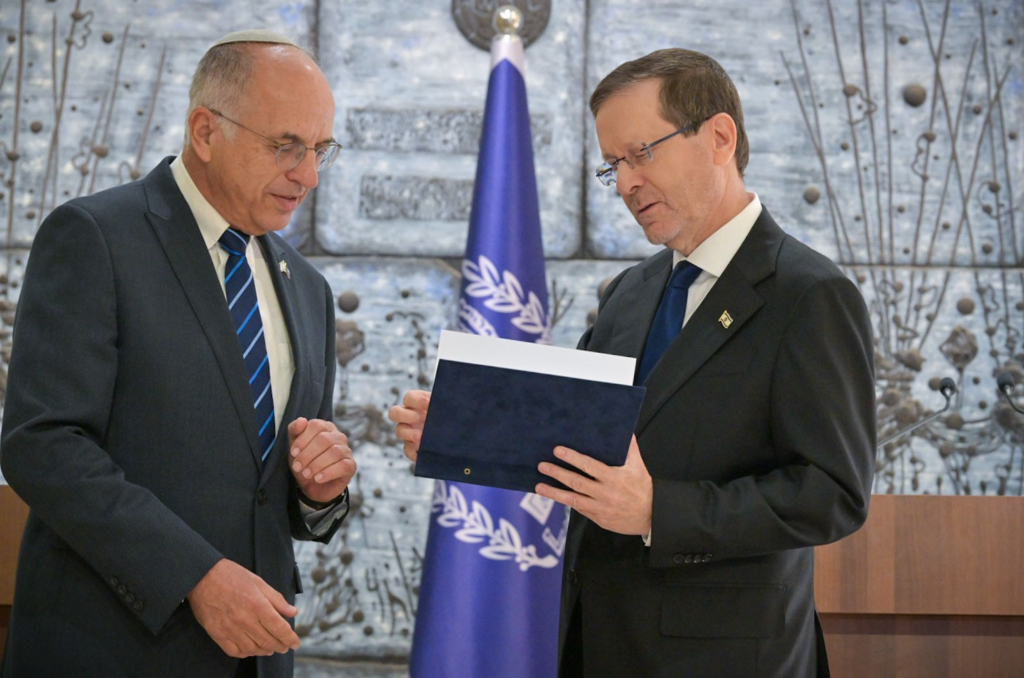
Herzog presented with the official election results
(Photo: GPO)
"In recent days, voices have been heard seeking to cast doubt on the election results and undermine their validity. This is a real danger," he said.
"One of the secrets of democracy is the ability to transfer power peacefully."
Sohlberg said Israel had weathered bitter political disputes, fiercely contested elections and unexpected outcomes throughout its history without abandoning the principle that voters' decisions must be respected.
"Serious disagreements, turbulent political struggles and sometimes results that surprised many have not prevented us from recognizing the voters' decision and acting accordingly," he said.
"We must not deviate from this path, which lies at the foundation of our strength as a democratic state."
Addressing the ongoing investigation, Sohlberg acknowledged that serious allegations had been raised and said authorities were examining them thoroughly.
"Suspicions have indeed been raised, some of them serious. These suspicions require a thorough investigation, and that is indeed taking place," he said.
Sohlberg said election officials had been presented with a summary of intelligence information supplied by the Shin Bet chief at his request.
However, he emphasized that the allegations remained unproven and that even if substantiated, their potential impact on the election results would be limited.
"At this stage, these are suspicions only, and even if they are confirmed, the scope of their influence is limited," Sohlberg said.
He said the results were therefore being published on schedule, while noting that evidence emerging later could be addressed through the legal procedures available for challenging an election.
Sohlberg also warned against interpreting the allegations as grounds for questioning the legitimacy of Arab citizens' votes.
"There is nothing in these suspicions that should cast doubt on the voting of members of the Arab community in any way," he said. "High voter turnout is a welcome development for every community in Israeli society."
The Central Elections Committee leadership approved the results earlier Wednesday by a vote of three in favor, none against and two abstentions.
The committee said it had found no irregularities or evidence indicating that the integrity of the election had been compromised or that its results had been altered.
Herzog calls for investigation, warns against racism
Herzog also addressed the allegations of foreign election interference, saying any attempt to improperly influence the democratic process must be investigated.
"Any suspicion of subversive external influence on the election results must be thoroughly investigated by the Shin Bet and the police," he said.
The president urged patience and expressed confidence that the investigation would be conducted professionally, with cooperation among the agencies involved.
He also sought to separate the allegations against individual political figures from broader attitudes toward Israel's Arab minority, which accounts for roughly one-fifth of the country's population.
"An entire community must not be smeared. Beware of generalizations," Herzog said.
"I greatly respect Arab society in Israel. I appreciate its contribution to the country in every sphere of life and its desire to integrate. This is a welcome development."
Herzog condemned racist rhetoric and called for reconciliation following the bitter election campaign.
"I condemn the vulgarity and racist expressions we have heard recently. There is no place for them against any community in Israel," he said.
The president urged Israelis to reach across political divides even as disagreements continued over the country's direction.
"The election is over. Now is the time to face reality," he said.
Security scare briefly disrupts presidential residence
The opening of the consultations was briefly disrupted by a security incident involving a foreign journalist at the presidential residence in Jerusalem.
Magda Gibelli, a journalist with Venezuelan and Italian citizenship who works with outlets including Spain's EFE news agency, was detained after a security screening reportedly detected traces of explosive material on her hands.
Magda Gibelli
Journalists waiting to enter the residence were instructed to remain in the screening area while security personnel investigated the alert.
The president's office said an alarm had been triggered during the screening process, prompting authorities to temporarily suspend entry while police bomb disposal specialists examined the equipment.
Entry resumed after the security checks. No further findings were immediately reported. The incident did not prevent Herzog from beginning the consultations.