

A massive aircraft carrier, fighter squadrons and Tomahawk-armed destroyers, and this is only the beginning. While protests in Iran have subsided, the United States is continuing a significant military buildup, preparing for the possibility of action against the ayatollahs’ regime.
US President Donald Trump has said that “maybe we won’t need to use the forces,” but following his directive, American forces are continuing to reinforce their presence in the Middle East.
The aircraft carrier Abraham Lincoln, which had been operating in the South China Sea, changed course more than a week ago toward the Middle East and is expected to arrive in the region in the coming days. Its carrier strike group includes Arleigh Burke-class destroyers, each equipped with Tomahawk cruise missiles capable of striking targets deep inside Iran.
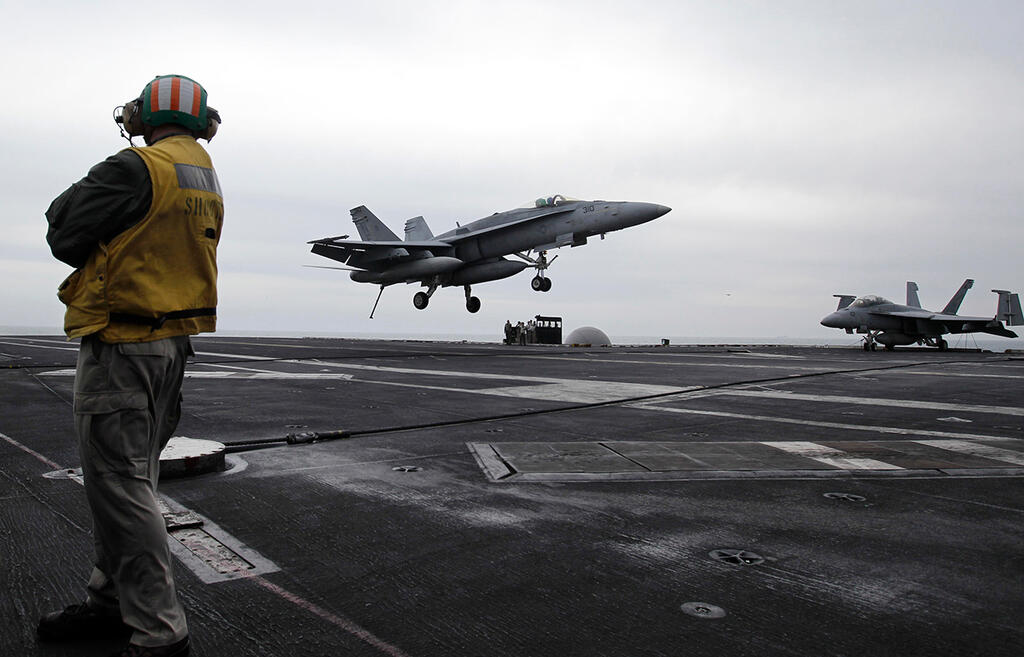
According to a report by Global Defense News, which is based on open sources, the Lincoln’s escort ships include the destroyers Spruance, Frank E. Petersen Jr., Michael Murphy, Bulkeley, Roosevelt, Oscar Austin and Paul Ignatius. These vessels are equipped with the Aegis combat system, providing air and missile defense against aerial threats, ballistic missiles and cruise missiles. The destroyers are also armed with Tomahawk cruise missiles with ranges of approximately 1,500 to 2,500 kilometers, enabling strikes against strategic targets deep within Iranian territory from distant maritime positions. During the US operation “Midnight Hammer,” carried out before the end of the War of the Lion’s Rise, American forces launched 30 Tomahawk missiles from submarines alongside strikes by B-2 bombers against Iranian nuclear sites.
The air wing aboard the Lincoln includes nine squadrons, among them F-35C stealth fighters, F/A-18E Super Hornet multirole strike aircraft, EA-18G Growlers for electronic warfare and jamming, Seahawk naval helicopters for search and rescue, and Osprey aircraft for logistical support and resupply.
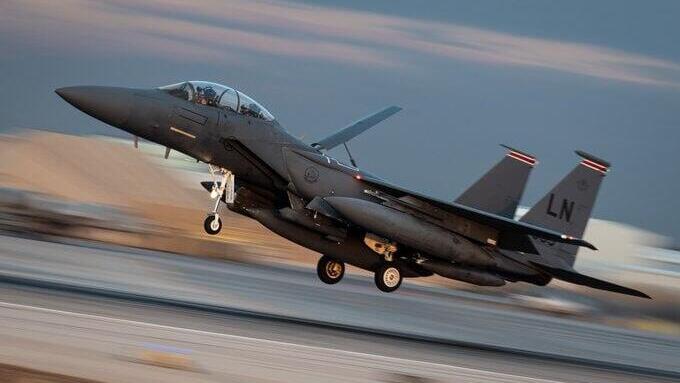
A US Air Force F-15E fighter jet that landed this week at a base in the region
(Photo: X)
In addition, the US Air Force has deployed about a dozen F-15E fighter jets to bases in the region, though it has not disclosed their exact locations. Previously, under US Central Command, squadrons of F-35A, F-15E, F-16 and A-10 aircraft were already deployed in the area, along with P-8A Poseidon maritime patrol aircraft and MQ-9 Reaper drones. KC-135 and KC-46A aerial refueling aircraft that have also landed in the region are extending operational range and allowing sustained long-duration missions. In the Persian Gulf, the destroyers Mitscher and McFaul are already operating alongside the supply and replenishment ships Carl Brashear and Henry J. Kaiser, providing logistical support and restocking capabilities. This ensures that naval and air forces can maintain a forward presence and remain deployed for extended periods without returning to port.
The command ship Mount Whitney is also in the region, providing integrated command and control capabilities and coordinating operations among naval, air and ground forces. Also present is the vessel Lewis B. Puller, which effectively serves as a floating sea base, along with Coast Guard ships Canberra, Tulsa and Santa Barbara, supporting sustained operations and the protection of maritime routes. The reinforcement package includes the nuclear-powered submarine South Dakota, which contributes intelligence, surveillance, reconnaissance and conventional strike capabilities beneath the surface, as well as the submarine Georgia, which is also armed with Tomahawk missiles.
Beyond the military assets already deployed, a US official quoted by Reuters said that Washington is also examining the possibility of reinforcing its air defense systems in the Middle East.
Speaking with reporters aboard Air Force One on his return from Davos, President Trump said: “We’re watching Iran. We have a lot of ships headed that way, a large fleet headed that way. We’ll see what happens. There is a big force moving toward Iran. I hope nothing happens, but we’re watching. We have a massive armada headed there, but maybe we won’t have to use it.” Asked whether he wanted Iran’s Supreme Leader Ali Khamenei to step down, Trump replied: “I don’t want to get into that, but they know what we want. There is a lot of killing.”