


The Trump administration is preparing to impose sweeping economic sanctions on the International Criminal Court that could cut the Hague-based tribunal off from much of the global financial system, The Wall Street Journal reported Sunday, citing U.S. officials and documents it reviewed.
The sanctions would prohibit most transactions with the ICC after a six- to seven-month grace period, according to the report. The restrictions could prevent the court from conducting transactions in U.S. dollars, potentially severing it from much of the international financial system. Transactions involving communications services would be exempt.
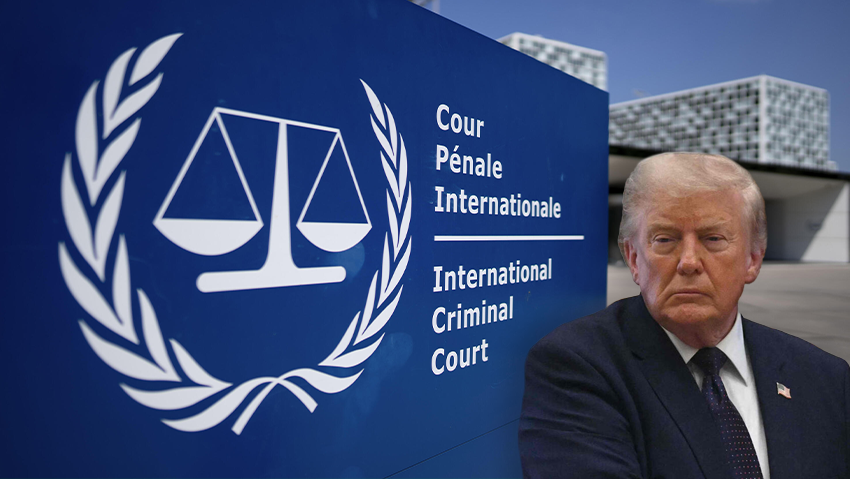
The International Criminal Court in the Hague; US President Donald Trump
(Photo: AP Photo/Peter Dejong, SAUL LOEB / AFP)
A final decision could be announced as early as this week, as world leaders gather in New York for the United Nations General Assembly, or in the days that follow, according to the Journal.
The proposed measures would represent a significant escalation in the Trump administration’s campaign against the ICC following the court’s decision to issue arrest warrants for Prime Minister Benjamin Netanyahu and former defense minister Yoav Gallant.
The U.S. Treasury Department declined to comment to the Journal. The ICC also did not respond to the newspaper’s request for comment.
The developments come as U.S. President Donald Trump is in New York for the General Assembly. Trump is not currently scheduled to meet with Netanyahu on the sidelines of the gathering, though Netanyahu has sought a meeting, according to reports. Trump is scheduled Monday to meet New York City Mayor Zohran Mamdani at Gracie Mansion. Mamdani has repeatedly criticized Netanyahu and Israel’s conduct of the war in Gaza and has called for the ICC warrant against Netanyahu to be honored.
The Trump administration has already imposed sanctions on several ICC officials as part of its campaign against the court. They include former chief prosecutor Karim Khan, who was removed from his post in July following allegations of sexual assault; ICC President Tomoko Akane and several other judges; the court’s two deputy prosecutors; and the lead prosecutor in the case against Netanyahu and other Israeli officials.
The administration is now preparing sanctions that would go significantly further by targeting the ICC as an institution rather than individual officials, according to the Journal.
US Secretary of State Marco Rubio blasts the International Criminal Court
(Video: US Department of State)


U.S. Secretary of State Marco Rubio said in July that the administration was preparing a broader campaign against the court, arguing that its assertion of jurisdiction over officials from countries that are not ICC members had created a “dangerous precedent” and posed a threat to U.S. sovereignty.
The United States and Israel are not parties to the Rome Statute, the treaty that established the ICC.
European countries and other major supporters of the court, including Japan, have pledged to protect the institution from U.S. pressure, though it remains unclear what measures they could take if Washington imposes institution-wide sanctions. The European Union could seek to require banks in the bloc to continue doing business with the court, according to the Journal.
Rubio’s current position on the ICC contrasts with his stance following Russia’s full-scale invasion of Ukraine. In 2022, while serving in the Senate, Rubio joined calls for the court to investigate alleged Russian war crimes in Ukraine, even though Russia, like the United States and Israel, is not an ICC member.
In 2023, the ICC issued an arrest warrant for Russian President Vladimir Putin over allegations involving the unlawful deportation and transfer of children from occupied areas of Ukraine. The court has subsequently issued warrants for other senior Russian officials.
Relations between Washington and the ICC deteriorated sharply after the court issued arrest warrants in November 2024 for Netanyahu and Gallant, accusing them of war crimes and crimes against humanity over the conduct of the war in Gaza.
The court said at the time there were reasonable grounds to believe Netanyahu and Gallant bore criminal responsibility for the war crime of starvation as a method of warfare and for crimes against humanity, including murder, persecution and other inhumane acts. The allegations centered in part on restrictions on humanitarian aid entering Gaza.
Israel has rejected the accusations and challenged the court’s jurisdiction.
Khan had also sought arrest warrants for senior Hamas leaders over their alleged roles in the Hamas-led attack on southern Israel on Oct. 7, 2023, which triggered the war. Those proceedings were subsequently terminated as the Hamas leaders named in the applications were confirmed dead.
The ICC has also examined allegations involving Finance Minister Bezalel Smotrich and National Security Minister Itamar Ben-Gvir in connection with Israeli settlement activity in the West Bank. The United Nations and much of the international community consider Israeli settlements in the territory to violate international law, a position Israel disputes.
If imposed, the new U.S. sanctions could have substantially broader consequences for the ICC than the restrictions placed on individual judges and prosecutors. Because the U.S. dollar plays a central role in international banking, barring most transactions with the institution could make it difficult for banks, contractors and other organizations to continue doing business with the court.
The Journal reported that administration officials described the planned sanctions as considerably more punitive than the measures already imposed on individual ICC officials.