

Kurdish Iranian opposition groups based in northern Iraq say they are preparing to cross into Iran, but stress such a move is not imminent and would require significant US and Israeli military pressure on the regime first.
Amid reports that US President Donald Trump has been in contact with Kurdish leaders, Iranian Kurdish opposition groups operating in northern Iraq told the BBC they are planning a possible cross-border move into Iran.
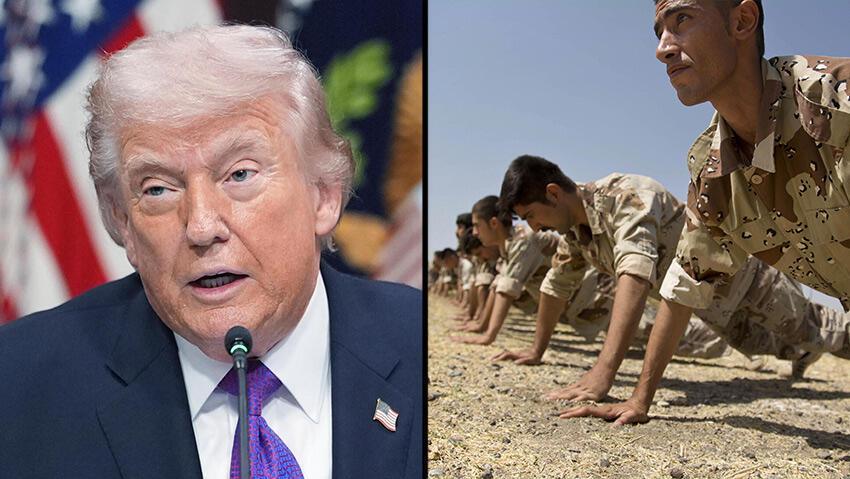
(Photo: AP Photo/Jacquelyn Martin, AP Photo/Maya Alleruzzo)
“We have been preparing for this for the past 47 years, since the age of the Islamic Republic,” Hana Yazdanpana, a fighter from the Kurdistan Freedom Party (PAK) told the BBC. She said six opposition groups that recently formed a coalition are coordinating politically and militarily.
However, she emphasized that none of the groups has yet launched an attack against Iran and that such an operation is unlikely in the coming days. According to her, Kurdish forces cannot advance without first gaining control of the airspace above them. She said the fighters would need the regime’s weapons depots destroyed beforehand, warning that moving forward without such conditions would amount to a suicide mission. She described the Iranian regime as extremely ruthless and said the most advanced weapon many fighters possess is a Kalashnikov rifle.
She also called on the United States to establish no-fly zones that could protect Kurdish fighters operating in the region.
Mustafa Mawludi, deputy leader of the Democratic Party of Iranian Kurdistan (KDPI), said the United States and Israel had not launched the war with Iran to advance Kurdish aspirations but to pursue their own interests. Still, he said the fact that the strikes target bases of the Islamic Revolutionary Guard Corps could ultimately benefit Kurdish opposition forces and potentially help them enter Iranian territory.
Earlier this week, a source in Iraq originally from Iranian Kurdistan told ynet that given Israel’s ongoing airstrikes, Israel could potentially mount a ground operation from Iraqi Kurdistan with support from Iranian Kurdish peshmerga forces.
The Washington Post reported Thursday that the United States has begun reaching out to internal opposition groups in Iran as potential partners in an effort to spark an uprising against the regime.
According to officials familiar with the contacts, Trump discussed the possibility of extensive American air cover and additional support for Iranian Kurdish forces opposed to the regime during talks with Kurdish leaders in Iran and northern Iraq, in an effort to help them seize parts of western Iran.
A senior figure in one of Iraq’s two main Kurdish parties said Washington had asked Iraqi Kurdish authorities primarily to avoid obstructing Iranian Kurdish groups organizing in Iraq and to provide logistical support that could allow them to operate.
According to the official, Trump told Patriotic Union of Kurdistan leader Bafel Talabani that the Kurds would ultimately have to choose sides in the conflict, aligning either with the United States and Israel or with Iran.
A senior member of the second major Kurdish party in Iraq, led by Masoud Barzani, confirmed that such contacts had taken place. However, he cautioned that the decisive factor would not be which side could deploy more armed militias capable of entering Iran, but rather which forces could secure broader support within Iran itself.
In addition to speaking with Talabani, Trump also held talks this week with Mustafa Hijri, the head of an Iranian Kurdish opposition party. The group is part of the newly formed coalition of Iranian Kurdish parties opposing the regime, which was announced last week in Iraqi Kurdistan.
In a statement released Wednesday, the party called on soldiers and personnel serving in Iran — particularly in Kurdish areas — to abandon their bases and withdraw support from what it described as the regime’s armed and repressive forces.
A US official cautioned that the extent of Kurdish cooperation with Washington remains unclear. He said opportunities for coordination could emerge, but suggested Kurdish groups on both sides of the Iraq-Iran border would likely wait to see how the situation develops before committing themselves.