

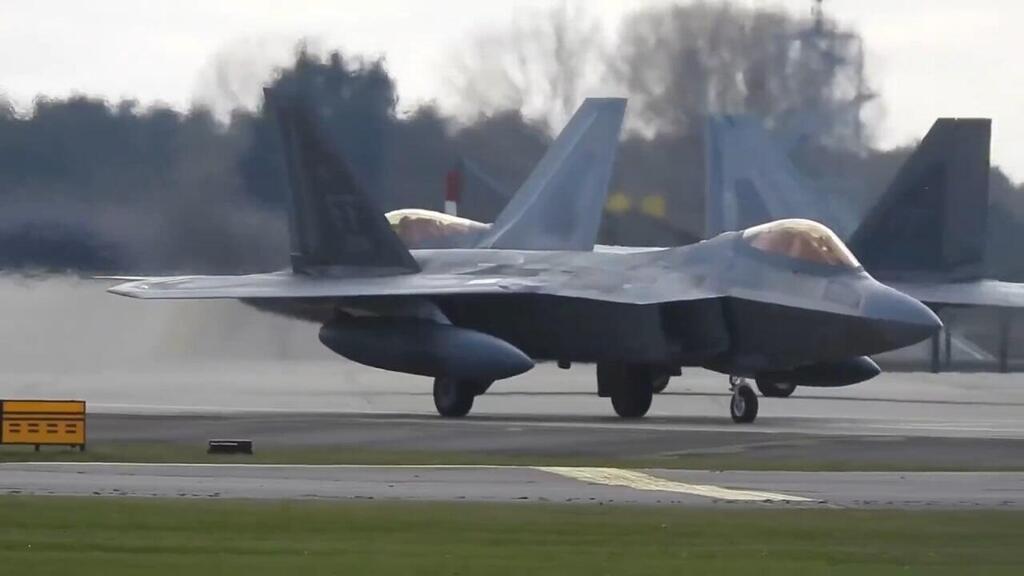
Twelve U.S. F-22 fighter jets, among the most advanced in the world, landed in Israel on Tuesday as part of a broader American military buildup amid the possibility of a strike on Iran.
The F-22 Raptor is one of two fifth-generation fighter jets in the U.S. arsenal, alongside the F-35, which is also operated by the Israeli Air Force. The landing of American fighter jets in Israel is unusual; the deployment of advanced stealth F-22s is particularly so.
US F-22 fighter jets depart from Britain for a base in Jordan on Tuesday
(Video: from X)


The F-22, which first flew in 1990, is primarily an air superiority fighter but is also capable of ground attack, electronic warfare and intelligence missions. Unlike the F-35, the F-22 has not been sold to foreign militaries due to a U.S. legal prohibition.
The aircraft’s first operational mission was in 2014, when it struck Islamic State targets. Its first shootdown came in 2023, when it downed a Chinese surveillance balloon over the Atlantic Ocean. It has not shot down a manned aircraft.
Meanwhile, the aircraft carrier USS Gerald R. Ford continues operating in the eastern Mediterranean and has passed Crete. It is expected to join the USS Abraham Lincoln, which has been in the region for an extended period.
The developments come ahead of President Donald Trump’s State of the Union address later Tuesday and against the backdrop of heightened tensions over Iran.
In a series of posts on X, Iranian Foreign Minister Abbas Araghchi stressed that diplomacy remained possible. “A deal is within reach, but only if diplomacy is given priority,” Araghchi wrote. He said Iran would return to talks with the United States in Geneva, based on understandings reached in a previous round, with determination to reach a “fair and equitable deal” as quickly as possible.
“Our fundamental convictions are crystal clear,” he wrote. “Iran will under no circumstances ever develop a nuclear weapon; neither will we Iranians ever forgo our right to harness the dividends of peaceful nuclear technology for our people.”
Araghchi described what he called a “historic opportunity” to reach an unprecedented agreement addressing mutual concerns and securing shared interests, while warning that Iran would defend its sovereignty. “We have proven that we will stop at nothing to guard our sovereignty with courage. We bring the same courage to the negotiating table, where we will pursue a peaceful resolution to any differences,” he wrote.
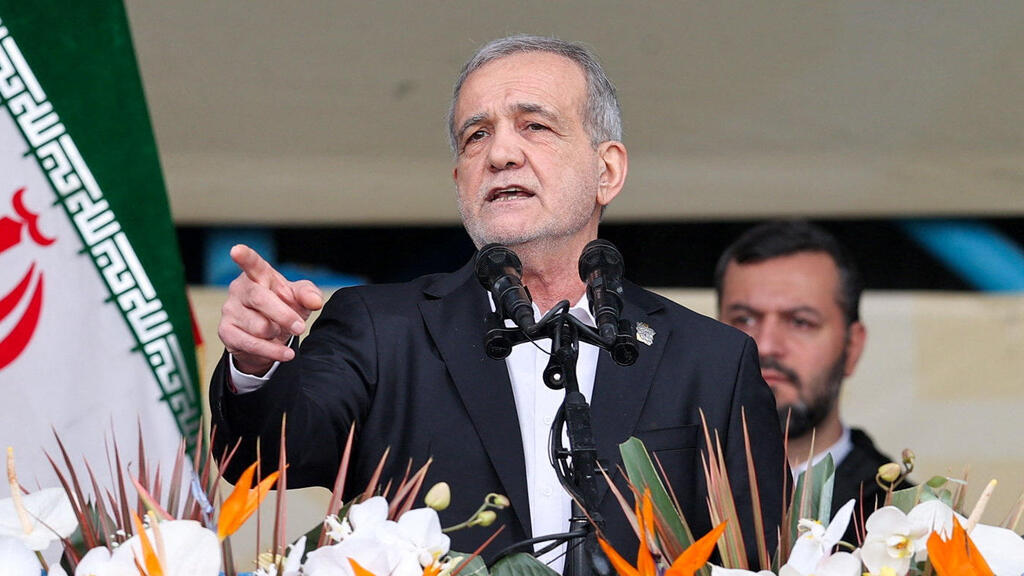
Iranian President Masoud Pezeshkian
(Photo: Majid Asgaripour/WANA (West Asia News Agency) via REUTERS)
Iranian President Masoud Pezeshkian said his government supports “peace and stability” in the region. “We do not seek to undermine them,” he said. “We believe that tension and instability in the region will harm all countries.”
Deputy Foreign Minister Majid Takht-Ravanchi said Tehran is ready “at any moment” to take steps necessary to reach an agreement with Washington but warned that a U.S. strike would be “a real gamble.”
“If there is political will on all sides, an agreement can be reached as soon as possible,” he said. “Everyone should know that starting a war is possible, but ending it is not easy. The entire region will suffer the consequences of aggression against Iran.”
Despite the stepped-up military posture and heightened alert, Israeli officials pointed to two indications that a strike on Iran was unlikely before the weekend.
One is a planned trip on Wednesday by President Isaac Herzog to Ethiopia. The second, seen as more significant, is the expected arrival Thursday of Indian Prime Minister Narendra Modi for a two-day visit.
Rubio is also scheduled to visit Israel on Monday, though officials noted that such a trip would not necessarily preclude military action and could even serve as a diversion.
White House press secretary: Trump willing to use military if necessary
Before Trump’s address and Rubio’s arrival, Rubio, who is also serving as national security adviser, will brief the so-called “Gang of Eight” — four Republican and four Democratic congressional leaders with access to the most sensitive intelligence — on the situation with Iran. The briefing was scheduled for Tuesday at 10 p.m. Israel time.
Israeli officials said the prevailing assessment remains that a strike is likely unless Iran makes a last-minute concession and agrees to U.S. demands — a scenario viewed as improbable. On Feb. 19, Trump said he was giving Tehran “10 to 15 days” to reach a deal. Five days have since passed.
White House press secretary Karoline Leavitt reiterated Tuesday that "President Trump’s first option is always diplomacy, but as he has shown, he is willing to use the lethal force of the United States military if necessary.”
Aaron David Miller, a former State Department official, wrote on social media that it would not be surprising if Trump announced the start of strikes against Iran in his address. “No President has ever announced the start of military conflict in a [State of the Union speech],” Miller wrote. “Why would they? That’s reason enough for Trump to do it.”