

U.S. Secretary of State Marco Rubio is set to deliver a rare classified briefing to senior members of Congress on Iran on Tuesday, as Washington continues to bolster its military presence in the Middle East amid mounting tensions with Tehran.
The White House said Rubio, who is also serving as national security adviser, will brief the so-called “Gang of Eight” — four Republican and four Democratic congressional leaders with access to the most sensitive intelligence — on the situation with Iran. The briefing was scheduled for Tuesday at 10 p.m. Israel time.
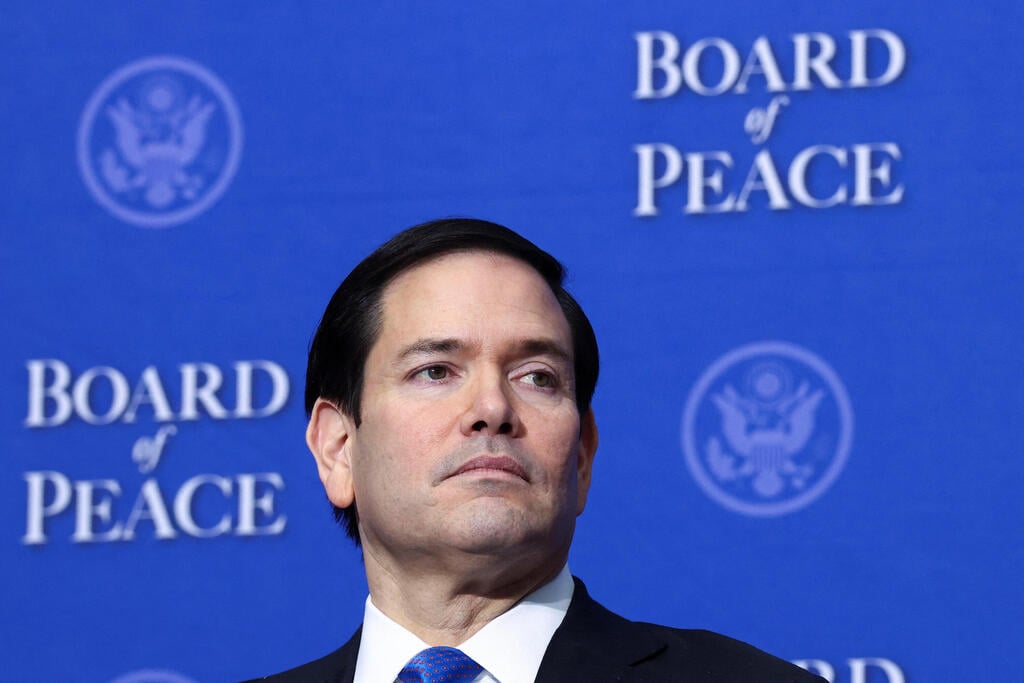
The move comes hours before President Donald Trump is expected to address developments with Iran in his State of the Union address. ynet Global will broadcast the speech live starting at 4 a.m. Israel time (9 p.m. Eastern time, 6 p.m. Pacific time).
Meanwhile, the U.S. military buildup in the region continued. Two additional American refueling aircraft landed at Ben Gurion Airport on Tuesday, bringing the total number to four in two days. At the same time, F-22 fighter jets departed from Britain for a base in Jordan.

US refueling aircraft land at Ben Gurion Airport on Tuesday
Despite the stepped-up military posture and heightened alert, Israeli officials pointed to two indications that a strike on Iran was unlikely before the weekend.
One is a planned trip on Wednesday by President Isaac Herzog to Ethiopia. The second, seen as more significant, is the expected arrival Thursday of Indian Prime Minister Narendra Modi for a two-day visit.
US F-22 fighter jets depart from Britain for a base in Jordan on Tuesday
(Video: from X)


Rubio is also scheduled to visit Israel on Monday, though officials noted that such a trip would not necessarily preclude military action and could even serve as a diversion.
Israeli officials said the prevailing assessment remains that a strike is likely unless Iran makes a last-minute concession and agrees to U.S. demands — a scenario viewed as improbable. On Feb. 19, Trump said he was giving Tehran “10 to 15 days” to reach a deal. Five days have since passed.
White House press secretary: Trump willing to use military if necessary
White House press secretary Karoline Leavitt reiterated Tuesday that "President Trump’s first option is always diplomacy, but as he has shown, he is willing to use the lethal force of the United States military if necessary.”
Iran, for its part, has sent mixed messages. Iranian state media aired on Tuesday footage of missile launches during military drills.
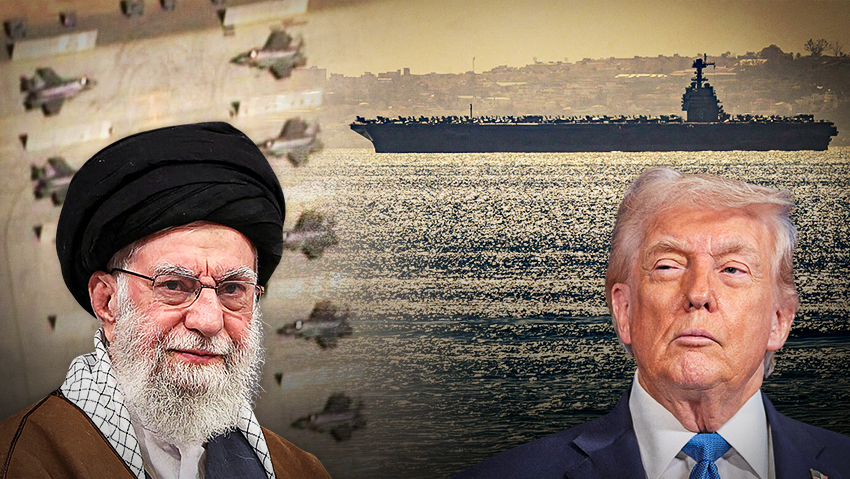
(Photo: dparody/Instagram/via REUTERS, REUTERS/Jonathan Ernst, KHAMENEI.IR/AFP, Airbus)
Deputy Foreign Minister Majid Takht-Ravanchi said Tehran is ready “at any moment” to take steps necessary to reach an agreement with Washington but warned that a U.S. strike would be “a real gamble.”
“If there is political will on all sides, an agreement can be reached as soon as possible,” he said. “Everyone should know that starting a war is possible, but ending it is not easy. The entire region will suffer the consequences of aggression against Iran.”
Iranian President Masoud Pezeshkian said his government supports “peace and stability” in the region. “We do not seek to undermine them,” he said. “We believe that tension and instability in the region will harm all countries.”
Aaron David Miller, a former State Department official, wrote on social media that it would not be surprising if Trump announced the start of strikes against Iran in his address. “No President has ever announced the start of military conflict in a [State of the Union speech],” Miller wrote. “Why would they? That’s reason enough for Trump to do it.”
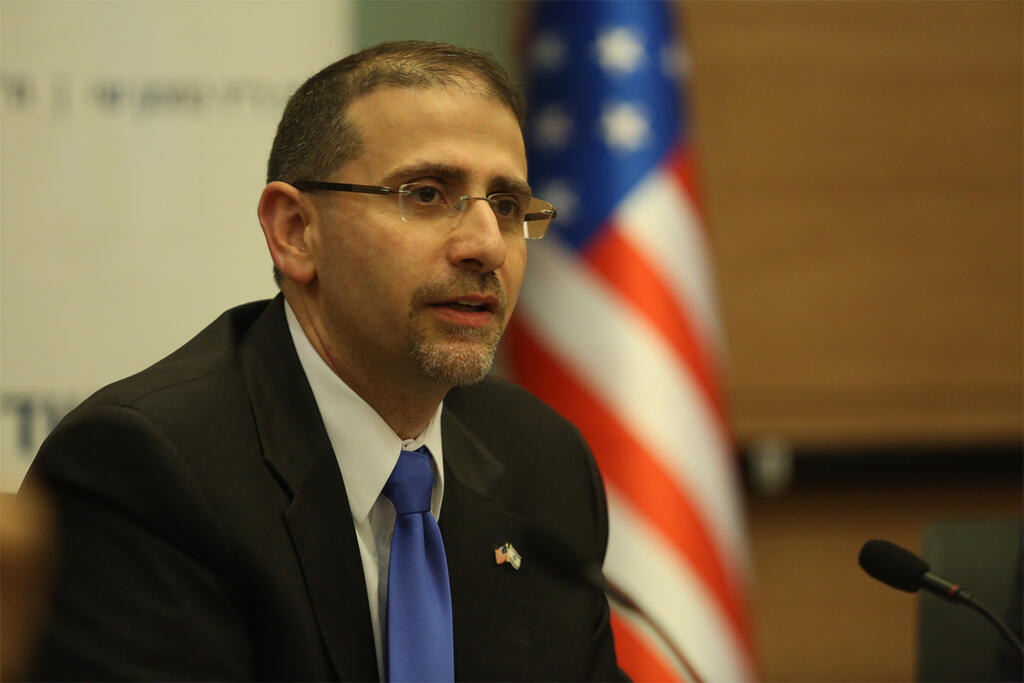
Dan Shapiro
(Photo: Gil Yochanan)
Dan Shapiro, former U.S. ambassador to Israel and a former senior Pentagon official, told ynet: “I believe Trump has not yet decided whether or not to go to war. He has not declared what his strategic objective is. I’m sure the military comes to him and says, ‘We can do many things, but tell us what you want. What outcome do you want from this operation?’ But I don’t think he will announce it during the State of the Union address because of Modi’s visit here and the negotiations in Geneva on Thursday. Nothing will happen before that. Beyond that, I expect he will decide to take some kind of military action.
“I don’t expect any agreement in Geneva, but he also does not want a broad, difficult and prolonged war. He was elected on the claim that he would not enter wars and bring about regime change. So what is left? In my view, it is to strike the regime in a way that hurts — such as the Revolutionary Guards, the Basij, perhaps even the supreme leader himself — and also something in the nuclear sphere. But there is not that much to do, because they have not done much since the war in June. He will not want to be dragged into a long war that would occur if he goes with Bibi on all the ballistic missiles.”
Shapiro added: “It would be something much bigger that the Iranians would not absorb quietly. They could respond, but in a way that lowers the escalation rather than intensifies it. I think Trump wants to hit them and finish, like in June. Trump put himself in a trap — he put himself in a trap because he called on protesters to take to the streets and said help was on the way. But it has already been more than a month and he is not even talking about the protesters anymore, only about the nuclear issue. He is very confused.”
Is the United States talking only about the nuclear issue, or also about ballistic missiles and the proxies?
“Rubio said two weeks ago that the United States is demanding nuclear, missiles and proxies. But Trump is not saying anything about missiles and proxies, so who knows how they make decisions. I think Trump is inside a box he invented, because he said so many things about his intentions but has not decided on the objective. He does not want a long, ongoing war and for Iran to respond.”
Will Iran try to draw Israel in?
“If Trump attacks only the regime and not the ballistic missiles, I assume the Iranians will not respond against Israel, and Israel has no right or justification to enter if the response is only against American bases in the Gulf.”