

Israeli security officials are continuing to investigate what happened aboard flyDubai Flight FZ1073 from Dubai to Tel Aviv, after an apparently routine flight turned into a cockpit emergency, a rapid loss of altitude, a suspected hijacking and an emergency landing in Saudi Arabia.
What is known so far is based on flight data, Israeli security assessments, flyDubai’s statements and testimony from passengers aboard the aircraft. Israeli officials increasingly suspect the incident was an act of terrorism. The flight was carrying 174 passengers, including 27 children.
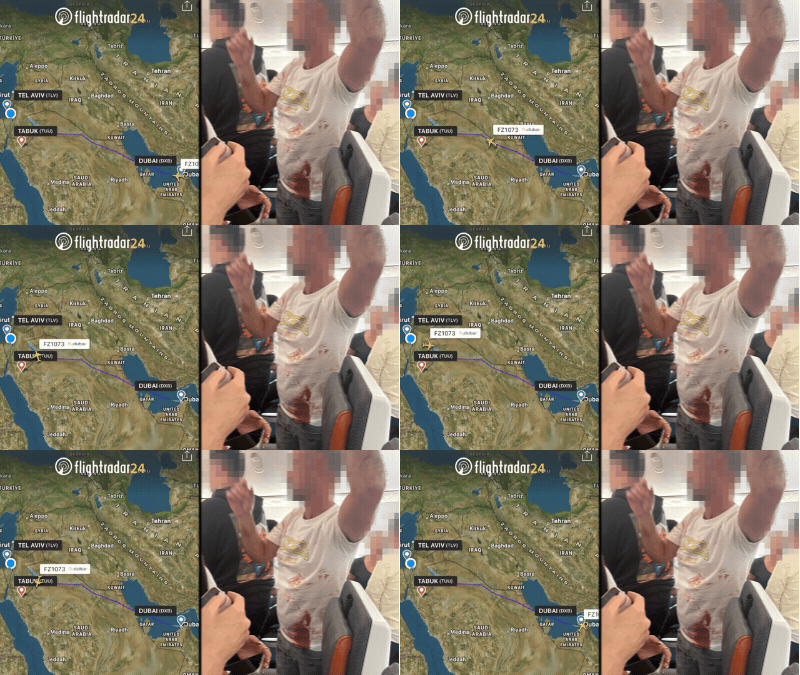
6:05 a.m.: flight takes off from Dubai
Flight FZ1073 departed Dubai at 6:05 a.m. on what was supposed to be a routine flight to Tel Aviv lasting about three hours and 15 minutes.
No unusual activity was reported during the initial stage of the flight.
8:21 a.m.: aircraft suddenly loses more than 14,000 feet
At 8:21 a.m., unusual movements began to appear in the aircraft’s altitude.
The plane lost more than 14,000 feet in less than 30 seconds, marking the first clear indication from outside the aircraft that something serious was happening onboard.
According to the emerging Israeli assessment, an Omani co-pilot is suspected of attempting to crash the aircraft. An Emirati pilot managed to overpower him, with passenger testimony indicating that several Israelis aboard the flight also helped subdue the suspect.
8:31 a.m.: general emergency code transmitted
Ten minutes after the sudden drop in altitude, the aircraft briefly transmitted squawk code 7700, the international code used to signal a general emergency.
At that stage, the precise nature of the incident was still unclear to authorities monitoring the flight.
8:38 a.m.: hijacking code activated
Seven minutes later, at 8:38 a.m., the aircraft transmitted code 7500, used to indicate an aircraft hijacking.
That signal sharply escalated the response in Israel.
Two Israeli Air Force fighter jets were scrambled, while senior IDF officials began holding urgent consultations to understand what was unfolding aboard the aircraft.
The assessments included IDF Chief of Staff Lt. Gen. Eyal Zamir, the head of the Operations Directorate, the head of Military Intelligence and the commander of the Air Force.
The Air Force also activated a procedure known as “Global Trade,” used in the IDF command center when fighter jets are scrambled over a suspected hijacking.
Inside the plane: passenger describes knife attack in cockpit
Passenger testimony later provided the first detailed account of what was allegedly happening inside the aircraft during those minutes.
One passenger said in a video posted to social media that a man armed with a knife had stabbed one of the pilots and that several passengers intervened.
“We’re on the flight from Dubai. We took control of the flight. There was an attacker with a knife who stabbed one of the pilots,” he said.
Content Warning: injured pilots receive treatment as Israelis guard the cockpit


“A few of us just jumped in and pulled him out of the cockpit. Everything is OK now. We’re apparently landing in Saudi Arabia.”
The passenger said the suspected attacker had been neutralized and described at least one pilot as seriously wounded.
“There’s a pilot here who is seriously wounded, and apparently another pilot inside who is wounded, but he is managing to land the plane,” he said.
He added that crew members had secured the cockpit door.
Other testimony reaching Israeli investigators described “large amounts of blood in the cockpit.”
9:20 a.m.: Netanyahu and Katz hold urgent consultation
At 9:20 a.m., Prime Minister Benjamin Netanyahu and Defense Minister Israel Katz convened an urgent security consultation as Israeli authorities continued following the aircraft.
9:35 a.m.: plane heads toward Saudi Arabia
At 9:35 a.m., Israeli officials received a report that the plane was heading toward Saudi Arabia for an emergency landing under fighter escort.
By then, the immediate concern had shifted from what was happening inside the cockpit to whether the damaged and reportedly bloodied flight crew could bring the aircraft safely to the ground.
9:45 a.m.: aircraft lands in Tabuk
Ten minutes later, at 9:45 a.m., the aircraft landed at Tabuk airport in Saudi Arabia.
The landing ended the immediate danger aboard the plane and prompted Israeli authorities to begin preparations to bring the passengers home.
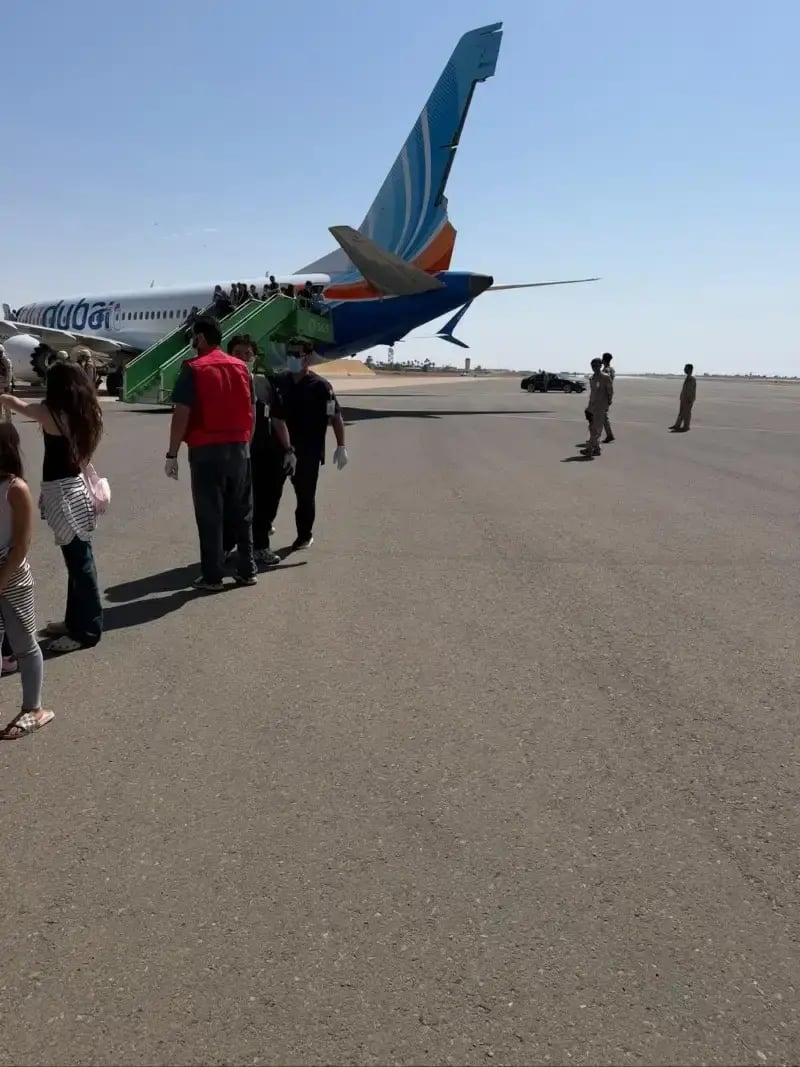
The plane’s tail, damaged in the rapid plunge
(Photo: Rotter.net)
Security agencies simultaneously began a detailed investigation into the sequence of events and the suspected motive.
The Mossad is now handling contacts with Saudi Arabia, while Israeli authorities are working to obtain the approvals needed to send an IDF aircraft to the kingdom.
flyDubai confirmed that a distress signal had been activated because of a violent incident aboard the aircraft, describing it as an altercation between the pilots. The airline said it had opened an investigation and notified Israeli authorities.
Israeli security officials, however, are increasingly assessing the incident as a suspected terrorist attack, as investigators work to reconstruct exactly what happened inside the cockpit during the flight.