

As various scenarios for escalation in the Middle East remain possible, The Wall Street Journal reported Friday evening that Bahrain and Kuwait secretly carried out strikes in Iran earlier this month using fighter jets. The strikes marked their first retaliatory attacks in response to ongoing Iranian fire targeting their territories. According to the report, the targets included missile and drone storage facilities as well as additional military sites. The United Arab Emirates provided intelligence and air defense assistance.
Meanwhile, the U.S. Embassy in Israel issued another warning to American citizens Friday evening, calling on them to "exercise increased caution, stay alert, and be prepared for possible flight cancellations, airspace closures, and other travel disruptions."
Trump on fighting Iran, yesterday
(Credit: Reuters)


At the same time, Iranian Foreign Minister Abbas Araghchi made clear that Tehran "will not surrender to pressure," saying: "We will continue until the goals and demands of the Iranian people are met."
Araghchi added that Iran "will not accept a temporary ceasefire," saying: "This issue will not be on the table unless our demands regarding the Strait of Hormuz are met. The current problem between Tehran and Washington is not a lack of mediators. Pakistan and Qatar continue to play their roles. Whenever Washington tests Iran, it receives a decisive response from us, but it continues with the same approach."
Reuters reported Friday evening that Pakistan and Iran are exploring a path toward new talks with the United States as part of an effort initiated by China, according to sources. Reuters reported that Iran's interior minister made two visits to Islamabad within 10 days, while Pakistan's foreign minister discussed a new Middle East initiative with Chinese officials last week.
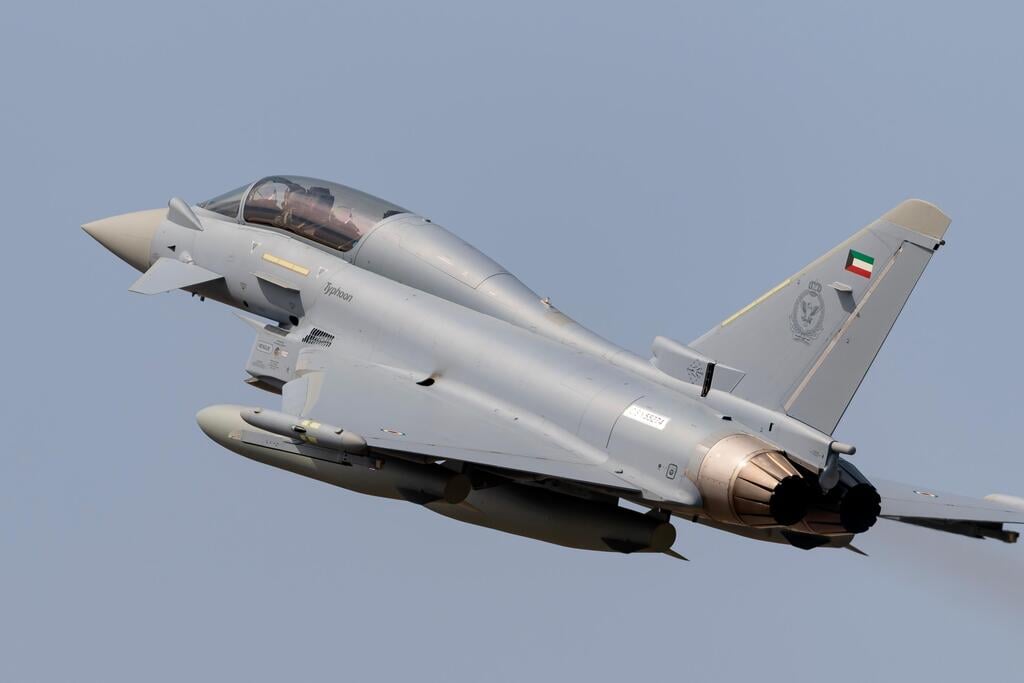
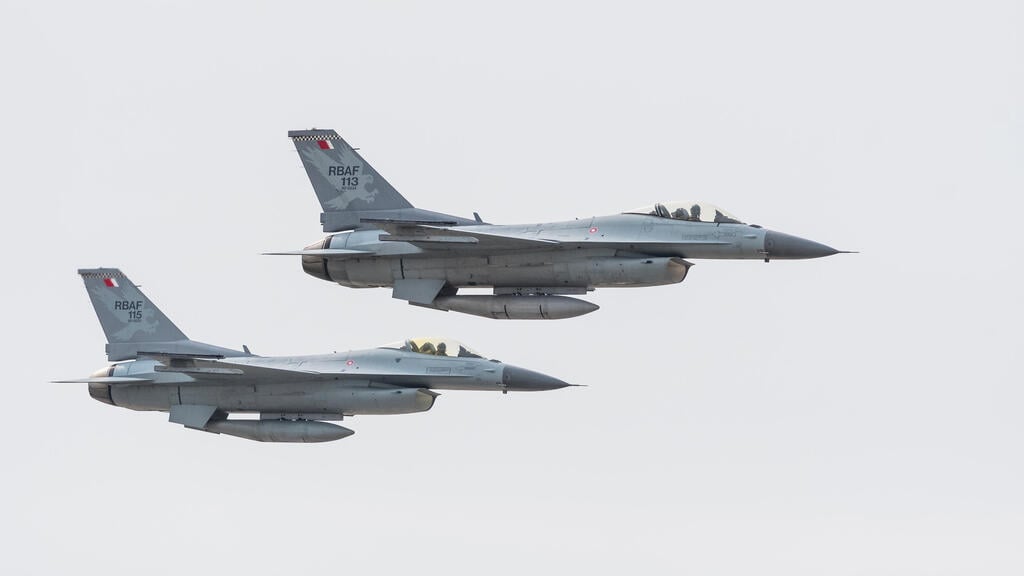
Bahrain's F-16 fighter jets
(Photo: VRMP-1 / Shutterstock)
"Stopping the attacks on Saudi Arabia and other Gulf countries is a necessary condition," a Pakistani official said.
The official added that "the Chinese are not satisfied that Iran's attacks on Gulf countries and the closure of the Strait of Hormuz are harming their interests." China's Foreign Ministry said that "China supports the mediation efforts of Pakistan and other parties." It added that China would continue to "play an active role in restoring peace and stability in the Gulf region."
Meanwhile, Ali Abdollahi, commander of Iran's Khatam al-Anbiya Central Headquarters, threatened that "for every death of an Iranian civilian, one American soldier will be sent to hell." He added: "We have prepared direct tickets to hell for you."
Documentation of the US's nightly attacks on Iran
(Credit: CENTCOM)
Prime Minister Benjamin Netanyahu held a meeting lasting more than five hours on Iran Friday. Israeli assessments indicate that the situation is heading toward escalation, and preparations are being made for all possible scenarios, including entering a direct conflict. Mediators are working to halt the escalation, but so far without apparent success.
Overnight, the U.S. military launched a broad wave of strikes in Iran for the 13th consecutive night, after President Donald Trump said Thursday that he was considering "a massive attack bigger than anything ever" against the Islamic Republic. At the same time, The New York Times reported that Iran rejected a ceasefire proposal from Trump himself, which was delivered through Iraqi Prime Minister Ali al-Zaidi.
Over the past two weeks, the escalation in exchanges of fire between the U.S. and Iran has intensified daily. The U.S. military has bombed military bases alongside civilian infrastructure, including railways, airports, bridges and seaports. Iran, for its part, has carried out daily drone and missile attacks against Gulf countries and Jordan, focusing on U.S. bases as well as civilian infrastructure. In addition, Iran has fired on tankers passing through the Strait of Hormuz, while the U.S. enforces a blockade on Iranian ports and prevents vessels from entering or leaving them.
Overnight, after previously threatening to destroy a bridge and power station, including in Tehran, for every ship attacked, Trump announced in a post on his Truth Social account that Iranian funds would be used to pay for any damage caused to affected vessels.
"Until further notice, that from this point forth, any and all damages done to ships, cargo, or anything related thereto, will be paid for by Iranian money that the United States has in its possession, and controls," Trump wrote.
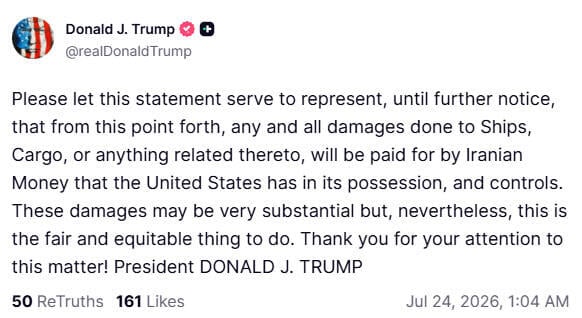
(Photo: Truth Social)
Iran's foreign minister responded Friday morning on X to Trump's statement, saying such a move would set "a dangerous and provocative precedent." Araghchi, who did not directly mention Trump, added: "Those who celebrate or benefit from such funds should remember: once governments normalize confiscation, no one's assets are safe. The chaos that follows will not be beautiful or peaceful."
Two Iranian officials said the regime's armed forces are monitoring and preparing for the possibility of an expanded war if Trump carries out his threats to strike Tehran and vital infrastructure. If he does so, the officials claimed, Iran would expand the fighting at the regional level, including an attack on Tel Aviv, while also asking Yemen's Houthi rebels to close the Bab el-Mandeb Strait connecting the Gulf of Aden and the Red Sea, another strategic shipping route threatened by Tehran.