

The Israel Defense Forces failed to stop a deadly terrorist assault on the southern city of Ofakim on October 7 due to critical lapses in communication, planning and situational awareness, according to a military investigation released Sunday.
Fifteen Hamas terrorists infiltrated the city at approximately 6:40 a.m., and within 40 minutes had murdered 33 people — 25 civilians and eight members of Israel’s security forces. The IDF arrived too late to impact the fighting, according to the report.
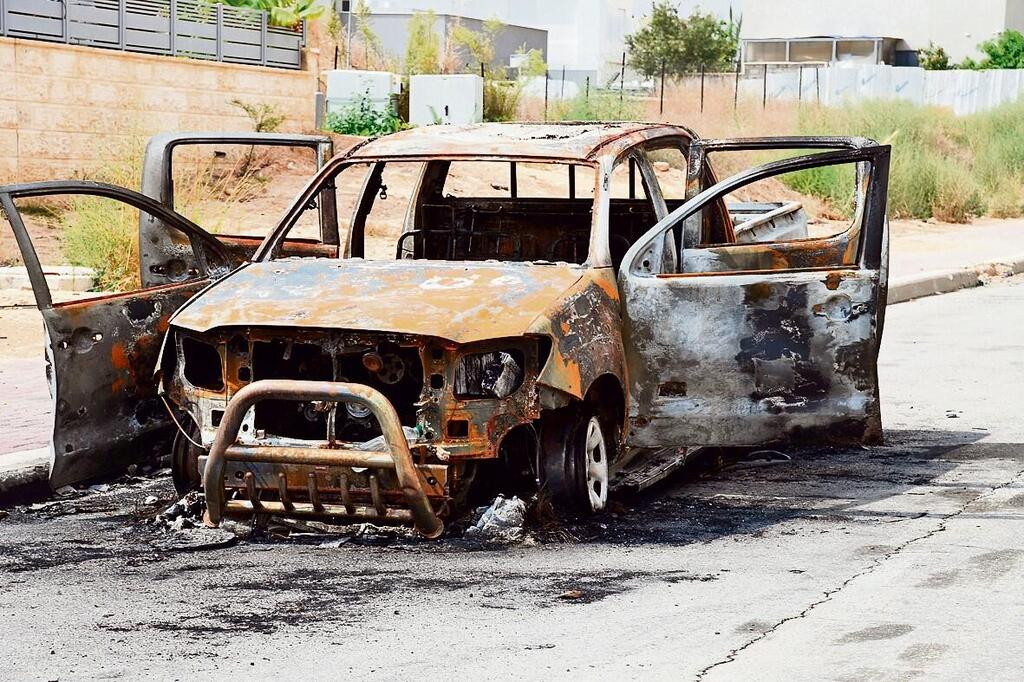
(Photo: Israel Police)


The six-month probe, led by Brig. Gen. Oren Simcha, found that troops from the Chaim Laskov Officers Training School, also known as Training Base 1 (Bahad 1), were among the closest military units but were dispatched to the wrong location. They then had to proceed on foot for 30 minutes to reach the Mishor HaGeffen neighborhood, by which point the terrorists had already been killed or had barricaded themselves inside homes.
“This was a battle that could have ended in hundreds of deaths,” a senior IDF official involved in the investigation said. “It was the determination of police officers, civilians and soldiers that stopped the massacre.”
Breakdown in coordination
The report cited poor coordination between the IDF, the police and local authorities as a key factor in the delay. On the morning of the attack, Ofakim had no active emergency command center, no standby squad, and no real-time intelligence about the terrorists' movements. Frantic civilian reports created a picture of a city overrun, leading to widespread confusion.
In reality, the 15 terrorists concentrated their assault on just three streets in the Mishor HaGeffen neighborhood. A functioning municipal command center, the report said, could have provided accurate information and guided both residents and responding forces more effectively. Since then, Ofakim has established an operational command hub, armed response units and surveillance camera integration.
The first IDF forces from Bahad 1 reached the industrial area of the city at 9:10 a.m., more than two hours after the attack began, and had to walk to the combat zone. “By the time they arrived, the battle had effectively ended,” a military source said. “The terrorists were either dead or entrenched. The soldiers were no longer relevant to the fight.”
Only at 2:30 p.m. were two of the five IDF platoons reassigned to assist civilians in nearby Kibbutz Kisufim. Three others remained in Ofakim.
Hamas targeted weak points
The report highlighted the attackers’ preparation and intent. Hamas operatives specifically chose Mishor HaGeffen because its homes lacked fortified safe rooms (known as "mamadim"). Anticipating that residents would flee to public shelters, the terrorists hoped to catch more victims in the open. Captured maps labeled the area as a “neighborhood without protection.” The attackers carried enough arms and ammunition for sustained combat lasting days.
A city’s pain
Sarit Ohayon, whose husband Moshe and son Eliad were killed defending their neighbors, said the report did not offer new information. “I’m thinking about how to prevent this from happening again,” she said. “We’re not where we need to be yet. I don’t feel enough has been done to make us feel safe.”
(Photo: Herzl Yosef)
Ofakim Mayor Itzik Danino said the report was a sobering confirmation of local fears. “We heard the truth, and the truth hurts — the IDF was not here when we needed it most,” he said. “But it has learned, recovered, and is active on multiple fronts. We believe in its ability to restore trust. The heroes of Ofakim are real — they live among us.”
Hostage rescue: A first for Israel’s special forces
Superintendent L., deputy commander of Israel’s Yamam counterterrorism unit, called the battle in Ofakim “complex and unprecedented in intensity.” He described the operation to rescue Rachel and David Edri — a hostage rescue from a private home — as the first of its kind since Yamam’s founding in 1974.
Get the Ynetnews app on your smartphone: Google Play: https://bit.ly/4eJ37pE | Apple App Store: https://bit.ly/3ZL7iNv
The assault on the Edri home came under difficult conditions, with most Yamam operatives deployed elsewhere. Forces reallocated from other engagements reached the house late at night. After 14 hours of planning, a two-minute breach ended with four terrorists killed and the hostages rescued unharmed. Three Yamam fighters were wounded, one seriously. He later returned to duty.
“We faced this mission exhausted — after hours of combat and after losing nine unit members,” Superintendent L. said. He paid tribute to First Sgt. Yitav Lev Halevi, one of the first to enter the Edri home. Halevi was killed seven months later during a counterterrorism operation in the West Bank. “He was a principled warrior and an extraordinary human being,” he said. “I wanted you to know his name.”