

They were six — Tom, Manu, Nadav, Bar, Guy and Rani. Today they are five. They grew up together in Meitar, a close-knit community where everyone knows everyone. A group built over years, one that saw itself as family.
“We became one unit,” said Tom Brodsky. “A group that understands each other just by looking, without words. The families, the partners — everyone was part of it. We did everything together.”

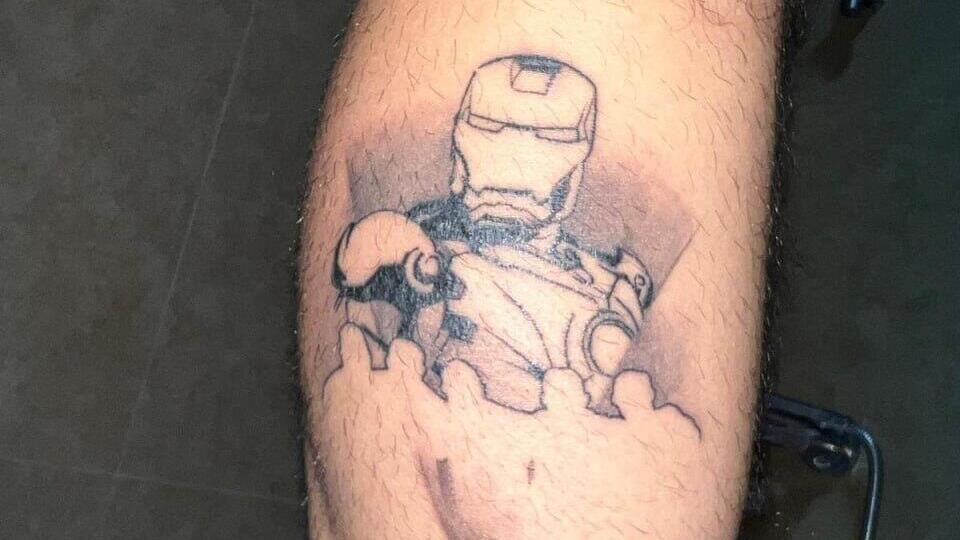
The shared tattoo in his honor: 'Rani was the Iron Man'
On the night before October 7 — the last night before Rani Gvili was killed in the battle for Kibbutz Alumim and later identified as the last fallen soldier held captive in Gaza — the group spent time together. They went to a party in Beersheba. Two weeks earlier, Rani had broken his shoulder and was in severe pain. After someone accidentally hit his injured shoulder at the party, he went home early.
“His shoulder hurt badly,” Tom said. “On October 7, when I woke up and understood what was happening, it was clear to me — Rani wasn’t going out. No chance.” All of the friends assumed he would stay home because of the injury. “We all knew about it. We knew he was scheduled for surgery. There was a certain calm, thinking he was injured at home,” said Guy Elkabets.
But Rani was not at home. He went out to save lives.
“I called him Saturday morning and he told me, ‘I’m in an exchange of fire, I’ll talk to you later,’” Tom recalled. “Then I started hearing bursts of gunfire in the background.” Shortly afterward, a message arrived: “I’m injured, brother, don’t tell anyone,” along with a selfie showing blood on his face. Contact was then lost.
“Rani was a special person,” Tom said. “There’s a reason he told me not to tell anyone. He knew that if the friends found out, we’d all gear up and go looking for him. He didn’t want to put us at risk. That was Rani.”

Friends of the late Rani Gvili await his return
(Photo: Uriel Even Sapir)
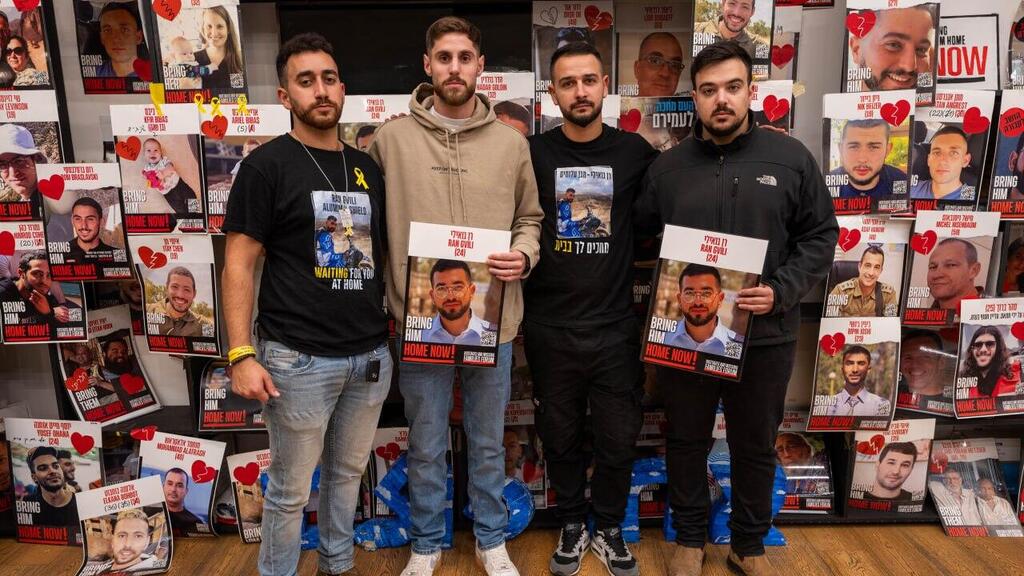
(Photo: Uriel Even Sapir)
For two weeks, Gvili was listed as missing. Tom, himself a police officer, tried to investigate, to find any sign of hope. “My mind never stopped working. I tried to find any lead.” The group kept messaging, discussing and searching for clues.
On the day they realized the last location where Rani had fought, they went there together. “We found Rani’s shell casings,” Guy said. “We understood what had happened.” When he arrived at the site and sent the location and photos to the group chat, an alert appeared seconds later: Rani Gvili had left the group. “It was surreal,” Guy said. “Like the sign we had been looking for.”
The group’s WhatsApp chat is called “Misken Metumtam,” roughly translating to “clumsy idiot,” a name born from their shared habit of stumbling, falling, breaking things and laughing at themselves. “We’re all clumsy,” they said. “Rani especially.” Each has a nickname. All have logged hundreds of days of reserve duty over the past two years. All miss Rani.
“The only thing that stopped Rani,” Tom said, “was that he ran out of ammunition. Today I drive to the same spot where he fought, near that cursed tree. There are a million places to hide around there. And every time I ask myself — why didn’t you hide, Rani? And then I understand: that’s who he was. He didn’t give up.”
Rani was the glue of the group — outwardly strong, inwardly sensitive. “He loved going out and having fun, but he also really loved staying at home,” said Bar Yissacharov. Two days before October 7, they sat in Nadav’s sukkah for a pizza night. Rani told them about his dream of joining the elite Yamam counterterrorism unit. “It was the first time he said that was his direction — that the police were his goal. On October 7, he proved how worthy he was.”
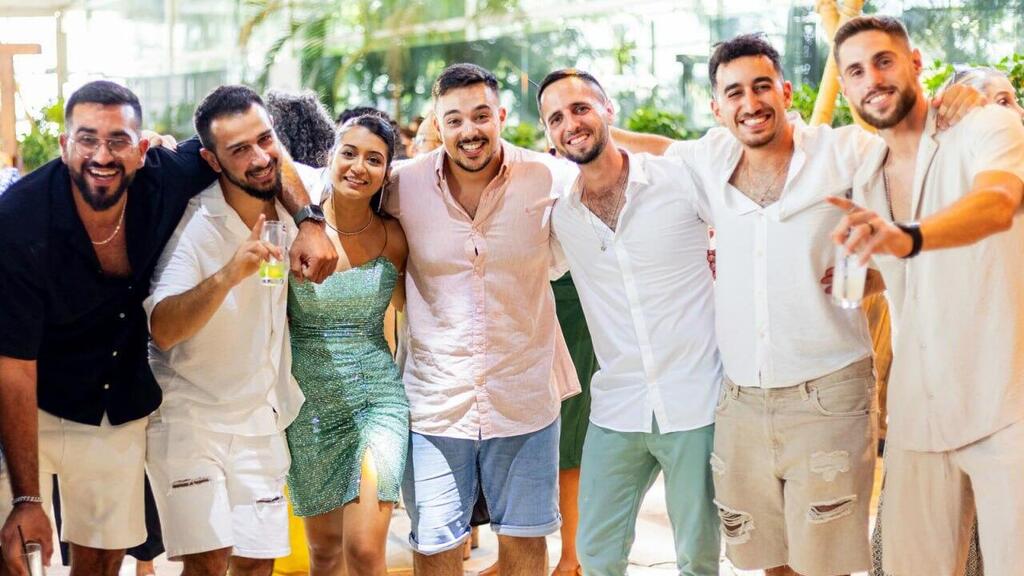
The entire group - with Rani (left)
On Jan. 30, when word arrived that Rani was no longer alive, the friends immediately went to his family’s home. “From the day he was defined as a hostage, I already thought he wasn’t alive,” said Emmanuel “Manu” Ohayon. “I knew his level of dedication. He wouldn’t have allowed himself to go without giving everything.”
His return, they say, will close a circle. “If he returns as a fallen soldier, there will be a grave to cry at. If he somehow returns alive, it will be a miracle. But we’ve already received the worst news.”
“When we got the news, something inside me broke,” Tom said. “To this day I ask myself what I could have done differently.” But out of the pain came love: Tom met his wife through Rani’s sister. “I’m sure he sent her to me,” he said. “He looked out for me.”
Shortly after October 7, the friends decided to commemorate their bond with a shared tattoo in Rani’s memory. The tattoo shows silhouettes of the five remaining friends, set against an image of Iron Man — a symbol representing Rani, “the Iron Man,” as they called him after the many injuries he endured.
“It’s not over until Rani comes back,” the friends said. “Not for us, and not for the people of Israel. The war isn’t over. There’s someone there who needs to come home.” They end with a sentence that lives with them every day in pain: One for all, all for one.