

Gadi Eisenkot is currently the leading contender in Israel’s race for prime minister. He is also walking around armed.
The former IDF chief of staff carries a gun as his campaign presses for stronger security amid threats against him, while the Shin Bet maintains that he does not meet the criteria for protection by Unit 730, the agency’s elite VIP security detail. Eisenkot is exposed to the public almost every day, moving through crowds, meeting voters and allowing people to approach him directly. His aides say threats have included references to the assassination of former prime minister Yitzhak Rabin, including messages invoking the phrase “Rabin is looking for a friend.”
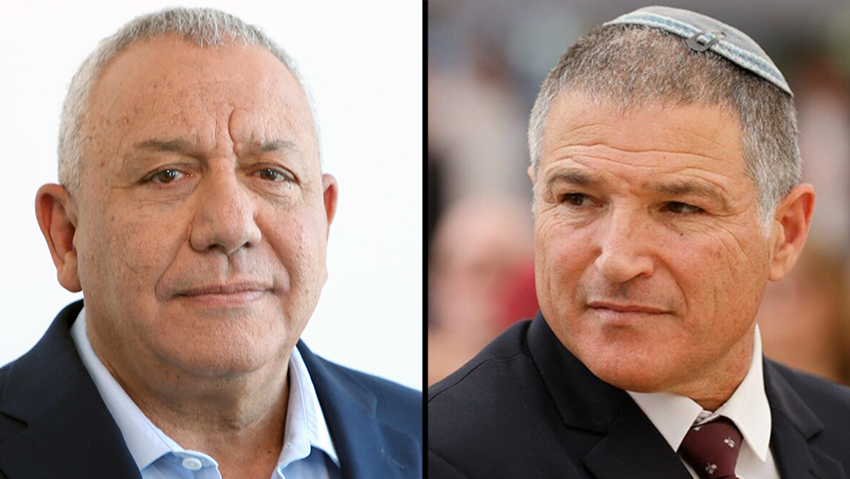
Gadi Eisenkot and David Zini
(Photo: Ryan Preuss, Olivier Fitoussi)
His camp also points to the possibility of threats from Iran, given Eisenkot’s years at the highest levels of Israel’s military and security establishment and Tehran’s interest in retaliating against senior Israeli figures following operations targeting Iranian officials. Yet despite the concern, Eisenkot has not been assigned a Shin Bet protection detail.
Several months ago, according to Eisenkot’s campaign, his headquarters hired a private security company. The company asked police for authorization to arm the guards but was refused. Weeks later, Eisenkot’s staff submitted another request to the police and Shin Bet, this time accompanied by information about specific threats. His aides say police did not respond. After the request became public, police said an answer would be provided, but Eisenkot’s camp says none has arrived.
The Shin Bet also promised to coordinate security arrangements, according to the campaign, but aides say that coordination did not initially materialize. Shin Bet chief David Zini later spoke directly with Eisenkot and, according to his camp, said authorization would be arranged for the private guards to carry weapons and that a contact person would be designated in the Shin Bet operations room. The campaign says neither happened immediately.
On Sunday, a representative from Unit 730 contacted Eisenkot’s Yashar party headquarters and said he would serve as the point of contact. Eisenkot’s aides regarded the move as insufficient and questioned why the matter was still being handled largely through telephone conversations rather than formal written decisions. They also asked why Zini had consulted Supreme Court Justice Noam Sohlberg, chairman of the Central Elections Committee, and why Eisenkot was being denied full protection when, after the Oct. 28 election, he could hold a position that automatically comes with state security, whether as prime minister, defense minister or opposition leader.
Until a solution is found, Eisenkot is taking his own precautions. He carries a gun and recently completed a shooting-range test, where his performance was described as more than adequate.
Shin Bet: He does not meet the threshold
The Shin Bet presents a different picture. According to the agency, the request from Eisenkot’s headquarters was delayed because of a technical malfunction. Zini apologized to Eisenkot personally, and once the request was received, the agency carried out a security assessment.
The conclusion of the Shin Bet’s protection division was that Eisenkot does not require Unit 730 protection. Officials argued that there is no precedent for assigning such a detail to a candidate who does not already hold one of the positions classified as a symbol of government. Naftali Bennett is protected because he is a former prime minister, while Yair Lapid receives protection as opposition leader and former prime minister.
The claim that Benny Gantz received the same level of protection solely because he was a candidate was examined and, according to the Shin Bet, found to be incorrect, though there remains disagreement over the arrangements provided to Gantz during one of his election campaigns.
Zini nevertheless sought alternatives. He consulted Sohlberg, according to the Shin Bet, but did not ask the judge to make the decision for him. The agency then reviewed the intelligence again and its professional assessment remained unchanged: Eisenkot neither requires nor qualifies for a Unit 730 security detail under the existing criteria.
Zini spoke with Eisenkot on Thursday and explained the decision. Eisenkot himself appears to accept that, while the Shin Bet’s approach may be rigid and bureaucratic, it is consistent with existing rules and precedent. Zini also told him that permission for his private security guards to carry weapons should be granted within days. The guards are veterans of a specialized IDF security unit.
The political question
The dispute also reaches Prime Minister Benjamin Netanyahu. In political terms, Netanyahu and Zini both have strong reasons to ensure Eisenkot is adequately protected. Any attack on a leading prime ministerial candidate would immediately raise questions about whether the state had done enough to safeguard him.
The issue also highlights the role of the ministerial committee responsible for the protection of public figures. The committee previously approved Shin Bet protection for Netanyahu’s sons, Yair and Avner, but has not convened to discuss Eisenkot’s case despite a request being submitted. Its secretary, retired Col. Ronen Cohen, is a political appointee. Eisenkot’s camp has questioned why the committee has not met, though no evidence has been presented establishing that political considerations were behind the delay.
The broader question is whether the Shin Bet should bend established criteria when a candidate faces unusual threats, or whether doing so would open the door to political pressure over decisions that should remain strictly professional.
For now, the result is stark: Israel’s leading contender for prime minister is regularly moving through crowds, his aides say he faces specific threats, and the Shin Bet has decided that he does not warrant its full protection detail.
So Eisenkot carries his own gun.