

U.S. President Donald Trump is planning to convene his Cabinet on Wednesday at Camp David, an unusual setting for a president who has rarely used the Maryland retreat.
Camp David has historically been reserved for major national security discussions. Trump has visited only 16 times across his two terms, far less frequently than many of his predecessors.
Trump: Iran is not going to have nuclear weapons
(Video: The White House)


All members of Trump’s Cabinet are expected to attend, including outgoing intelligence chief Tulsi Gabbard, according to U.S. reports. The White House told the New York Post that the meeting will focus on economic achievements, the administration’s anti-fraud task force and foreign policy updates, which could include Iran.
The meeting comes as Trump weighs his next steps in negotiations with Tehran. In recent days, he said he was giving his envoys time to negotiate with Iran but would not sign a “bad deal.”
Overnight, however, Trump appeared to shift his position. After weeks of saying Iran’s enriched uranium must be removed from the country, he did not rule out another option: destroying it inside Iran under the supervision of the International Atomic Energy Agency, the UN nuclear watchdog.
It remains unclear what Trump plans to do at Camp David. U.S. reports have not indicated that he intends to present an agreement or announce a breakdown in talks. The New York Post, which first reported the Camp David Cabinet meeting, cited the Iran backdrop but offered few details. Fox News also said the gathering comes as the administration considers its next moves on Iran, foremost among them a possible agreement.
Iranian media, meanwhile, reported possible progress on one of the main sticking points in the talks: frozen Iranian funds.
Iran’s Fars news agency, citing a source close to the negotiating team, said the “last serious dispute” between the sides — access to frozen funds — was “on the way to being resolved” through Qatari mediation.
According to Fars, Tehran has insisted that “no agreement is possible until the agreed-upon money is deposited.” The report said progress had been made, but the source added that given what Iran views as a history of broken U.S. promises, Iranian negotiators do not consider the understandings final and “are prepared for every possibility.”
Iran’s Tasnim news agency, which is affiliated with the regime, earlier reported that under a draft understanding, Iran’s frozen funds, estimated at $23 billion, would be released during the negotiations. A source familiar with the talks said Iran was demanding that half the money be released after the understandings are announced and the other half after 60 days.
Tasnim said Iranian Parliament Speaker Mohammad Bagher Ghalibaf’s visit to Qatar was partly aimed at reaching understandings on implementing Iran’s demand, including the first transfer of $12 billion. Ghalibaf completed the visit Tuesday and returned to Iran.
The Camp David meeting also comes as analysts scrutinize Trump’s broader approach to Middle East crises: reaching an initial ceasefire or narrow agreement first, then leaving the hardest issues for later.
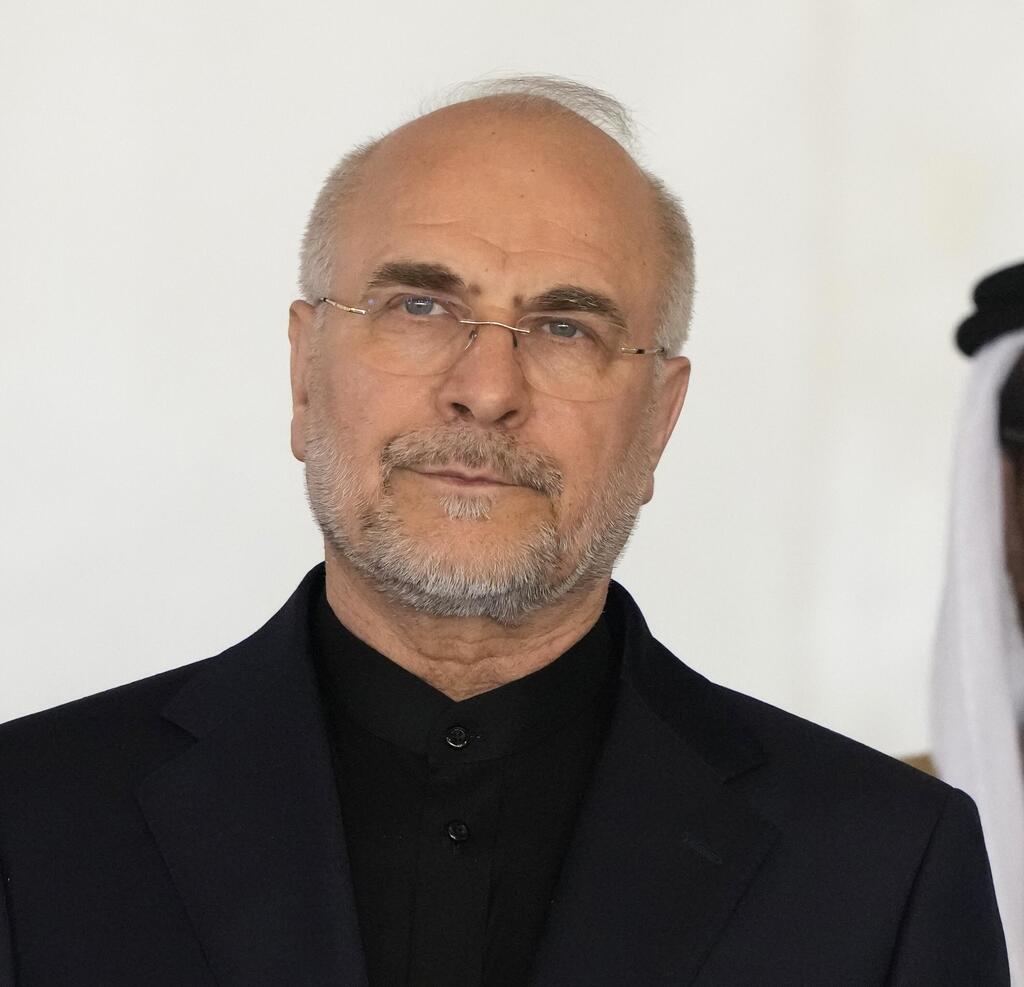
Iranian Parliament Speaker Mohammad Bagher Ghalibaf
(Photo: AP Photo/Eraldo Peres)
The New York Times reported that this approach produced mixed results in Gaza, where the United States and Qatar mediated between Israel and Hamas. The first stage of the deal secured the release of the remaining hostages held by Hamas, a partial Israeli withdrawal from parts of Gaza and a sharp increase in food and medicine entering the enclave.
But the second stage stalled. Hamas has not laid down its arms, an international force is not expected to deploy in Gaza soon and a new Palestinian administration has not taken charge of rebuilding destroyed cities.
Instead, Israel continues daily strikes in Gaza, Hamas is consolidating its power and the technocratic committee meant to assume responsibility for running the enclave remains in Egypt.
Michael Koplow, chief policy officer at the Israel Policy Forum, a New York-based research group, said a phased approach can be useful in negotiations. But with Trump, he said, it can also allow the president to declare victory while leaving the central problems unresolved.
Analysts say a similar approach to Iran carries major risks. Trump appears to be pursuing an agreement that would first address the Hormuz crisis while postponing the issues that fueled the conflict: Iran’s nuclear program, missile stockpiles and support for proxies across the Middle East.
Koplow said the Iran track will be far more difficult than Gaza because it involves a larger conflict and issues that are “much tougher and much more complicated.”