


Prime Minister Benjamin Netanyahu ordered the removal of a 5-billion-shekel plan for northern Israel from the agenda of Sunday’s Cabinet meeting in Jerusalem after ministers failed to agree on the wording of the government decision, ynet has learned.
The plan, which in its current form does not meet the rehabilitation needs of the north, is now expected to be submitted next week at a ceremonial Cabinet meeting in the north.

The package includes a series of significant decisions and major investments, but they are expected to bear fruit only years from now. They do not provide the immediate answers needed by residents of communities along the confrontation line, who are trying to adjust to the region’s current reality: a permanent wartime routine under Hezbollah fire and without security.
The demands of local authority heads, who fought for measures that would bring some hope to hundreds of thousands of residents living under fire despite a nominal ceasefire in Lebanon, have not yet been met, despite promises from senior government and Finance Ministry officials.
Government officials note that another 3 billion shekels, delayed for more than a year, is supposed to go toward repairing war damage and developing communities in the “northern envelope,” a term used for Israeli communities near the Lebanese border. Responsibility for that government decision lies with the Prime Minister’s Office, but it is currently unclear whether the government will manage to implement it before it is dissolved.
The lack of a sense of security
As the government struggles to provide economic, educational and community solutions for northern residents, the IDF is also struggling to provide the security they were promised.

Lebanon border town homes damaged in Hezbollah attacks
(Photo: Gil Nechushtan, Nachum Segal, Avihu Shapira, AP Photo/Leo Correa)
Over the weekend, drone and rocket fire toward communities along the northern border did not stop. The military has maintained ambiguity and has not provided information on the scope of Hezbollah attacks. In the north, officials accuse the army of trying “to normalize the dangerous security reality.”
One explosive-laden first-person-view (FPV) drone sent into Israeli territory fell Saturday morning in the orchards of Kibbutz Sasa in the Upper Galilee, a short distance from workers who were pruning trees. Meanwhile, in the kibbutz dining room, many residents, families and children were present, with children playing in playgrounds nearby. As in other cases, no warning sirens or alerts were issued before the drone hit.
“The feeling is definitely unpleasant,” said Yehuda Livne, head of the kibbutz’s emergency response team. “The noise from IDF strikes and explosions does not stop, and there is a real war here on the border.”
Against the backdrop of a U.S. announcement extending the ceasefire between Israel and Hezbollah by another 45 days, Livne said, “The expectation is that the IDF will provide security here and that we will be able to live in peace and quiet.”
Hezbollah FPV drone strikes on Israeli forces in Lebanon


With the start of the war with Iran and Hezbollah’s entry into the renewed fighting, the IDF declared its first security objective: a ground maneuver to the so-called “anti-tank line,” about 10 kilometers, or 6 miles, inside southern Lebanon, to push back the threat of direct fire from precision anti-tank missiles that caused damage and destruction in communities near the border.
That threat was also the official reason for the evacuation of more than 65,000 northern residents for more than a year and a half after the Hamas-led October 7 attack. But military officials now understand that while it succeeded in pushing back that threat, it must confront another one that caught Israel relatively off guard: the launch of precision FPV drones and unmanned aircraft, some of which cannot be detected in advance.
The IDF is now examining whether to deepen the ground maneuver beyond the 10-kilometer line to try to push the latest threat farther away. Military officials say Israeli forces are fighting a full-scale war in southern Lebanon but are constrained from striking deeper inside Lebanon and in Hezbollah’s Dahieh stronghold in Beirut.
Meanwhile, the hunt for senior Hezbollah figures continues, and the IDF says all of the Iran-backed terrorist group’s commanders and planners are targets and do not enjoy immunity.
The abandoned ‘civilian enclave’
Meanwhile, Northern Command ordered a closed military zone from the beaches of Betzet to Achziv due to the ongoing drone threat, barring civilians from entering over concern they could be targeted by Hezbollah.
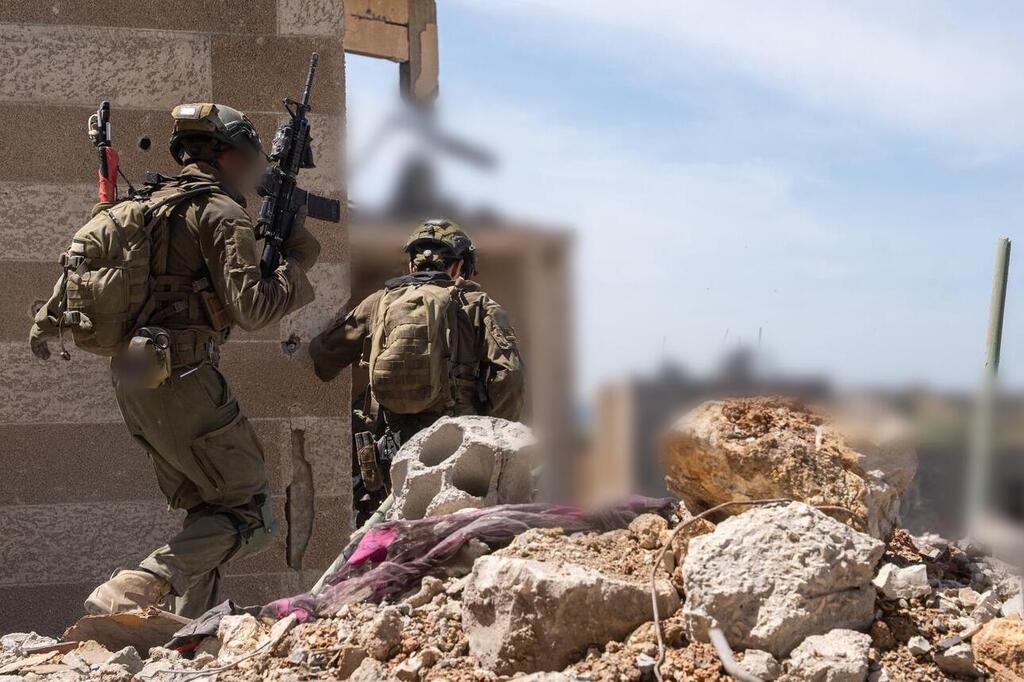
IDF force operating in southern Lebanon
(Photo: IDF)
But the Rosh Hanikra tourist site, where three construction workers were wounded Thursday by a direct hit from an FPV drone, is still considered by the military a “civilian enclave” that can operate as usual.
“In effect, south of us the entire area is under a general’s order as a closed military zone, and north of us is Lebanon. In this situation, we are supposed to open and receive people as usual,” said Albert Pinchas, CEO of the tourist site and a member of Kibbutz Rosh Hanikra.
Pinchas said the site will remain closed to visitors.
“We are not prepared to risk the lives of travelers and visitors by operating the cable car and the grottoes,” he said. “People will stand here in line to go down in the cable car while Hezbollah drones and UAVs are above them. Who will take responsibility for dozens of dead or wounded here?
“We no longer know whether the army’s decisions are security-related or political. The blood here on the asphalt is still fresh, and already, after a few hours, as far as the army is concerned, the instructions are to open the tourist site to visitors, as though there is no war here and no danger.”