


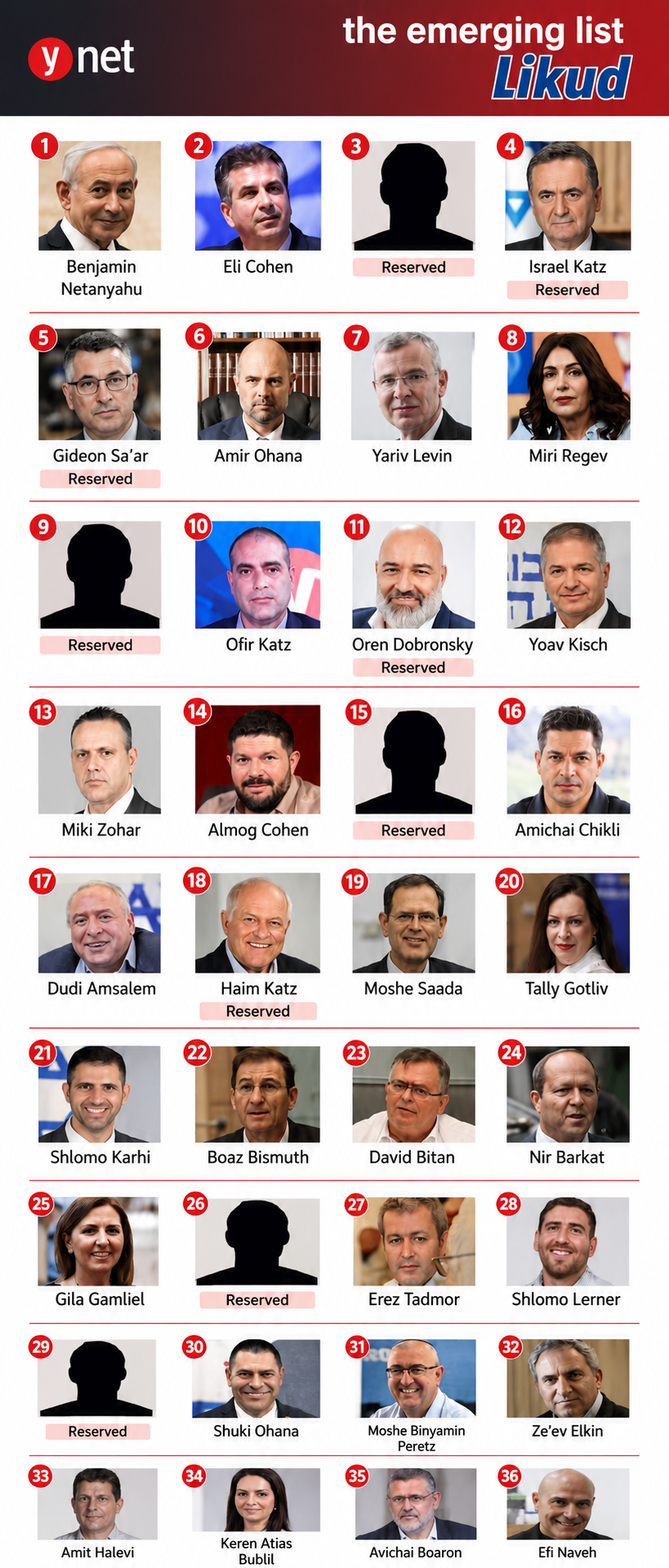
Likud’s list is changing. A number of ministers and lawmakers were pushed sharply down the rankings in the party primaries and are unlikely to return to the Knesset, while the new lineup contains no former IDF major general or chief of staff and features seven Mizrahi candidates in the primary’s top 10, before reserved slots are added.
Prime Minister and Likud Chairman Benjamin Netanyahu said in a statement that he was “very pleased with the results” and congratulated those elected to the list.
“The new Likud list reflects renewal and the integration of new forces at the top of the list,” Netanyahu said. “Together with the reserved candidates, who will strengthen the list even further, the Likud team will lead us to a great victory and the establishment of a broad national government.”
Netanyahu said this was “the only way to prevent a left-wing government of Eisenkot, Yair Golan, Liberman and the Arab parties.”
He thanked Likud members who, he said, “voted according to common sense and not according to deals,” adding that he also greatly appreciated those who failed to secure places on the list and intended to involve them in the party’s efforts ahead of the election.
Seven of the primary’s top 10 candidates are of Mizrahi origin: Eli Cohen, Amir Ohana, Miri Regev, Miki Zohar, Almog Cohen, Amichai Chikli and Dudi Amsalem. Justice Minister Yariv Levin and Education Minister Yoav Kisch are Ashkenazi, while Ofir Katz is the son of immigrants from Iraq and Romania.
The list contains no senior former military commanders apart from Regev, a reserve brigadier general.
Candidates associated with the Religious Zionist movement, particularly the national-religious community traditionally identified with knitted kippahs, suffered a significant setback. Ministers Idit Silman and Ze’ev Elkin, along with lawmakers Ariel Kallner, Amit Halevi, Nissim Vaturi and Avichay Buaron, were pushed into positions not currently considered likely to win Knesset seats. Moshe Saada and Shlomo Karhi fared better but neither reached the top 10.
The setbacks follow the earlier departures of other religious Likud figures, including Dan Illouz, who moved to Yisrael Beytenu, and Yuli Edelstein, who joined forces with ex-Likud lawmaker Gilad Erdan in forming a new party. Agriculture Minister Avi Dichter was another prominent casualty.
The former Shin Bet chief, who supported the coalition's controversial judicial reform plans despite harsh criticism from former members of the security agency, fell to 27th place on the national list. His eventual position will be even lower once reserved slots are taken into account.
Social Equality and Advancement of Women Minister May Golan finished just ahead of him, in 23rd place on the national list, also considered unrealistic. An investigation was opened into Golan during the outgoing term, and she did not appear for questioning sessions to which she had been summoned.
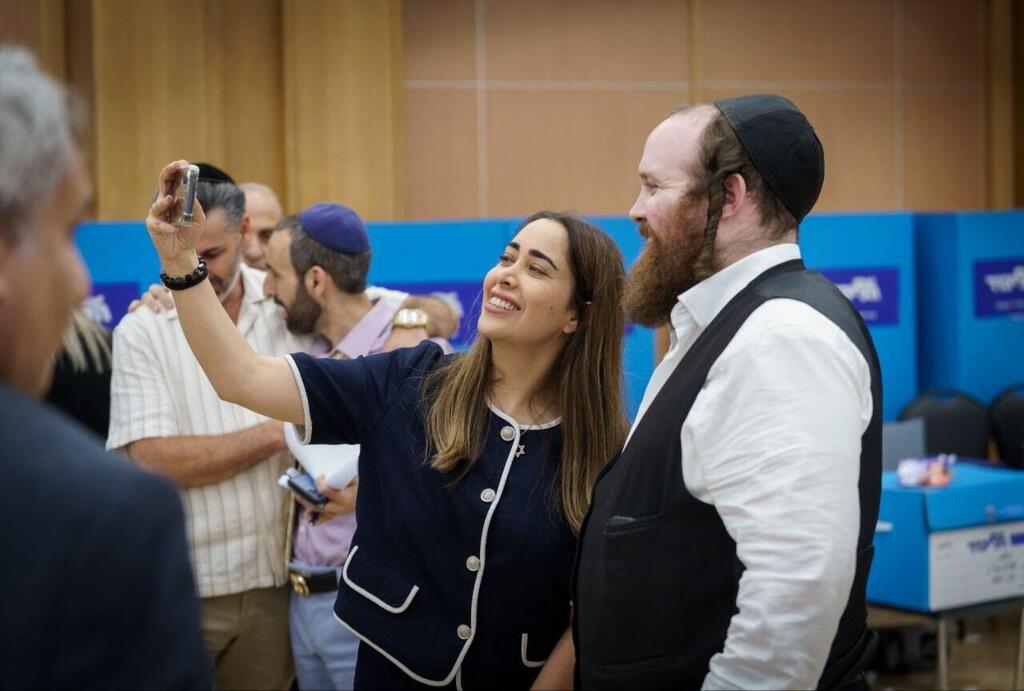
Minister May Golan taking a selfie with a voter
(Photo: Shalev Shalom)
Despite commitments to women’s representation, she is not expected to be among the first 39 candidates on the final list.
There remains some possibility that Otzma Yehudit leader Itamar Ben-Gvir could offer her a place on his party’s slate. The two worked closely throughout the term and have a good relationship.
Elkin, a minister in the Finance Ministry who returned to Likud alongside Foreign Minister Gideon Sa’ar, ranked 17th on the national list, below Economy Minister Nir Barkat, who currently holds the last slot regarded as realistic.
Environmental Protection Minister Silman, whose campaign emphasized her decision to quit the previous “government of change” — a move that ultimately helped bring down the coalition and trigger the election that returned the right to power — finished 25th and is not expected to make the top 40 once reserved slots are added.
Other lawmakers pushed outside realistic positions include Keti Shitrit, Sasson Guetta and Shalom Danino, as well as Eti Atiya, who failed to secure a place despite major backing from Likud heavyweight Haim Katz.
Atiya’s final tally, 21,449 votes, offers a revealing measure of the power of organized deals inside Likud. Katz managed to propel a lawmaker considered relatively unknown among the broader membership to what was regarded as an extraordinary result.
Even so, Atiya is unlikely to enter the next Knesset unless Likud remains in power and again uses the so-called Norwegian Law, which allows ministers to temporarily resign from parliament so lower-ranked candidates on their party list can take their seats.
The results also indicate that organized voting blocs and independent voting each accounted for roughly half of the primary vote.
Tally Gotliv, a firebrand lawmaker known for her hard-line positions on the judiciary and opposition to political compromise, finished 12th in the vote. She said after most ballots had been counted that she had survived despite efforts by Netanyahu’s circle to weaken her.
“Even though the prime minister’s circle really worked hard to thwart and weaken me, even though all the organized votes in the deals were instructed not to mark my name, and even though I was the only one for whom no message was sent from the prime minister calling for support, right-wing Likud voters fought for me with tremendous force,” she said.
Likud lawmaker Hanoch Milwidsky struck a more conciliatory note after finishing outside a position considered likely to win a Knesset seat.
“Democracy is democracy, even when you don’t particularly like the results,” he said. “I want to wish great success to the team chosen by Likud members. Major missions and challenges lie ahead.”
Deputy Minister Almog Cohen, who reached the top 10, thanked Likud members and the security forces. “None of this would have been possible without the heroism of our soldiers and members of the security forces, and for that I thank them,” he said.
“I entered the battle when the prime minister told me he was certain I could succeed even with three days, without signs, without a campaign headquarters, without stickers. It was the party members that brought me here, and I thank them and the Creator for that.”
Levin, who finished third in the primaries, interpreted the result as an endorsement of his political agenda. “This is an expression of confidence not only in me personally, but first and foremost in the path I am leading,” he said. “A huge public demands the completion of the judicial reform. A huge public demands justice. I will continue to act without fear to make sure that happens.”
Levin also thanked ministers and lawmakers from the outgoing Knesset who did not win realistic positions. “Their contribution to the country and to the movement will always stand to their credit,” he said.