


Moscow is increasing pressure on Israel over the future of the Alexander Courtyard in Jerusalem’s Old City, as Russian Ambassador to Israel Anatoly Viktorov made an unusual visit to the disputed compound on Saturday.
Viktorov arrived with a large delegation that included nuns who had traveled from Russia, family members and several embassy employees.
Russian ambassador’s visit to the Alexander Courtyard



The visit came days after the Russian Embassy in Israel said the process of re-registering Russian ownership rights over the Alexander Courtyard was in its “final stages” and that the issue was now “purely legal.”
Viktorov made Moscow’s position even clearer in an interview last week with RTVI. “The courtyard is ours, Russia’s courtyard. There is no need for negotiations on this. We only need to complete the legal procedures,” he said.
His remarks suggest that Moscow considers the ownership question settled and views the remaining dispute as merely a matter of completing the legal process in Israel. Israeli officials, however, stress that the matter is still under professional review and that it is too early to determine whether, or when, the process will be completed.
Officials familiar with the issue cautioned against interpreting the ambassador’s visit as evidence that a decision has already been made to transfer the compound to Russia. They said that alongside the legal and diplomatic process, Moscow is also waging a public campaign aimed at creating the impression that the outcome is already inevitable and increasing pressure on Israeli decision-makers.
One assessment is that Russia is seeking to exploit the current political window in Israel, calculating that after the election a decision could become more difficult, particularly if Benjamin Netanyahu is no longer prime minister. Officials familiar with the matter therefore say Moscow has recently intensified both diplomatic and public pressure surrounding the site.
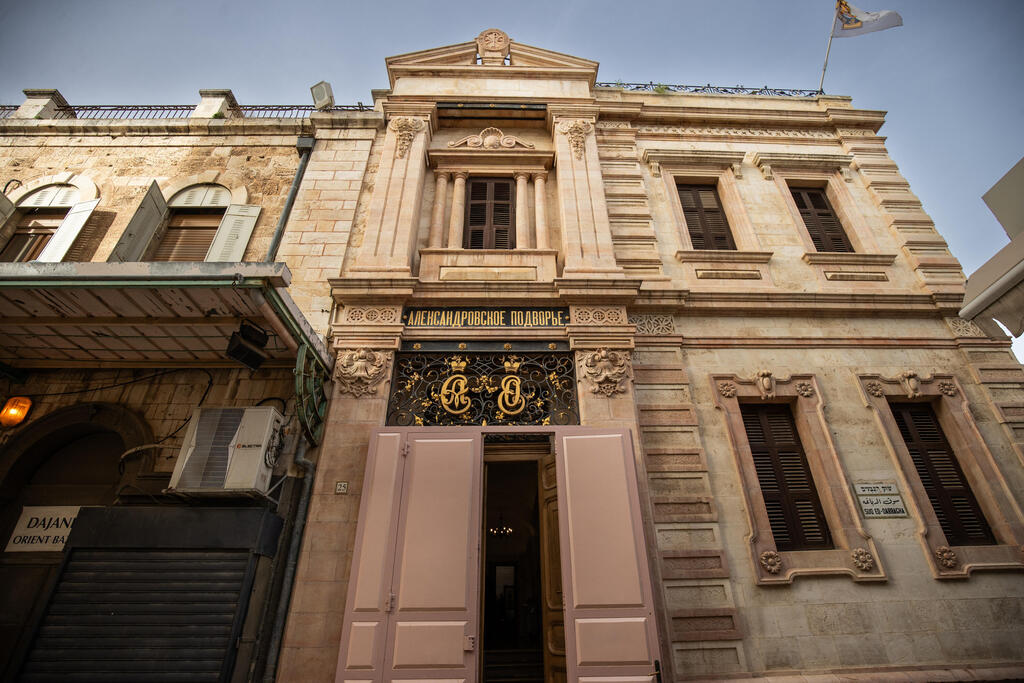
Alexander Courtyard
(Photo: Alex Kolomoisky)
Viktorov’s arrival at the Alexander Courtyard with nuns who had traveled especially from Russia may form part of that effort. The visit gives Moscow’s claim a highly visible public dimension and conveys the message that Russia already sees the property as an asset moving toward its control.
That impression has been reinforced by Ukrainian nuns who currently operate the compound. They said Russian clergy recently asked them, “When are you leaving?” a remark they interpreted as a sign that the Russian side believes an Israeli decision may be close.
The Alexander Courtyard is a historic Russian compound in the heart of Jerusalem’s Old City, a short walk from the Church of the Holy Sepulchre. Covering about 1,300 square meters, it includes the Church of St. Alexander Nevsky, inaugurated in 1896, as well as buildings and archaeological sites of religious and historical significance.
The land was purchased during the Russian Empire, and the compound was established in the late 19th century by the Imperial Orthodox Palestine Society, known as the IOPS. After the Russian Revolution, a long-running dispute emerged over ownership of Russian properties acquired in the Holy Land during the czarist era.
In recent years, Moscow has demanded that Israel recognize an Ottoman-era registration in the name of the “Glorious Russian Kingdom” as granting present-day rights to the Russian Federation. The organization that established the compound disputes that claim, arguing that ownership rights belong to it and do not automatically pass to the Russian state.
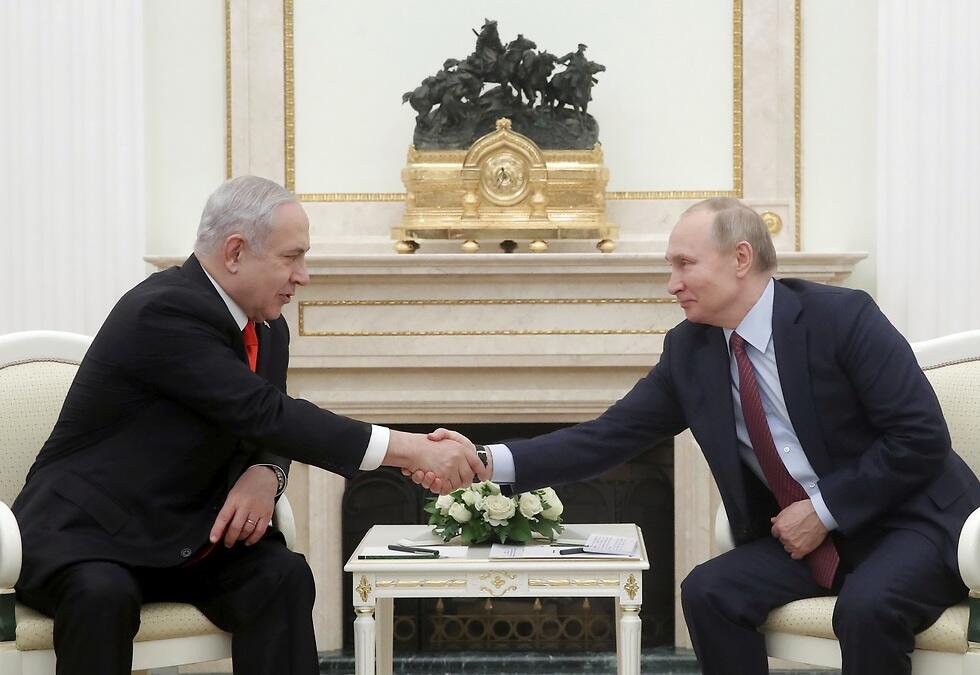
Netanyahu and Putin
(Photo: AP)
In 2020, during a Netanyahu government, an order designated the Alexander Courtyard a “holy place.” At the same time, Israel moved to renew registration of the property in the name of the Russian Federation. A petition filed by the IOPS halted that process and effectively preserved the status quo.
Two years later, Russian President Vladimir Putin personally wrote to then-prime minister Naftali Bennett asking him to act to transfer the rights to Russia, underscoring the importance the Kremlin attaches to the issue.
In late 2024, Netanyahu revived the work of a ministerial team examining the dispute. The team includes Foreign Minister Gideon Sa’ar and Justice Minister Yariv Levin, while the National Security Council and Prime Minister’s Office are coordinating the process. In November 2025, a special interministerial committee held a hearing attended by the parties. Russia participated actively and has since been waiting for the official protocol and an update on the next steps.
‘Another foothold in the heart of Jerusalem’
The dispute over the Alexander Courtyard extends beyond the legal question of ownership. A study published last month by Israel’s Institute for National Security Studies, written by Ella Itkin and Arkady Mil-Man, warned that the activities of the Russian Orthodox Church in Israel go far beyond religion.
According to the study, the Russian Church has historically served as an instrument for advancing Moscow’s diplomatic interests, while ties among the church, the Kremlin and Russian security services have grown stronger under Putin. The researchers also pointed to ties between the IOPS and senior figures in Russia’s political and security establishment.
The organization is headed by Sergei Stepashin, a former Russian prime minister and former head of the Federal Security Service, or FSB. According to the study, Ambassador Viktorov is also affiliated with the organization.
The authors argued that, given the close cooperation between the Russian Church and Putin’s government, and because they say Israel is under no legal obligation to transfer the compound to Russia, Israel is unlikely to gain any strategic benefit from doing so. They also cited Moscow’s close relations with Iran and other actors hostile to Israel.

Naama Issachar
(Photo: Yair Sagi)
The researchers warned that handing over the Alexander Courtyard could give Russia another foothold in the heart of Jerusalem and that a Russian victory in the case could lead to future demands for additional properties linked to Russia’s historical presence in the Holy Land.
The Alexander Courtyard also became part of public discussion surrounding the case of Naama Issachar, an Israeli woman imprisoned in Russia and released in January 2020. During negotiations for her release, reports suggested that transferring the Alexander Courtyard to Russia was part of understandings between Netanyahu and Putin.
There is no public evidence that the property transfer was formally included in the deal, although various officials have said over the years that the matter was discussed in talks between Jerusalem and Moscow. Officials familiar with the issue say Putin sees the compound as personally and symbolically important.
For the Russian president, transferring such a prominent historic Russian property into Moscow’s hands could be presented as a significant diplomatic and symbolic achievement in Jerusalem, particularly at a time of acute confrontation between Russia and the West.
Against that backdrop, Viktorov’s unusual visit takes on added significance. Formally, the process remains unresolved, and Israel has not announced any decision to transfer the compound to the Russian Federation.
But the ambassador’s arrival with a large Russian delegation, coupled with the questions reportedly directed at the Ukrainian nuns about when they intend to leave, suggests Moscow wants to convey that, from its perspective, the battle over the Alexander Courtyard has entered its final stage.