

Nine grams of cannabis — the small amount found in Naama Issachar’s luggage — became the opening shot in one of the most intense and secretive struggles still unfolding between Moscow and Jerusalem.
In 2019, Russian President Vladimir Putin spotted an opportunity after the young Israeli woman was arrested during a layover in Moscow on her way home from India. A public campaign for her release gathered momentum in Israel, and Prime Minister Benjamin Netanyahu submitted a formal clemency request to the Russian president.
Putin, for his part, expected Israel to pardon Russian hacker Alexei Burkov, who was being held in Israel. The United States sought his extradition, and Jerusalem chose Washington over Moscow. Russia reacted angrily, convicted Issachar of drug smuggling and sentenced her to seven and a half years in prison.
Public pressure on Netanyahu mounted. Israel then floated an alternative gesture that could appease Putin: Alexander's Courtyard, a historic property in Jerusalem’s Old City.
In January 2020, at the height of an election campaign, Netanyahu stopped in Moscow and personally accompanied Issachar back to Israel after Putin ordered her release. But Putin does not give gifts for free. He was said to expect a significant gesture in return — the kind not signed on paper and not spoken of openly.
“It was important to Putin not to formally link the two matters,” said a senior official involved at the time. “He does not want to be seen as a trader. He comes from a world of personal commitments and gestures between leaders. His view is: ‘I acted like a man toward you, now you act like a man toward me.’”
Without signing any official document, Netanyahu is said to have personally committed to advancing the issue of Alexander's Courtyard.
A strategic foothold in the Old City
Over the past decade, the ancient compound in the Christian Quarter has become the center of an international dispute and a symbol of Putin’s ambitions. Russia has no foothold in the Old City, and for a country that sees itself as the protector of Orthodox Christianity, the site carries deep significance.
Yet the path to control is fraught with diplomatic and security landmines, placing Israel between Russia and the West.
Since Netanyahu’s alleged commitment, procedural steps have been taken, mostly for appearances. A request to renew the property’s registration — previously listed in Ottoman-era records as belonging to the Russian tsarist empire — was accepted by Israel’s land registry. The property was re-registered under Russia as the successor state to the tsarist empire.
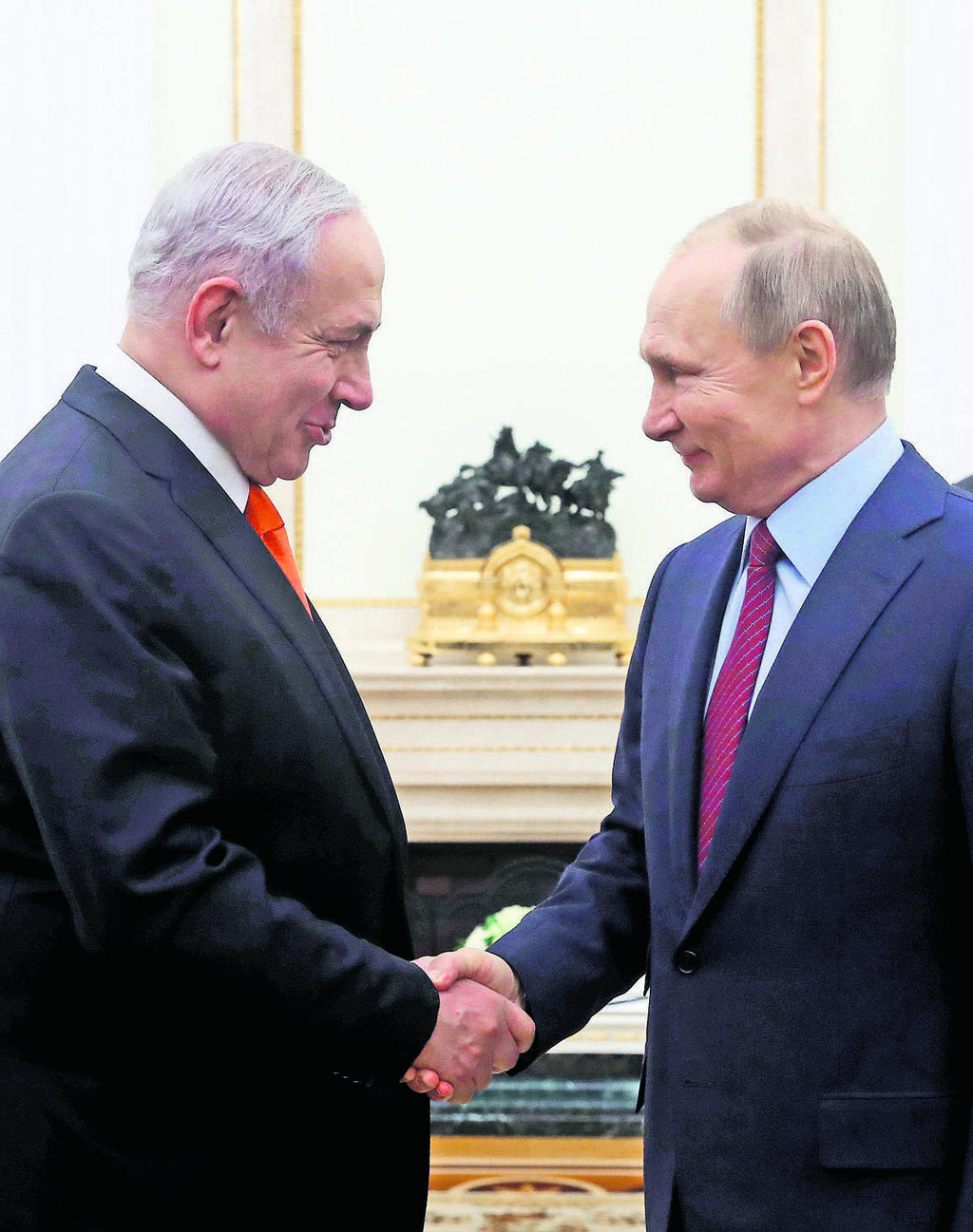
Vladimir Putin and Benjamin Netanyahu, January 2020
(צילום: Maxim Shemetov/AP)
But the registration was technical and did not determine ownership, the issue that most interests Moscow. Appeals and objections pushed the matter to the Jerusalem District Court.
Netanyahu then invoked an unusual legal mechanism dating back to the British Mandate, known as the “King’s Order in Council,” declaring the compound a “holy site.” Under that designation, authority over ownership questions shifts from the courts to the government.
The prime minister must now decide on both registration and ownership, taking into account the recommendation of a special ministerial committee.
Beyond diplomacy, security officials have voiced concerns. Some fear that if Russia gains control, the compound could be used for intelligence purposes.
“The Russian Compound in Jerusalem was always considered a hub of Russian intelligence, even during the Soviet period, and it appears that has not changed,” said a senior official familiar with the matter. “The suspicion is that intelligence operatives are still active there.”
Russia’s renewed push
Putin appears to see a fresh opportunity. The war in Ukraine no longer dominates headlines as it once did, and relations with Washington have shifted under President Donald Trump. Netanyahu and Putin have resumed phone calls.
Messages from the Kremlin reportedly contributed to the first meeting last November of the ministerial committee established to address the issue — nearly four years after its formation.
In March last year, Netanyahu sent his then-military secretary, Roman Gofman, now a candidate to head the Mossad, for a series of discreet meetings in Moscow. Sources say Russia raises Alexander's Courtyard in every encounter with Israeli officials.
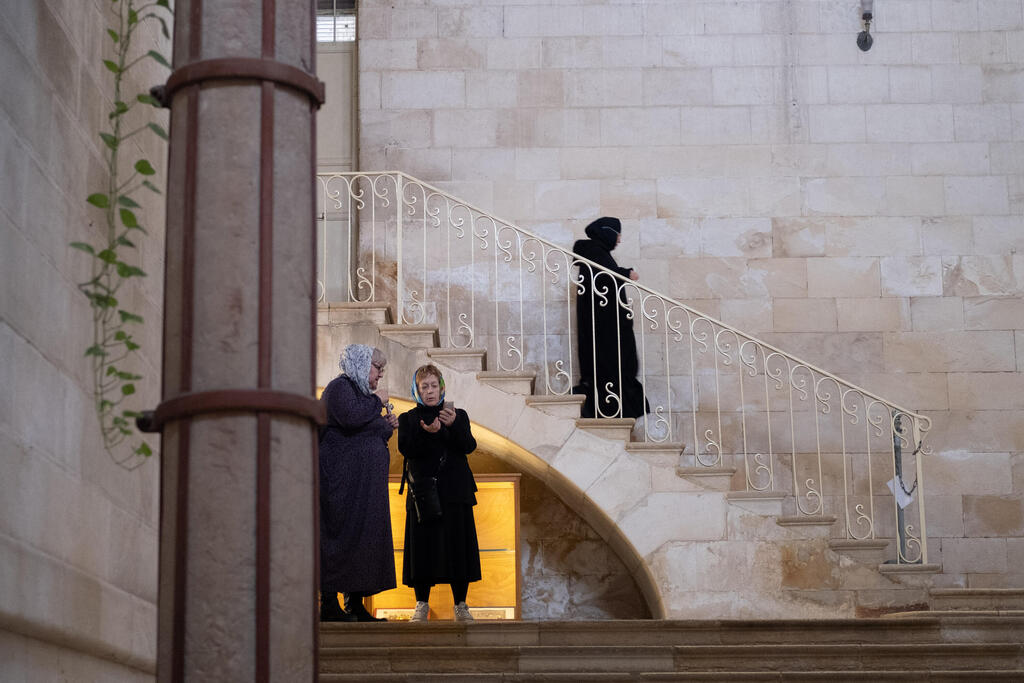
Russian pilgrims at the Alexander Courtyard complex
(Photo: Yoav Dudkevtich)
Putin, they add, does not wish to be perceived as a leader whose promises can be broken.
The committee is formally headed by ministers Gideon Sa’ar and Yariv Levin, but discussions are conducted quietly under the Prime Minister’s Office. Participants reportedly leave their phones at the door.
With Israel in an election year, some believe Netanyahu may see an opportunity to extract diplomatic concessions from Moscow — but only if he delivers on what Russians view as a personal commitment.
A compound layered in history
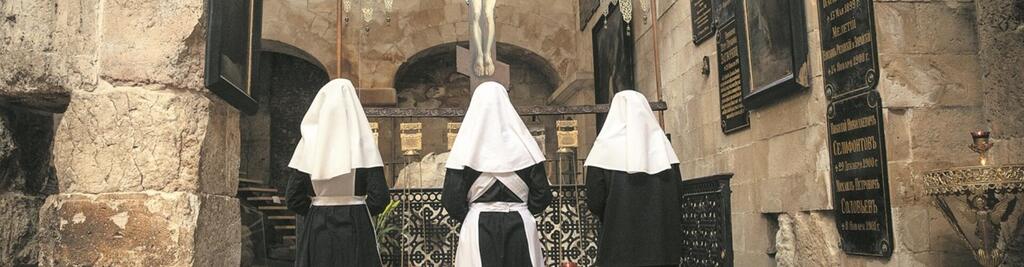
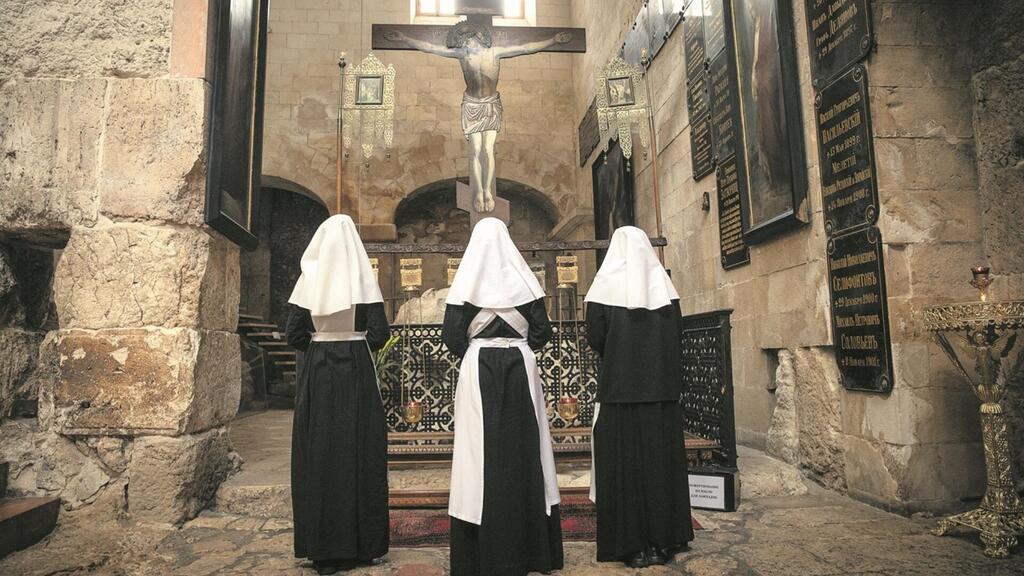
From the outside, Alexander's Courtyard resembles an elegant European building with heavy wooden doors and high ceilings. A small group of nuns receives visitors. Downstairs, however, the space opens into a subterranean Roman street dating back nearly 2,000 years.
The compound borders the Church of the Holy Sepulchre and lies about 70 meters from Golgotha, where Christian tradition holds that Jesus was crucified. A Roman triumphal arch from the second century still stands at the entrance. Some believe stones from the Second Temple were used in its construction, making it significant to Jews as well.
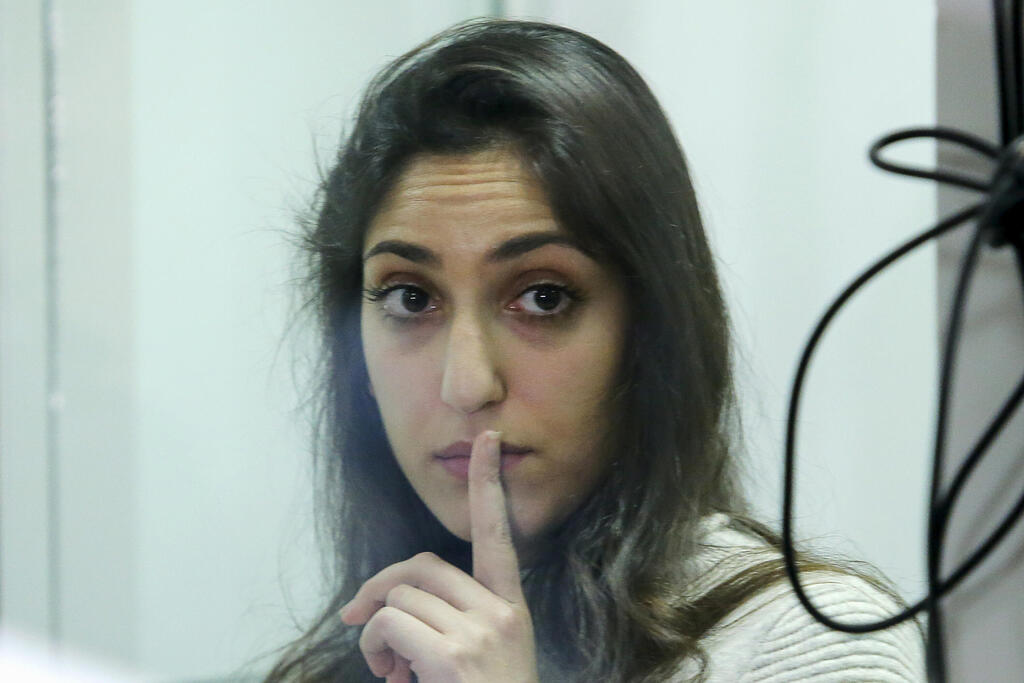
Naama Issachar
(Photo: Alexander Zemlianichenko Jr./AP)
In the 19th century, as European powers competed for influence in Jerusalem, the Russian Empire acquired the property. Archaeological discoveries transformed it into a prized religious and political asset. In 1889, it was transferred to the Imperial Orthodox Palestine Society, known as OPS.
After World War I and the Bolshevik Revolution, the Russian Orthodox Church split into “white” and “red” factions. The exile-affiliated OPS continued to manage the site under British and later Jordanian recognition.
Following the Six-Day War, Israel maintained the status quo and avoided intervening in ownership disputes involving Russian church properties.
Putin’s rise changed that dynamic. Reasserting Russia’s imperial and religious identity, he strengthened ties with Patriarch Kirill. About 15 years ago, Russia regained control of Sergei Courtyard in the nearby Russian Compound, despite domestic opposition.
Now Alexander's Courtyard stands at the center of competing claims by organizations bearing similar names, each asserting itself as the legitimate successor to the original OPS.
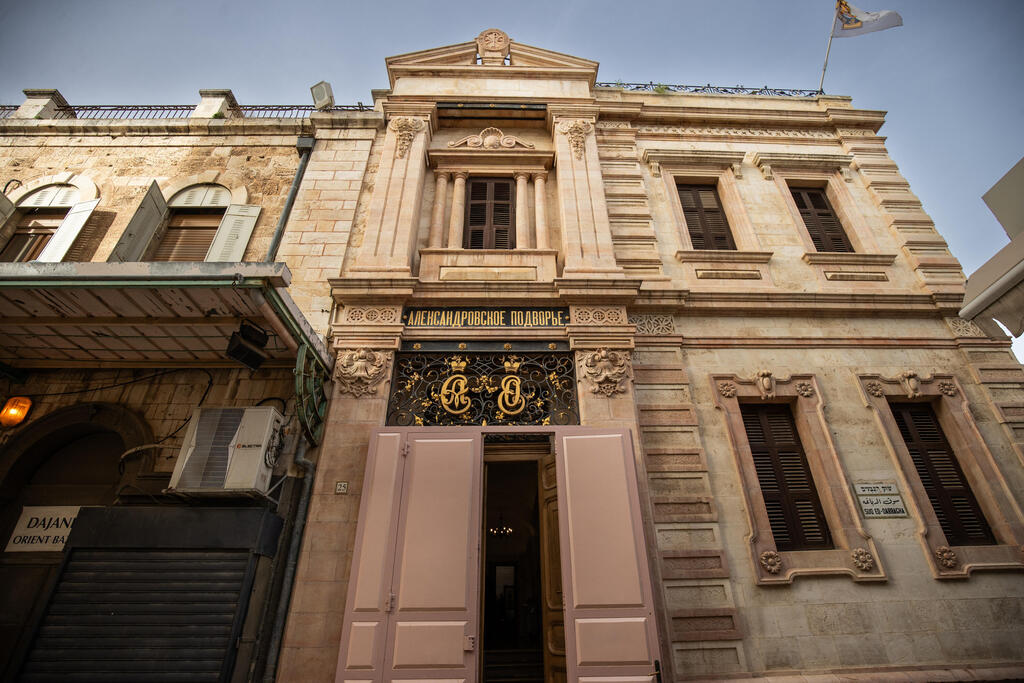
(Photo: Alex Kolomoisky)
Espionage fears
The Russian Orthodox Church’s international activities have drawn scrutiny elsewhere. In Bulgaria, lawmaker Atanas Atanasov, a former national security chief, accused Russian clergy of acting as intelligence agents.
Archimandrite Vassian, now head of the Russian Ecclesiastical Mission in Jerusalem, was expelled from North Macedonia in 2023 over allegations of interference. Bulgarian officials said he posed a national security risk.
Russia denies the claims. Its embassy in Israel said allegations of intelligence activity are “baseless” and part of a Western campaign to demonize Russia. It described Vassian’s role as purely religious and said any suggestion that Russia would act against Israel’s security interests is “fake news.”
Former Israeli ambassador to Russia Arkady Mil-Man said Israel must reassess its approach.
“Russia and its security services see us as part of the hostile camp,” he said. “The Russian Church is a central pillar of Putin’s regime. Some clergy sent here are not ordinary religious figures.”
Others in government argue Russia does not need an Old City property to carry out intelligence work, pointing to its existing holdings in Jerusalem.
Still, critics warn that Alexander's Courtyard's sensitive location — overlooking the Church of the Holy Sepulchre, the Hurva Synagogue and al-Aqsa Mosque — makes it strategically significant.
A frozen gift
Inside the compound, time appears suspended. Twelve nuns run the site. All are Ukrainian.
According to Nikolai Vorontsov Hoffman, head of the Munich-based OPS that currently manages the property, their nationality is coincidental. Others suggest it complicates any potential transfer to Russia.
Sister Elizabeth, whose family remains in Kyiv, says she cannot imagine serving under Russian authority. “If that happens, we will leave,” she said. “We cannot serve those who are killing our relatives.”
For now, Israel faces a delicate choice: uphold what Moscow views as a personal pledge or resist amid mounting geopolitical and security concerns.
No official response was provided by the Prime Minister’s Office.
Russia’s embassy said the property’s ownership stems from historical rights and that Moscow has pursued legal recognition accordingly. It rejected allegations of subversion, emphasizing decades of bilateral dialogue between Russia and Israel.
But as quiet deliberations continue behind closed doors, a centuries-old compound in Jerusalem’s Old City remains at the center of a modern geopolitical struggle — one entwined with personal promises, war, religion and power.