


In southern Lebanon, it is not only the echoes of explosions or the noise of heavy machinery that can be heard, but also — and perhaps above all — the familiar buzz of explosive-laden first-person-view (FPV) drones, the weapon that has become Hezbollah’s most effective tool and one of the most challenging threats facing IDF soldiers on the front line.
In the absence of a broad, systemwide solution from the IDF’s senior command, local initiatives are emerging from soldiers in the field who are trying to protect themselves during the fighting. One such idea is building a net around vehicles so it can trap an FPV drone and prevent it from detonating on the troops.
Improvising solutions against Hezbollah drones
(Video: Use under Section 27A of the Copyright Law)


Quite a few soldiers, especially reservists, are trying to develop solutions in the field. Some have even conducted experiments: 3rd Brigade reservists, who have dealt over the past two and a half years with low-altitude drones, carried out a test in which they spread a net over a Humvee and launched a drone, which was caught. Whether this is operationally effective remains too early to tell.
In addition, commanders are focusing on sharpening proper soldiering practices and appropriate camouflage. Some IDF units specialize in camouflage, making it harder for Hezbollah drone operators. It is no surprise that most videos and strikes involve heavy vehicles, and less often forces moving in the field.
To cope with the drone threat, infantry soldiers move through the terrain in a special way, less visibly, more under cover of darkness and in unlit places such as shadows. Nets are being deployed not only on heavy vehicles but also on positions and defensive compounds, certainly within the yellow line.
Hezbollah documents launching FPV drones in the past month
At the same time, a senior officer sought to cool what he described as hysteria over the drones. “This is a very complex threat that must be dealt with," he said, "but In the end, remember that Hezbollah publishes only the ‘successes.’ Most drones fall, get stuck or are intercepted in different ways. It is definitely a threat that occupies us, but it also provides Hezbollah with a psychological service. The enemy is studying us, but we are studying it. It changes every time. Right now we are dealing with it, and my soldiers are acting accordingly.”
Still, it is important to note that, since the beginning of the week, two Israelis have been killed in FPV drone strikes. On Sunday, Sgt. Idan Fooks, a soldier in the 77th Battalion, was killed. Two days ago, Amer Hujeirat, who worked for a contracting company, was killed.
A range of 50 kilometers
Within the IDF, the need for a fast and effective solution appears to be growing more urgent by the day. The drone issue has become a more effective tool also because of the nature of the fighting and the framing of the “ceasefire,” which in practice is based on understandings under which the IDF does not attack and thwart operatives in Beirut and mainly strikes only direct threats in southern Lebanon, despite one strike in the Bekaa Valley this week. Hezbollah, for its part, does not fire rockets deep into northern Israel.
As a result, the campaign against the drone threat focuses mainly on defense rather than offense. Military Intelligence and the Operations Directorate are formulating a plan to hit what the IDF calls the “value chain,” meaning the operatives who send the drones, technicians who handle them and the entire human chain of Hezbollah’s drone array. But for now, because of U.S. restraint, there is no ability to target senior figures.
Gallery

Sgt. Idan Fooks, a soldier in the 77th Battalion was killed by an FPV drone
(Photo: IDF Spokesperson's Unit)
For years, the IDF invested billions in sophisticated interception systems, precision missiles and superpower-level intelligence capabilities. But when Hezbollah, with simple and deadly sophistication, decided to lower the flight altitude and switch to drones, using fiber optics that make detection and interception harder, Israel found itself facing a “low-tech” threat that disrupts all operational plans.
Lebanese sources report that Hezbollah has amassed a huge stockpile of FPV drones in recent months as part of strengthening its military capabilities. The drones flowed into Lebanon in large quantities without Israel preventing it. Lebanese security agencies reported that, as early as last June, one shipment out of dozens was seized containing 5,000 drones. These are devices with a flight range of 50 kilometers and the ability to carry an explosive payload of 7 kilograms.
In the 15 months after the ceasefire, Hezbollah used the time to significantly upgrade its drone array. These drones are relatively cheap, which is why the terrorist organization prefers them over long-range missiles or RPG launchers. The drones are treated and upgraded in workshops in southern Lebanon, with terrorists adding components such as skids, a camera and explosives.
But the key component came in the form of an innovation from the Ukrainian front: The drone is physically connected by fiber optic cable directly to the control room where its operator is located. The cable is about 10 kilometers long, allowing the drone to reach distant targets effectively without IDF electronic warfare soldiers being able to detect and bring it down.
Hezbollah launches FPV drones from long distances, from areas where the IDF is not present. They may not carry massive explosive charges, but they have become a significant and threatening nuisance. The IDF has previously struck such explosives labs, where terrorists assembled explosives and additional equipment onto drones. In the field, electronic warfare forces are trying to deal with the threat, and Hezbollah launches drones at them as well.
The defense establishment is working on solutions to FPV drones at almost every level: from defense industries, through the IDF senior command, down to company commanders — each trying to get ahead in the race for protection.
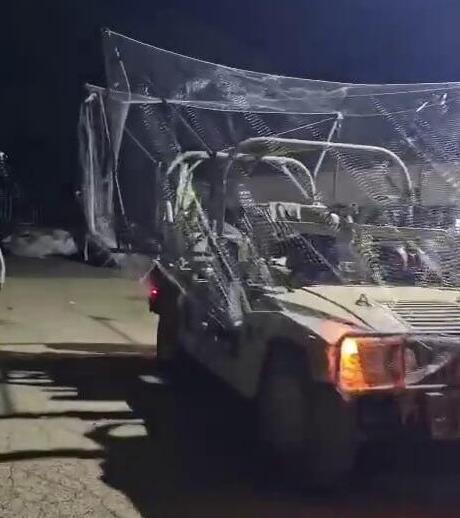
Netting covers the military vehicle in an improvised solution against Hezbollah's FPV drones
(Photo: Use under Section 27A of the Copyright Law)
On Wednesday, IDF Chief of Staff Lt. Gen. Eyal Zamir visited the area of the town of Taybeh in southern Lebanon and stressed that the IDF is effectively holding the yellow line, as defined by the political leadership. “The mission assigned to us by the political echelon is to position ourselves on the line to prevent direct fire on the communities. We achieved that — this is the line we are on,” Zamir said. “We may be required to remain on it. We will not tolerate attacks and fire on our communities, and we will not leave until security for the northern communities is guaranteed over time.”
Zamir added that the IDF continues fighting and working to deepen its operational achievements and protect its forces. “On the combat front, there is no ceasefire,” he told the troops. “You continue to fight, remove direct and indirect threats from the northern communities, thwart terrorist infrastructure, locate and kill terrorists.”