

The Islamic Republic of Pakistan, a massive country of more than 254 million people in South Asia, has suddenly emerged as a mediator between Iran and the United States. Israeli officials will not say so publicly, but Pakistan’s involvement is seen as highly problematic. From Israel’s perspective, it is clear that nuclear-armed Pakistan — which borders Iran and maintains ties with the Islamic Revolutionary Guard Corps — has a conflict of interest and will likely favor Tehran’s interests over Israel’s.
Pakistan, the only Muslim-majority country with nuclear weapons, maintains close alliances with Saudi Arabia and Turkey, while Israel is aligned with India, Pakistan’s main rival. In addition, Pakistan has very strong and growing ties with the United States. It is a member of the President Donald Trump's Peace Council, and Prime Minister Shehbaz Sharif even attended its launch conference in Washington. Trump, for his part, is close both to Turkish President Recep Tayyip Erdogan and to Pakistan’s leadership — a dynamic that could eventually create friction with Israel.
Gallery
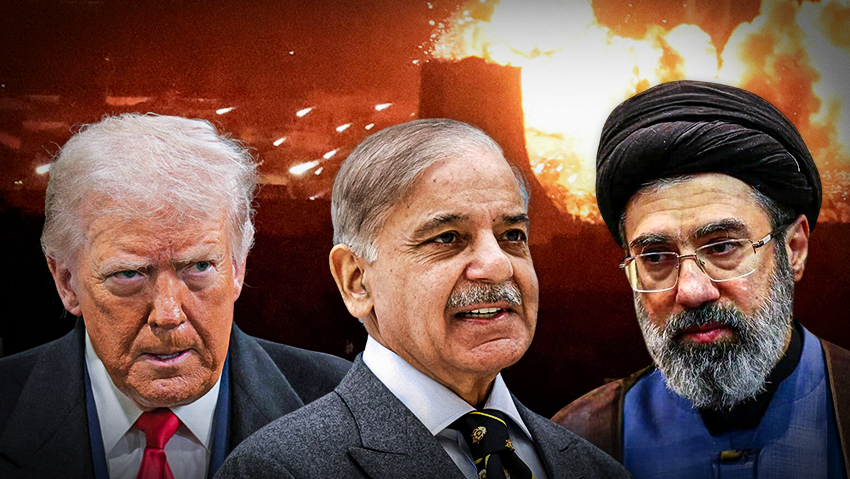
Will Pakistan mediate between Iran and the US?
(Photo: Anna Moneymaker/AFP, Atta Kenare / AFP, Sputnik/Alexander Kazakov/Pool via Reuters)
Public opinion in Pakistan is strongly hostile toward Israel, almost to a fanatical degree, second only to Malaysia in Asia. In the past, there were attempts at contacts with Pakistan that did not lead to any tangible results. At the same time, the United States sees Pakistan as a potential candidate for expanding the Abraham Accords in the future, which is why Pakistan is also involved in the Peace Council.
The United States maintains close ties with Pakistan’s army chief, Gen. Syed Asim Munir, who is widely regarded as the most powerful figure in the country. Munir, who took office in November 2022, has pursued an active security policy that includes tensions with India, strengthening security ties with Washington, and engagement in regional issues such as the situation in Gaza. In July 2025, Munir met with Trump at the White House in what was considered an unprecedented meeting. He frequently speaks with senior U.S. officials and has been the dominant figure mediating between Iran and the United States.
In Israel, officials are already accustomed to Trump speaking with all parties and understand they cannot influence Washington’s choice of mediators. Still, the fact that Pakistan — effectively run by a military junta — is taking the lead is far from reassuring. A landmark moment in Israel-Pakistan relations was a 2005 meeting between then-Foreign Minister Silvan Shalom and his Pakistani counterpart Khurshid Kasuri, though diplomatic contacts did not progress further.
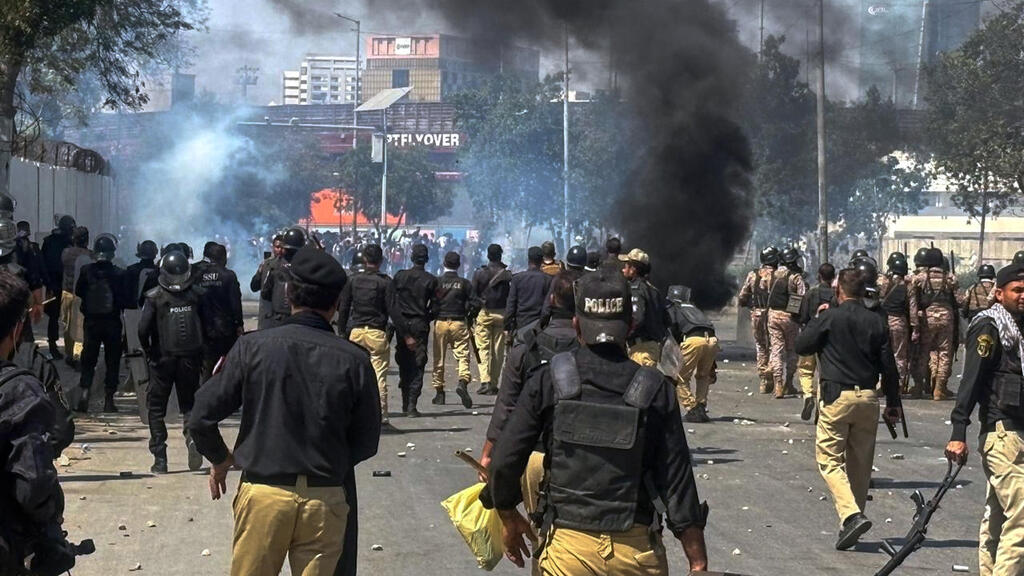
Shiite mob angry over Khamenei's assassination in Karachi, Pakistan
(Photo: Muhammad Farooq/AP)
Israeli and Pakistani military representatives have met in the past during joint exercises, such as a U.S.- and NATO-led drill in the Black Sea in 2021. Over the years, there have also been tensions between the two countries.
In 2021, for example, Pakistani National Assembly member Maulana Chitrali called in a speech for Pakistan to strike Israel with a nuclear bomb on behalf of the Muslim world. An Israeli official, asked whether Pakistan’s mediation raises concerns, said that “because Pakistan is a nuclear state, there is always concern about leakage or an Iranian attempt to obtain something from the Pakistanis in the nuclear field. That is always in the background. But they have fairly strong control over that, and it does not appear they would take such a step.”
So far, reports have already indicated a possible meeting between the parties in Islamabad. The Pakistani prime minister also addressed the issue, saying: “We are ready to host talks between the United States and Iran to resolve the conflict. We support current efforts to hold dialogue to end the war in the Middle East.”
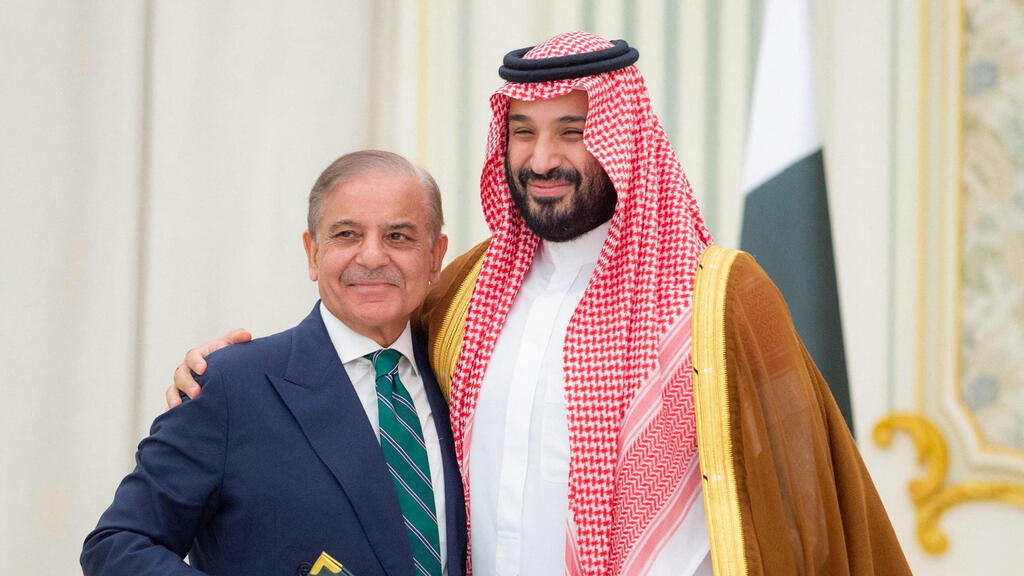
Saudi Arabia has a lot of influence over Pakistan. Bin Salman and Pakistan's Sharif
(Photo: Saudi Press Agency/Handout via Reuters)
Dr. Yoel Guzansky, a senior researcher at the Institute for National Security Studies (INSS) and a former senior official at Israel’s National Security Council, told Ynet and Yedioth Ahronoth that Pakistan is not part of the war with Iran and was not attacked. “This is a Turkish, Pakistani and Egyptian initiative,” he said. “What Egypt and Pakistan have in common is that both were completely outside the war and were not attacked. Another interesting point is that the Gulf states are not very involved, and it may be that Iranian strikes on their territory have significantly undermined trust.”
One country not participating in the mediation is Oman, despite the central role it played in prewar talks between Iran and the United States. According to Guzansky, although Oman reportedly sustained limited strikes during the war, it is surprising that it is not part of the solution, especially since its foreign minister strongly opposed the war and even tried to prevent it.
“The interesting point is that if the Pakistanis are leading this, Saudi Arabia has a great deal of influence over Pakistan,” he said. “Saudi security is important to the Pakistanis. There may be indirect Saudi influence here — a desire to end the war.”