

Some 2.6 million Israeli children returned to kindergartens and schools Tuesday as the new academic year began, with 180,000 entering first grade and thousands of families in communities near the Gaza and Lebanon borders marking a particularly emotional return to classrooms close to home.
Unlike several recent school years, classes began without threats of strikes or labor action from teachers’ unions.
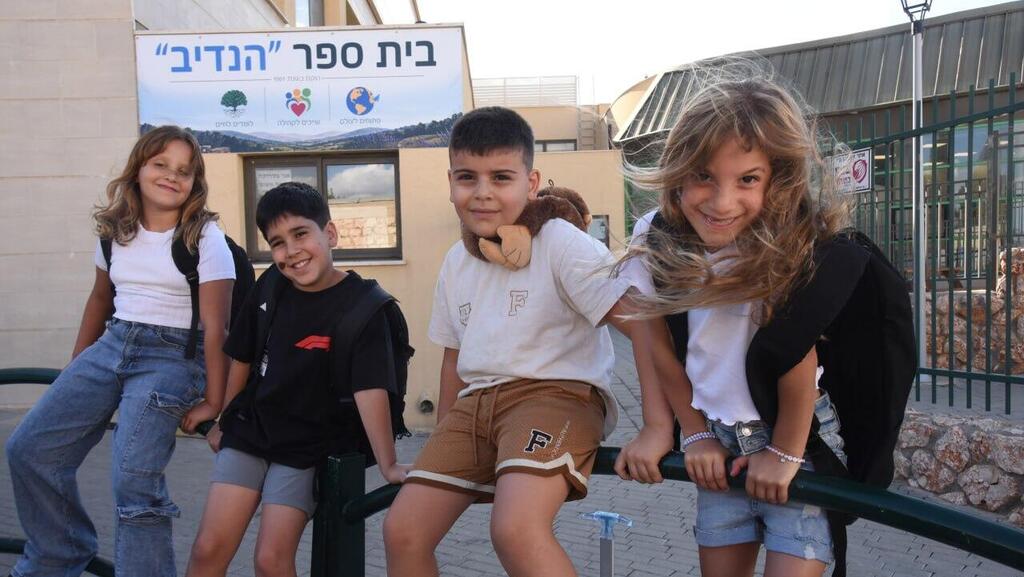
At the other end of the school system, 143,000 12th-graders began their final year.
Education Ministry figures show that 418,385 students, about 16% of all pupils, are eligible for special education services, an increase of 9% from the previous year.
Israel’s education system includes 27,757 institutions, among them 21,800 kindergartens and 5,957 schools.
The ministry said the first week would focus on rebuilding a sense of belonging, strengthening social connections and trust between students and educational staff. Schools were also instructed to devote time to emotional and social needs, resilience and preventing violence, exclusion and bullying both in person and online.
But for some children, the return to school carries a meaning far beyond the usual excitement of a new academic year.
‘It’s fun to be back in our home’
After nearly three years of evacuation, upheaval and repeated moves, children in communities near the Gaza border are returning to school close to home. For some, first grade is not only the beginning of their formal education but another milestone in their families’ return after the Oct. 7 massacre.
Six-year-old Galia Tivon of Kibbutz Nahal Oz is beginning first grade at Alonim School in the Sha’ar HaNegev region.
She returned to the kibbutz with her family this summer after spending two and a half years in Mishmar HaEmek, where they were evacuated following the Hamas-led attack.
Her parents, Amir and Miri, had known throughout their displacement that they wanted their daughter to begin school at home.
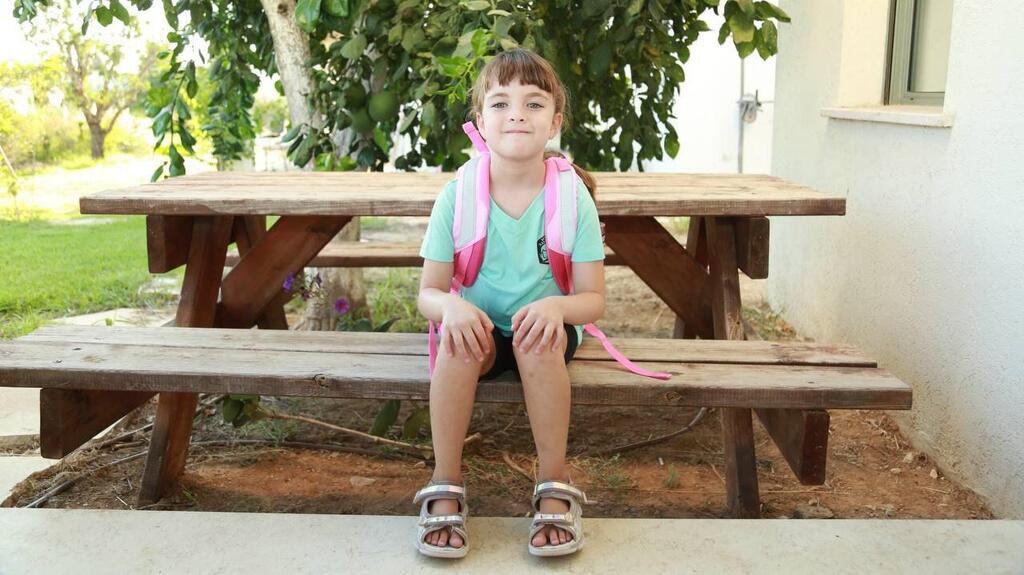
Six-year-old Galia Tivon
(Photo: Barel Efraim)
Galia is already preparing for the classroom. She can read simple sentences, solve arithmetic exercises and imagines what school will be like. But memories of Oct. 7 remain.
She calls that day “the scary Saturday,” and her main wish for the new school year is simple: no sirens.
Asked what she hopes for in first grade, she said: “That I have a nice teacher and that she tells me, ‘What a good student you are, Galia.’ I hope the lessons are interesting and recess is fun.”
She is equally happy simply to be home.
“It’s fun to be back in our home, eat ice cream on the porch with my sister and take a bath,” she said, adding that her favorite things in Nahal Oz are buying popsicles at the kibbutz store and going to the pool.
About 70% of Nahal Oz residents have now returned, but Amir said that figure also illustrates what remains missing.
“It may sound impressive, but in practice it means one out of every three people hasn’t returned,” he said. “That’s a big hole in the heart that takes time to get used to. Some of our friends came back and some didn’t. We love them all and understand every decision.”
Starting without all his friends
In nearby Kibbutz Holit, five-and-a-half-year-old Uri Sultan is beginning first grade at Sdot Eshkol School.
His grandparents, Roland and Ronit Sultan, were murdered on Oct. 7. His family returned to the kibbutz only this month after a long period of displacement.
His parents, Adam and Nir, said the decision to return was never really in doubt.
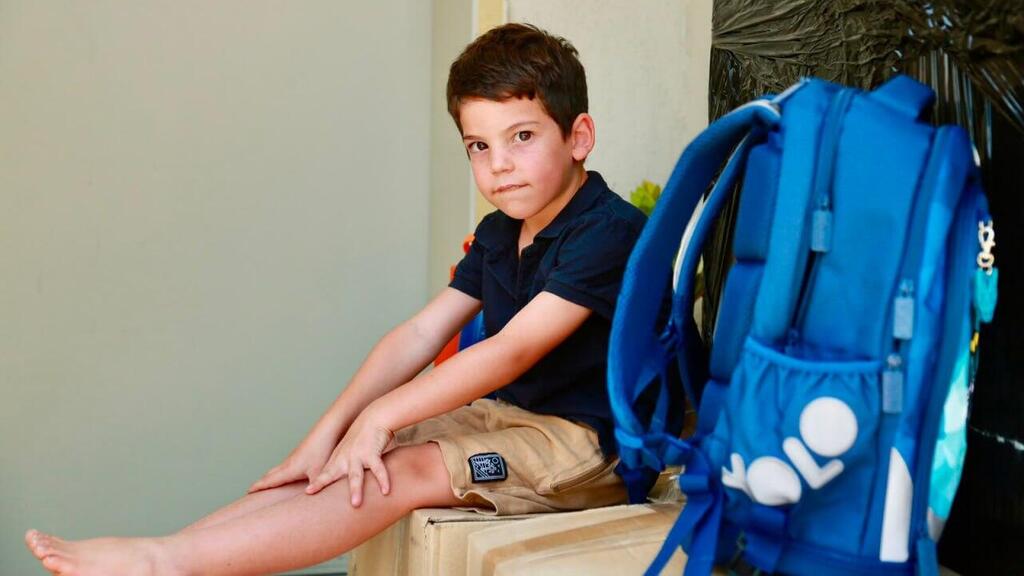
'I’m excited to start first grade. I’m most looking forward to learning to read and do math,' Uri Sultan said
(Photo: Barel Efraim)
“Throughout this entire period, we had a sentence we kept repeating to the children: ‘Home is wherever we are all together as a family,’” Nir said. “But we knew that eventually we would come back home, to Holit.”
Uri is beginning school without some of the friends he made while evacuated.
“We’re giving him a lot of support, introducing him to new friends and trying to show him another side of it,” Nir said. “He’s getting here first and can prepare the ground for his friends. When they return, he’ll already be able to help them fit in.”
His parents nevertheless acknowledge the anxiety accompanying the return.
“Sending a child to first grade is already not an easy moment for a mother,” Nir said. “Suddenly he’s grown up, he has to become independent and you have to let go. Now add all the legitimate concerns about returning to the Gaza border area: whether it will be safe, what the journeys will be like, how he’ll manage and what happens if the security situation deteriorates again.”
Uri himself sounds less worried.
“I’m excited to start first grade. I’m most looking forward to learning to read and also math, and I’m not afraid of anything,” he said.
Returning to Holit, he added, “feels a little strange because my friends won’t be with me at the same school at first.”
He said he loves playing around the kibbutz, jumping and diving in the pool and eating clementines and strawberries from the trees.
He also has one proposal for improving life there: “I want there to be lots of trampolines everywhere.”
Alma’s memory of Oct. 7
A few kilometers away in Kibbutz Kissufim, six-year-old Alma Hendler is beginning first grade at Shahar Eshkol School.
She returned to the kibbutz last month with her parents, Maayan and Liav, and her three older siblings.
“We still haven’t unpacked everything,” Maayan said.
For the family, returning also brings back memories of Oct. 7.
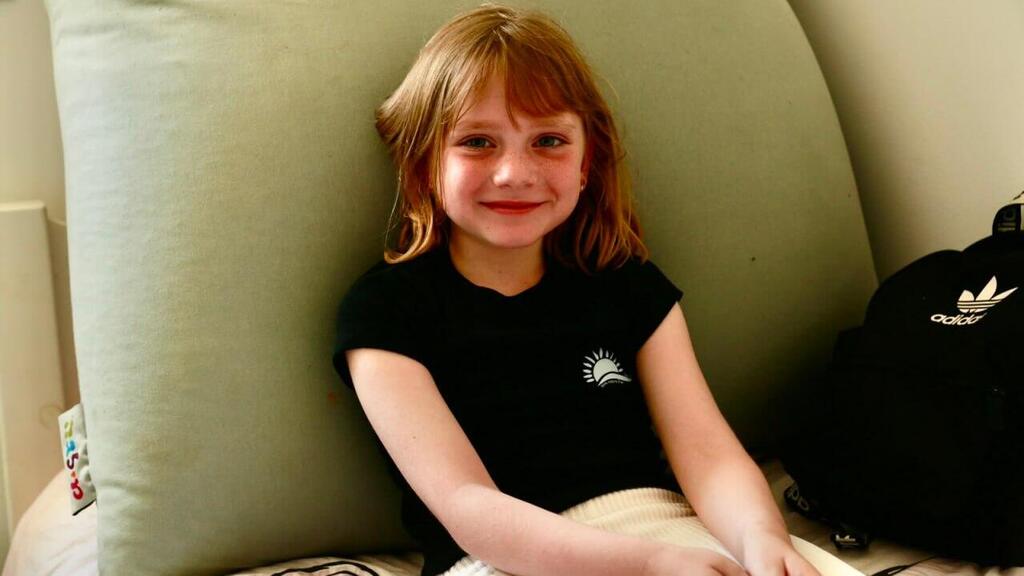
Alma Hendler, who will begin first grade
(Photo: Barel Efraim)
Liav was abroad that day. Maayan was at home with their eldest son, Adam, and Alma, while the two other children were at their grandparents’ home elsewhere in the kibbutz.
“From 7:30 in the morning, I could hear terrorists outside the house, and the three of us shut ourselves inside the safe room,” Maayan recalled. “I had no contact with anyone until we were rescued. During that time, they also shot at me through the window and terrorists entered our home.”
She said the experience profoundly affected Alma.
“It took her a very long time to move forward,” she said. “She regressed almost to infancy. She clung to me, was afraid, wouldn’t let go and experienced a speech delay. Today, after treatment, she’s in a different place. We still have work to do, but she’s starting first grade and she’s excited.”
Alma still remembers details from the attack.
About a year ago, Kissufim held a gathering with soldiers who had helped evacuate residents. Alma approached one of them and recognized him.
“She told him, ‘You gave me the chocolate,’” Maayan said. “A soldier had given her chocolate to calm her down. I didn’t remember it. My neighbor remembers opening the wrapper for her.”
Now Alma is beginning school back in the kibbutz even as the area remains affected by the fighting.
“We still hear the fighting and the fear is still there,” Maayan said. “But I suppose there is something in human nature that makes us cling to the small things that make reality seem more beautiful or safer. She walks around the lawns here and she’s happier than she was when we were evacuated.”
At first, she said, Alma did not want to start school and insisted she was still too young.
“Now she’s really excited to begin and she isn’t afraid of it.”
Alma said she is most excited about meeting friends.
“I don’t want to have too many lessons,” she added.
And what does she think will be the best part of first grade?
“The shelter that we go to if there’s a siren, because it has games in it.”
Three years, three schools
The new academic year is also a milestone in Metula, Israel’s northernmost town along the Lebanese border, where the historic HaNadiv School is reopening after being closed since October 2023.
The school, now marking its 130th anniversary, was repeatedly hit by Hezbollah fire during the war and also suffered deterioration while standing empty.
Thirty-six students are beginning classes there Tuesday, while another 18 children will attend the adjacent kindergarten.
Among them is Alma Assor, who is starting third grade and, for the third consecutive year, beginning the academic year at a different school.
After her family was evacuated from Metula on Oct. 7, she moved to Kibbutz Ma’oz Haim in northern Israel’s Beit She’an Valley. She later attended Ali Giva School in Kfar Giladi.
“I’m very happy, and I think it’s a better school because it has a really cool play area, a library and music and art rooms,” Alma said. “I hope I’ll be happy there, make new friends and have fun.”
Her mother, Yaara, attended HaNadiv herself as a child.
“Alma is starting a new school for the third time, and this time I hope it’s the last,” she said.
She acknowledged some concerns about the social adjustment. Alma’s class is multigrade: there are only three children in her year, so they will study together with 10 fourth-graders.
“We initially debated whether to return to Metula, and we were very happy to come home,” Yaara said. “Our hearts stayed here throughout the evacuation. The latest campaign against Iran wasn’t easy, but I hope it’s behind us.”
Also entering HaNadiv is Lahav Shtilman of Kibbutz Ma’ayan Baruch, who is beginning first grade.
“I have a Bambi backpack and a pencil case and a bottle, and today we bought shirts with the school logo,” she said.
She is particularly excited about one feature of school life she has heard about: the bell.
“I’m waiting to hear the bells because they told me that every time the bell rings, you go out for recess, and when it rings again you have to go back to class,” she said.
Her mother, Efrat, chose to send her daughter to the school despite its location close to the Lebanese border, in an area she describes as “paradise most of the time.”
“I live 400 meters from the border,” she said. “We weren’t hit in the kibbutz the way Metula was, but we also live with the security tension.”
Anyone too afraid to live there, she added, might conclude that northern Israel is not the best place for them to raise children.
“But to me it’s paradise, and we’re not afraid to live here.”
For Efrat, sending Lahav to HaNadiv also closes a family circle.
“I grew up in Metula and studied at HaNadiv, and my father studied there as a child too. Now Lahav will study there,” she said.
She said she wanted a small school where children receive greater individual attention and where the curriculum can be adapted to students rather than the other way around.
“The education system in the north is in pretty bad shape after the evacuation and the war,” she said. “A lot is being demanded of teachers and classrooms are terribly crowded. In Metula, you can really feel the investment.”
After extensive rehabilitation work, HaNadiv recruited a new teaching staff and began accepting children from nearby communities as well.
To attract educators to the north, a joint initiative by the government’s northern rehabilitation administration and the Education Ministry offered grants of NIS 60,000 to teachers who relocate to the area and meet the program’s criteria.
“We worked around the clock to reach this moment,” said the school’s new principal, Ida Kogan. “The children will receive a broad educational support system and some of the best resources in the country.”
Dr. Orna Simhon, director of the Education Ministry’s northern district, said seeing Metula’s children once again walking through the gates of a school in their own town was “deeply moving for all of us.”
Metula Mayor David Azoulay described the reopening as a victory in itself.
“We went through a very long and complicated period,” he said. “Opening the educational institutions is the real victory.”