

Yashar! party leader Gadi Eisenkot is pressing ahead with his plan to establish a minority government with outside support from Arab and ultra-Orthodox parties, issuing a veiled warning to Yisrael Beytenu chairman Avigdor Liberman after the latter dramatically reversed his position and expressed support for a government including ultra-Orthodox parties, even if it requires compromises on military conscription.
"I intend to fulfill the mandate the people have given me, and the mandate the president is expected to entrust to me, with a profound sense of responsibility," Eisenkot said after the conclusion of presidential consultations Thursday, during which 67 lawmakers recommended him for prime minister, compared with 46 who backed incumbent Prime Minister Benjamin Netanyahu.
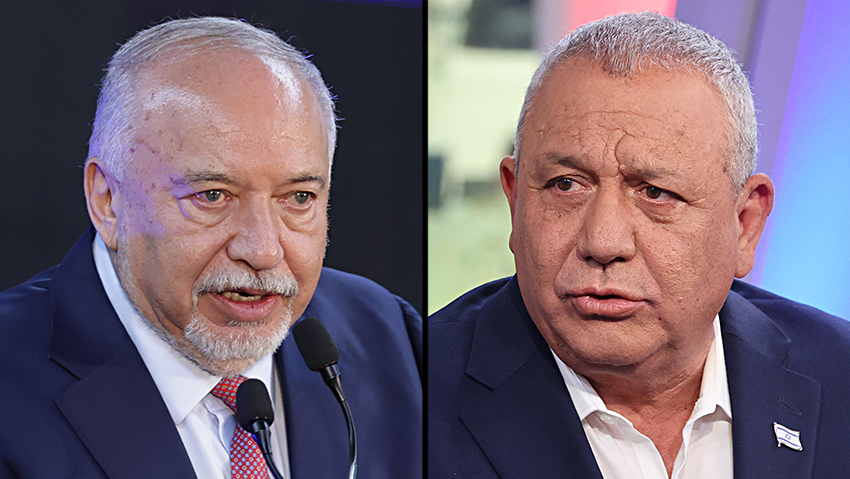
Avigdor Liberman and Gadi Eisenkot
(Photo: Oz Moalem, Yariv Katz)
In remarks widely seen as directed at Liberman, Eisenkot warned: "This is a test of leadership and love of country, in the fullest sense of those words. Anyone who tries to undermine or sabotage the formation of a government for personal rather than substantive reasons will be remembered by history as someone who failed to rise to the occasion and failed to act to save Israel in a time of emergency. They will not be forgiven."
In a social media post outlining his intentions, Eisenkot described Israel as facing an unprecedented domestic and diplomatic crisis, arguing that the outgoing government was threatening the country's democratic institutions while military conflicts remained unresolved.
"Israel is facing a real, tangible and dangerous emergency," he wrote. "The current government threatens the very foundations of Israeli democracy. All this while the fronts of the war remain open and are themselves subject to political and personal whims. Israel is already in the midst of a dangerous diplomatic tsunami."
Against that backdrop, Eisenkot said he had spent recent days advancing a proposal for a national emergency government in discussions with his political partners.
"The logic behind it is to swear in a government as quickly as possible, based on the four Zionist parties of change and reform, with any party or Knesset member willing to accept my four fundamental principles joining either immediately or gradually," he wrote. "This is what the moment demands in the face of the enormous, fateful challenges confronting Israel in this emergency, both at home and abroad."
Eisenkot also warned against allowing Netanyahu to remain in office as caretaker prime minister, arguing that his government had lost its public mandate and could no longer be trusted to oversee the country's security and legal institutions.
"A situation in which a caretaker prime minister in a minority government, who has lost the people's trust to such an extreme degree, continues to control the security establishment and law enforcement authorities is dangerous and must not continue for even one more day," he said. "That is the gravity of the situation, and that is why replacing the outgoing government is so urgent. This is the people's decision, the voters' will. This is why we were given a mandate in the elections."
Eisenkot reiterated the four principles he has established as the foundation for any government he leads: recognition of Israel as a Jewish and democratic state; acceptance of the values of Israel's Declaration of Independence; mandatory military, national or civilian service for all, aimed at strengthening the Israel Defense Forces and expanding its ranks; and recognition of Hamas as a terrorist organization, alongside a commitment to dismantling its military and governing capabilities.
The proposed arrangement would initially rely on four Zionist parties, with the possibility of outside parliamentary support from Arab and ultra-Orthodox factions to enable the government to take office without those parties formally joining the coalition. Eisenkot's invitation would also leave the door open for additional parties and individual lawmakers to join at a later stage, provided they accept his principles.
"I intend to approach every faction in the Knesset and invite its members to become partners, if they are prepared to sign on to these principles, under my leadership, now or later," Eisenkot wrote.
"Israel needs stable, unifying and responsible leadership that has won clear support from the people and members of the Knesset. That is exactly what I intend to deliver."