



A shift of just one or two parliamentary seats could determine whether Benjamin Netanyahu remains Israel's prime minister, opposition leader Gadi Eisenkot replaces him or the country finds itself heading toward yet another election. As Israelis vote Tuesday, the outcome remains deeply uncertain, with several possible paths to forming a government and no guarantee that either political camp will secure a majority.
Most opinion polls suggest neither Netanyahu's right-wing and religious allies nor the parties seeking to replace him will win the 61 seats needed for a majority in Israel's 120-member Knesset. But even without a clear winner, negotiations could produce a new government, a fragile minority administration or an unexpected agreement between political rivals. Here are the five main scenarios and the timetable for what happens after the votes are counted.
Gallery
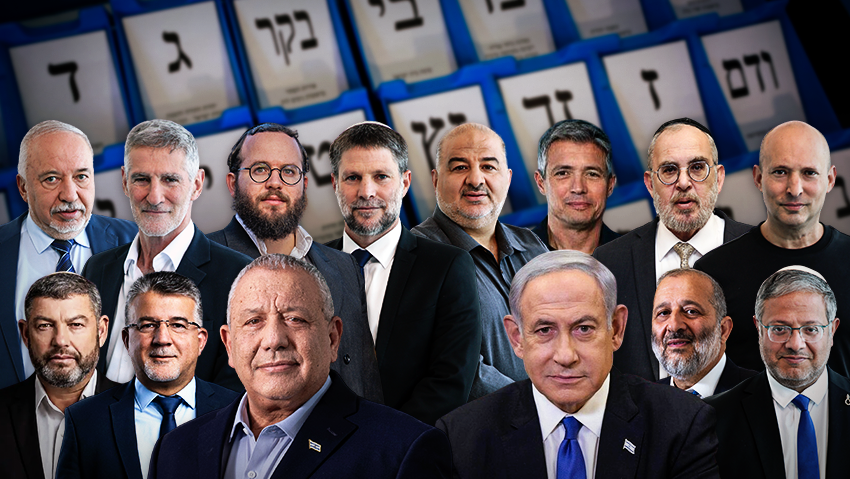
Who will form Israel's next government, if anyone? Leaders of the parties competing in the 26th Knesset election
(Photos: Amos Ben Gershom/GPO, Reuters, Shalev Shalom, Yuval Chen, Elad Malka, Joint List spokesperson, Ryan Preuss, Alex Kolomoisky)
Scenario 1: opposition government led by Eisenkot
Most polls suggest neither political bloc will win 61 seats, making an outright opposition victory an unexpected outcome. But if the parties seeking to replace Netanyahu secure a majority, they could form a coalition comprising Gadi Eisenkot's centrist Yashar party, former prime minister Naftali Bennett's Together party, Avigdor Liberman's Yisrael Beiteinu and Yair Golan's left-wing Democrats.
Despite disagreements within the opposition, particularly Bennett's and Liberman's reluctance to accept Eisenkot as prime minister, Eisenkot would be the likely candidate to lead such a government if his party emerges as the largest in the bloc. The challenge would then be translating an electoral majority into a functioning coalition despite the parties' political and ideological differences.
Scenario 2: Netanyahu wins another term
The alternative is a victory for Netanyahu's right-wing and religious bloc, which would have to secure at least 61 seats despite polls suggesting that outcome is even less likely than an outright opposition majority. Such a result would allow Netanyahu to rebuild his current coalition, bringing together Likud, the ultra-Orthodox Shas and United Torah Judaism parties, Itamar Ben-Gvir's far-right Otzma Yehudit and Bezalel Smotrich's Religious Zionism party.
The coalition could also include the People of Israel party led by former military commander Ofer Winter, provided it wins enough votes to enter parliament. If Winter's party fails to cross the 3.25% electoral threshold, Netanyahu's prospects of securing a majority could become even more difficult.
Scenario 3: minority government that depends on Arab parties
If the opposition wins more seats among Jewish-led parties than Netanyahu's bloc but falls short of an outright majority, Eisenkot could attempt to form a minority government. Under Israel's parliamentary system, a new government does not necessarily need the support of 61 lawmakers to take office. It needs to win a parliamentary confidence vote, which can pass with a simple majority of those voting, even by a single vote.
Eisenkot has said he will not negotiate with Arab or ultra-Orthodox parties, offer them political concessions or enter agreements with them. His calculation is that Arab lawmakers would abstain from a confidence vote rather than help Netanyahu remain in office. But even if such a government were formed, its survival could depend on outside parliamentary support from Arab parties or Ashkenazi ultra-Orthodox factions willing to negotiate over government funding and military conscription. Without that support, it could quickly collapse.
The biggest obstacle, however, is Liberman, who has ruled out supporting a minority government. He argues that such an arrangement would be short-lived and could ultimately strengthen Netanyahu in another election. Unless Liberman reverses his position, this scenario appears unlikely, even though some opposition figures would prefer replacing Netanyahu for a limited period to leaving him in office.
Scenario 4: Netanyahu-Eisenkot unity government
Another possibility is a broad coalition bringing together Netanyahu and Eisenkot, particularly if strong results for Arab parties leave both rival blocs well short of a majority. Such an agreement could include a power-sharing arrangement under which the two leaders alternate as prime minister during the government's term.

President Isaac Herzog could seek to broker a unity government or conclude that no candidate can form a coalition
(Photo: AP Photo/Ohad Zwigenberg)
Both Netanyahu and Eisenkot have publicly rejected such a partnership, making it politically difficult. Nevertheless, President Isaac Herzog could attempt to encourage a compromise if the election produces an extended deadlock and neither side can assemble a viable coalition.
Scenario 5: another election, with Netanyahu remaining in office
If Netanyahu's bloc wins more seats among Jewish-led parties than the opposition but falls short of 61, and neither side is willing to cooperate with parties outside its camp, Israel could face another election.
Under such circumstances, Netanyahu would remain in office as caretaker prime minister until a new government is formed, potentially extending his time in power by several months without securing a fresh parliamentary majority. This outcome would prolong the political uncertainty and could send Israelis back to the polls without any assurance that another vote would produce a different result.
What happens next? The timetable for forming a government
Even if the election delivers a clear winner, the process of forming a government could take weeks. Israel's Central Elections Committee has eight days to publish the official results, making Wednesday, November 4, the legal deadline. Election officials expect to complete the vote count by Thursday afternoon, October 29, potentially allowing the new 26th Knesset to be sworn in on Tuesday, November 10, two weeks after election day.
Once the official results are submitted, President Herzog will consult representatives of the parties elected to parliament and ask whom they recommend to form the next government. Within seven days of the publication of the official results, he must assign that task to the lawmaker he believes has the best chance of assembling a coalition. This is usually the candidate with the most support from other parties, although the leader of the largest party does not automatically receive the first opportunity.
The first candidate has 28 days to form a government, with the president authorized to grant extensions totaling up to 14 additional days. If that effort fails, Herzog can either select another lawmaker, who would receive 28 days without an extension, or formally announce that he sees no prospect of a government being formed.
If the president makes that announcement, or if a second candidate also fails, a final 21-day period begins during which at least 61 lawmakers can submit a written request asking the president to appoint a particular member of parliament. That candidate would then have 14 days to establish a government.
If no government emerges from these procedures, the Knesset is automatically dissolved and another election must be held. Until a new government takes office, the outgoing administration remains in power.
For now, the crucial question is not simply which party wins the most seats on Tuesday, but whether any combination of parties can overcome their differences and command enough parliamentary support to govern. Based on Israel's recent political history, another election would offer no guarantee of breaking the deadlock.