


Finance Minister Bezalel Smotrich said Thursday that Hezbollah’s stronghold in Beirut’s southern suburbs could face devastation similar to that seen in the Gaza city of Khan Younis, shortly after the IDF issued evacuation warnings and crowds were seen fleeing the area.
“Dahieh will look like Khan Younis,” Smotrich said during a visit to communities along the northern border.
Masses fleeing Beirut's Dahieh suburb following Israeli evacuation orders


The Dahieh district of Beirut is widely considered the main stronghold of the Iran-backed terrorist group Hezbollah. Khan Younis, the second-largest city in the Gaza Strip, saw heavy destruction during Israel’s war with the terrorist group Hamas, also backed by Iran.
Smotrich, a member of the decision-making Security Cabinet and a minister within the Defense Ministry, made the remarks during a tour of the northern Israeli communities of Ma’alot-Tarshiha, Shlomi and Zar’it near the Lebanese border.
“Hezbollah made a mistake and it will pay a heavy price,” Smotrich said. “We are cutting off the head of the octopus in Iran, and at the same time, we will sever the Hezbollah arm. Two years ago, we evacuated residents of the north. Today we issued evacuation notices to residents of southern Lebanon and the Dahieh district, while on the Israeli side, communities are returning to flourish.”
The comments came shortly after the IDF issued a rare evacuation warning for entire neighborhoods in Beirut’s southern suburbs. Residents of the neighborhoods of Burj al-Barajneh, Hadath, Haret Hreik and Shiyah were urged to leave immediately.
Gallery

Finance Minister Bezalel Smotrich; masses fleeing Beirut's Dahieh suburb following Israeli evacuation orders
(Photo: REUTERS/Claudia Greco, REUTERS/Ronen Zvulun)
“Save your lives and evacuate your homes immediately,” the military said in an Arabic-language statement. Residents were instructed to move east toward Mount Lebanon along the Beirut–Damascus highway. Those in Haret Hreik and Shiyah were told to head north toward Tripoli along the Beirut–Tripoli highway or east via the Metn highway. The statement warned that any movement south could endanger civilians, suggesting a large-scale strike could be imminent.
An Agence France-Presse team on the ground reported seeing crowds fleeing the area in panic. The journalists said heavy gunfire was heard shortly after the evacuation warning, and the Saudi television channel Al Hadath reported that many residents left on foot.
Video from the district showed heavy traffic congestion as residents attempted to leave the area, long regarded as one of Hezbollah’s most important strongholds.
Shortly afterward, Lebanese media reported Israeli strikes in southern Lebanon and near the village of Labaya in the eastern Bekaa region.
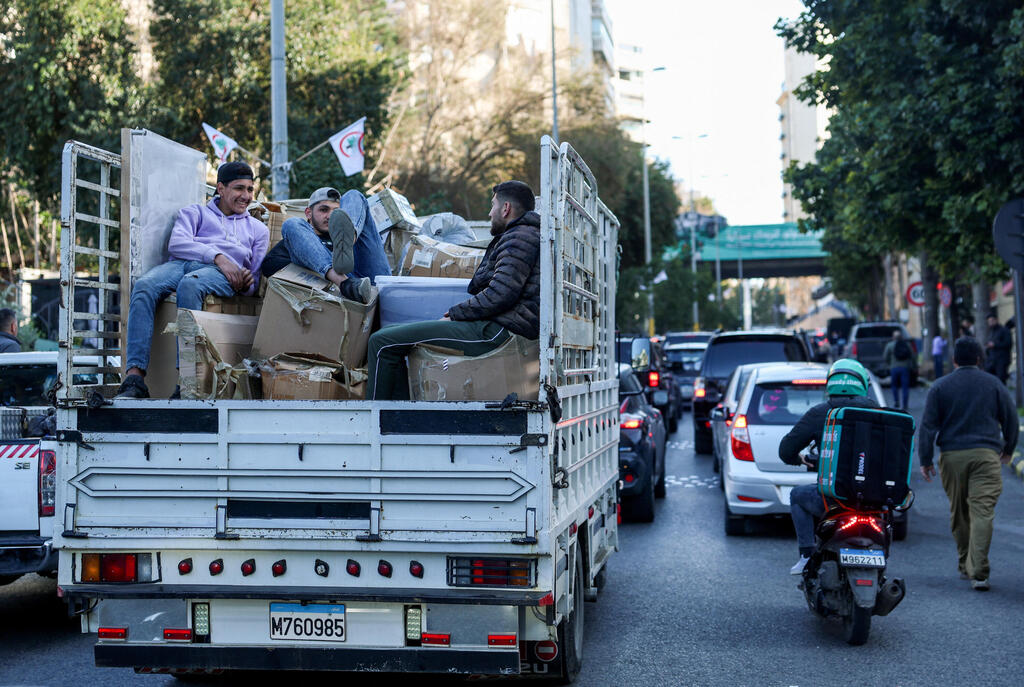
(Photo: REUTERS/Claudia Greco)
Smotrich has made a number of predictions during the war in Gaza that did not materialize. In May last year, while fighting in Gaza was ongoing, he said Hamas would no longer exist in the territory within six months. The group, however, continues to operate there. In April 2025, he also declared that “not a grain of wheat” would enter Gaza if it could reach Hamas, but significant quantities of humanitarian aid were later delivered to the enclave.
Almost simultaneously with the evacuation warning, the Lebanese government announced new measures targeting Iran’s presence in the country.
Prime Minister Nawaf Salam said Iran’s visa-free entry arrangement for Lebanese territory would be canceled, meaning Iranian citizens will no longer be able to enter the country without obtaining visas in advance.
Lebanon’s information minister added that the government also intends to ban activities by members of Iran’s Islamic Revolutionary Guard Corps inside Lebanon, saying the move could pave the way for their expulsion. Any IRGC member found operating in the country would be arrested, the minister said.