

Facing opposite the chair in the office of Jerusalem District Police Commander Maj. Gen. Avshalom Peled, in the headquarters building at the Russian Compound, hangs a huge panoramic photograph of the city under his command. At the center of the image, one area stands out clearly: roughly 35 acres.
It is a tiny piece of land, a little more than one-thousandth of the city’s total municipal area. But these are arguably the most charged and complex 35 acres in the Middle East, perhaps even in the world.
Gallery
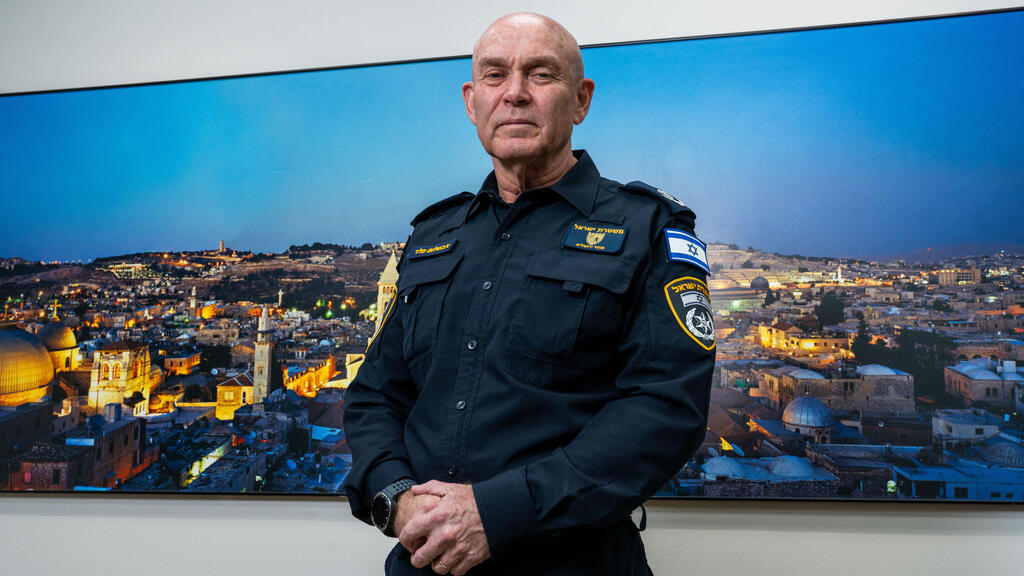
Jerusalem District Police Commander Maj. Gen. Avshalom Peled in front of a panoramic photograph of the city under his command
(Photo: Shilo Shalom)
Peled knows this is where his tenure will be judged. Other district commanders will be measured by how they fight organized crime, protection rackets, drugs and street violence. Him? By how well he manages this powder keg. Politically, too.
Indeed, as we meet, a stack of papers sits on his desk. “Restraining orders I have to sign,” he explains. “Some of them barring people from the Temple Mount.”
Right now the Mount is quiet. And when the Mount is quiet, Jerusalem is quiet.
“I don’t call it quiet. When things are quiet, people fall asleep. Part of my policy, which I told my senior command staff and all the officers, is that the worst thing is quiet. The most challenging thing for a security organization is maintaining alertness and vigilance during routine, especially routine that appears quiet. That’s the worst thing, because a person who thinks things are quiet falls asleep. Quiet creates monsters.”
So even when the city is quiet, you are not relaxed.
“I am never relaxed for a moment. Listen, we were supposed to go with the family on vacation to Eilat. They said to me, ‘You’re not coming?’ I said: You understand that I’m not coming. I am the Jerusalem district commander — I will not have an Oct. 7. I won’t be sitting in a hotel in Eilat while something happens here. This apparent quiet is great, but it lies to you and intoxicates you. Things can be seething beneath the surface, and that is what scares me most as a commander.”
*****
When Peled entered the job in January, he divided the district’s main challenges primarily between two arenas he defines as strategic: the Temple Mount and the Jerusalem perimeter. “They can affect the entire country,” he explains. “The other challenges will have a local impact.”
The main arena is the Temple Mount.
It is no coincidence that Hamas calls the October 7 attack the “Al-Aqsa Flood.” Yahya Sinwar, who planned a combined assault — one in which Iran, Hezbollah and Israeli Arabs would also join — understood very well that the Temple Mount is a unifying force in the Arab world and sought to use that fuse. Peled’s role is to make sure it does not ignite.
And the way to do that is the status quo?
“When we liberated Jerusalem in 1967, Moshe Dayan went up to the Mount and said, let’s establish a status quo. The thinking was to tell the Arab countries: We allow Muslims freedom of worship. But what happened since then is that the rules were enforced very strictly against Jews and less strictly against Muslims. I say this from personal experience: The status quo was consistently eroded by the Waqf.”
Give an example.
“Solomon’s Stables. They ignored everyone, carried out construction and tried to get rid of all the dirt so no Jewish findings would be discovered,” he says, referring to work carried out in 1999-2000, when thousands of tons of earth, including archaeological finds, were removed during construction in the lower Al-Aqsa compound.
What is the relationship with the Waqf like today? Are there confrontations?
“No. There are daily contacts between the David Precinct and the Waqf. They know their place. There are relations and there is respect — but there is also deterrence. What happened at Solomon’s Stables could not happen today. They will not carry out work without asking for our approval. And we do not just carry out work on the Mount either.”
One of the hottest issues surrounding the Temple Mount is, of course, Jewish prayer there.
In the past, Jews could visit at certain times and quietly recite prayers. Since National Security Minister Itamar Ben-Gvir took office, the conditions have been eased. Police no longer prevent worshippers from papers with prayers printed on them and, at least in part of the Mount, from prostrating themselves.
For now, however, police still prohibit more visible religious practices, such as carrying Torah scrolls, putting on tefillin or wearing prayer shawls.
Aren’t you worried the limits are being pushed too far?
“Jews should pray on the Temple Mount. Today we allow Jews to pray there. They have a designated area on the eastern side. Every group is accompanied by police officers, they receive a briefing, and anyone who violates the rules is removed. They come to a hearing, then to me, and I bar them from the site. We control this with an iron fist.”
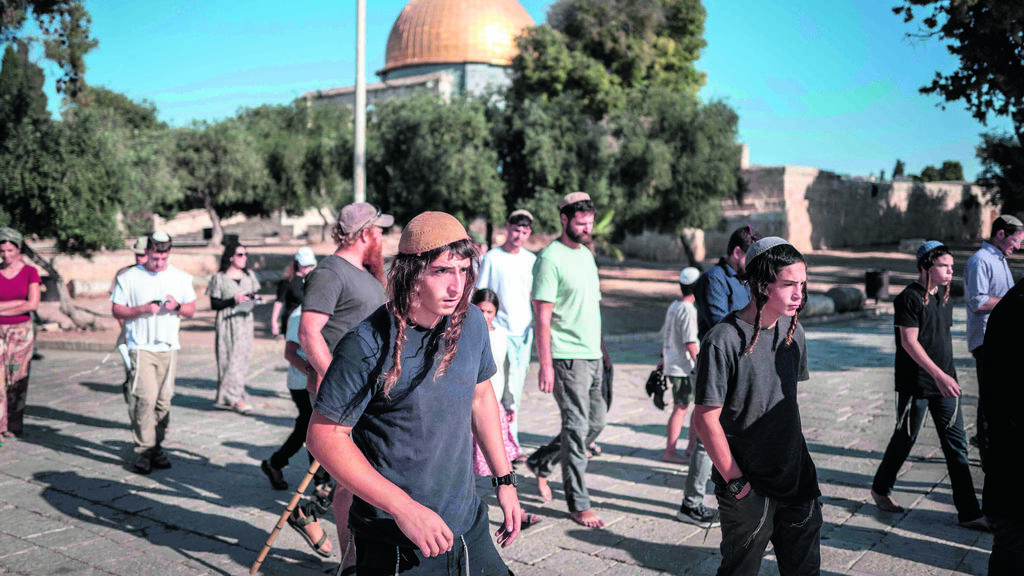
Jews go up to pray on the Temple Mount
(Photo: Ilia Yefimovich/AFP)
And worshippers who want to go a little further?
“We allow them to pray, enter with prayer sheets, prostrate themselves on the eastern side, even sing a little on the Mount. Sometimes an entire group violates the rules, and we remove them. Our role as police is to maintain balance.”
What were the reactions in East Jerusalem to those concessions on Jewish prayer at the Mount?
“There are people who are angry about it, but they are on the margins. We are not detecting any unusual buzz on Arab social media as a result of these moves.”
Peled confirms that several weeks ago police carried out a pilot program in which worshippers were allowed to enter the Temple Mount with siddurim, Jewish prayer books. He says the request came from people around Ben-Gvir.
“They said that if prayer sheets are allowed, and on Tisha B’Av a small book of lamentations was brought in, then what is the problem with a small siddur? I said I wanted to refer the matter to the police commissioner, because a siddur — the very word ‘siddur’ — could be perceived as a change in the rules on the Mount. Some things are within my authority, but with a siddur I thought the decision should be made by the commissioner.”
OK, and then?
“We ran a pilot. Fifteen people were selected to go up to the Mount with a siddur, and afterward we sat down with the Shin Bet to review it.”
What was the conclusion?
“The conclusion was that it didn’t create any noise.”
Other requests, however, he is still rejecting. “They are asking us to allow tefillin and prayer shawls. We are not at that stage. Maybe we will get there, but we are not there yet.”
What does it actually depend on? Why a siddur yes, but a prayer shawl no, for example?
“Good question. It depends on our situation assessment, mine with the commissioner, with the minister. But we are doing this responsibly. There isn’t a week when we don’t receive requests from organizations demanding that we allow more things for Jewish worshippers.”
One of those “more things” is a petition filed with the High Court of Justice earlier this month, seeking to allow the Mount to be opened for Jewish prayer on Saturdays as well. The petition also included a request for an interim order that would have allowed Saturday prayer as early as the Sukkot and Simchat Torah holidays.
What do you think about that?
“I am very careful about maintaining balance. Opening the Mount on Saturdays is beyond my authority. Right now, in 2026, 26 years after that was possible,” he says, referring to the fact that Saturday prayer was possible until the 2000 riots, “this would be a precedent. And a precedent like that is only within the authority of the political leadership.”
But if they ask for your professional opinion, what will you say?
“It would be wrong for the police to give an opinion and say, ‘It can’t be done, it will cause the destruction of the Third Temple.’ No. The position will be presented in a very professional way. We sit with all the relevant bodies, with the Shin Bet, put all the risks and our response capabilities on the table and make a decision.”
And if the High Court says ‘don’t go up,’ and the minister says ‘go up’?
“I don’t think there will be a situation like that. The minister is a responsible person. In my opinion, he would not do something contrary to a High Court ruling.”
And when he and other politicians go up to the Mount? Is that an event as far as you’re concerned?
“We are the sovereign and we provide protection for everything that takes place. There is a very orderly procedure with the Knesset. When we are informed that a member of Knesset is coming, we conduct an orderly situation assessment. Intelligence officials join the call, and in the end I make the decision. We will always allow them to visit during the hours designated for Jewish visitors.”
What is the reaction on the Arab street to such visits?
“If Ben-Gvir goes up — and he does — the Jerusalem street is less preoccupied with it. There are actors who are not even from Jerusalem, from abroad, who try to inflame it. Actors in the north try to stir things up, but it doesn’t gain traction.”
You deploy quite a lot of forces there every Friday these days.
“Today, during Friday prayers, we keep a force inside the Mount. We never used to keep a force on the Mount, and everyone can see them. When someone disrupts order there and we remove him, that sends a message. People in Jerusalem always used to say, ‘Is the Temple Mount in our hands?’ Today we are the sovereign throughout this entire land, including there.”
*****
Ben-Gvir’s name has been linked to Peled’s quite a bit in recent years. Ben-Gvir supported Peled’s candidacy for police commissioner and previously insisted that he be appointed deputy commissioner. That relationship also produced a label Peled dislikes hearing: “Ben-Gvir’s associate.”
Are you offended when people call you that?
“When they say ‘Ben-Gvir’s associate,’ how exactly does that manifest itself? I said this in the committee too,” he says, referring to the senior appointments committee during discussions over his candidacy for police commissioner. “It isn’t true, and I assume it affected the committee. It’s a farce.”
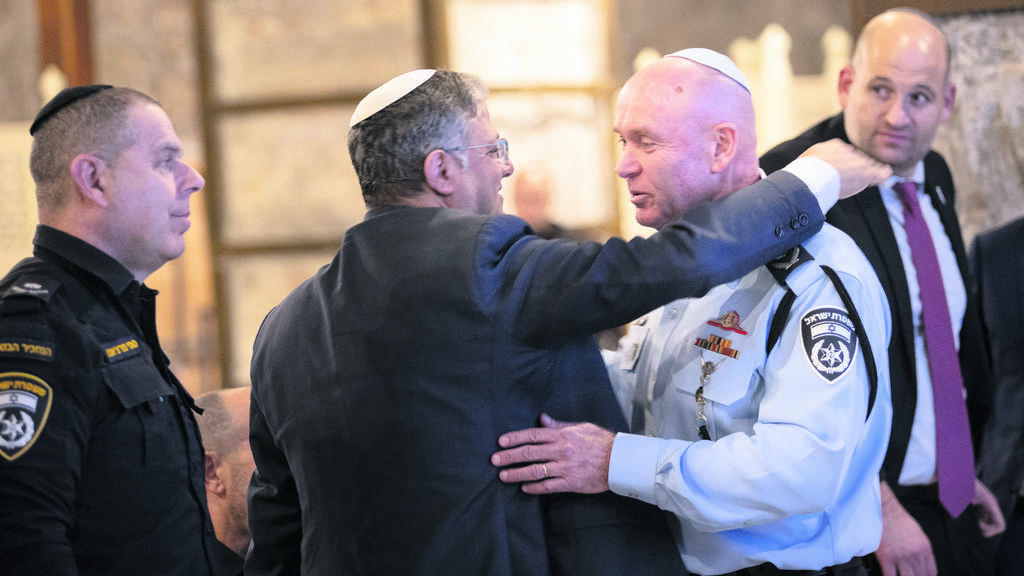
Peled and Ben-Gvir
(Photo: Alex Kolomoisky)
Peled knew Ben-Gvir long before he became a minister.
During the years when Peled commanded the Hebron district, Ben-Gvir lived there.
“I knew him between 2005 and 2007,” Peled recalled. “We didn’t have a close relationship. I would see him, we would sometimes talk, but he was not the person I was in contact with in Hebron’s Jewish community. I was in contact with Orit Struck, for example, and less with Ben-Gvir.”
After that, he says, they had no contact for years. They met again after Ben Gvir had become minister and attended a meeting of the police’s senior command staff.
“The meeting ended and everyone wanted to say hello to the minister. I was the last one left, and he saw me. We shook hands and he said to me: ‘You taught me to love the police. I hated the police.’”
Later, Peled says, Ben-Gvir insisted that he be appointed deputy police commissioner. “That was the first time in that role that we had interaction, and I found myself in a lot of meetings with him.”
So maybe there is closeness between you after all?
“They can say ‘associate,’ not ‘associate.’ The fact that he likes me is not a crime. If I like him and he respects me, that is not a crime either. But ‘associate’ is going too far.”
You also took criticism for attending the minister’s birthday celebration.
“There were other events I was invited to and didn’t attend because I felt uncomfortable. I did go to his birthday because I wanted to show him respect. I say, for God’s sake, we work with him. He is someone we work with. It seems completely natural to me.”
But when officers attend a private event for a minister who is also involved in appointments, aren’t they thinking about their next rank? Isn’t that a little problematic?
“In the end, people like that invite you. It is a happy occasion and we attend. These are people we work with. Is there always a thought in the back of the mind: ‘Maybe they want a promotion?’ Maybe. Maybe some people do come for that reason. But there are also human gestures between people, and when there’s a birthday, I go.”
Peled believes Ben-Gvir is a minister who has done a great deal for the police. “He is a minister who brought major resources to the police, backs police officers — he is a heart-and-soul player. He does not operate like a conventional minister, and the public should know that.”
But immediately afterward, Peled is quick to draw his own line: The minister is the minister, but at the top of the police chain of command stands Commissioner Danny Levy.
What is your relationship with the commissioner like?
“As district commander, I feel that he gives me backing to act, implement and enforce policy. And on more sensitive issues where his involvement is required, we work together to make the best decisions for the public and for the city of Jerusalem.”
And what if the minister approaches you directly and asks for something?
“Even if he comes to me asking me to do something, I say: the commissioner. I will not go around the commissioner. Even if there are people who do that, I am a loyal person, loyal to this institution I represent. If I start doing things behind the commissioner’s back, in the end I undermine the foundations of the organization, because an organization is built on order and discipline.”
So what do you actually tell him?
“Sir, there is a commissioner. Talk to the commissioner.”
There is a feeling among the public that the police have become political. Do you share that feeling?
“Absolutely not.”
As far as Ben-Gvir was concerned, Peled should have become police commissioner after Kobi Shabtai’s term ended.
But when Peled appeared before the senior appointments committee, it emerged that in 2015 he had been questioned by the Justice Ministry’s Police Internal Investigations Department on suspicion of breach of trust, after being recorded asking the head of a regional council to retroactively approve an unauthorized construction deviation at his home. The case was closed, and a note was placed in Peled’s file.
It is far from certain that the affair would have prevented his appointment, but Peled decided to withdraw from the race for commissioner.
“I conducted a situation assessment with myself. Various advisers told me, ‘Listen, there are people who support you, you can go to the High Court.’ I said that I am not the important person in this story. The police cannot remain for a long period without a commissioner. As long as there were disagreements, and as long as I knew that the judge,” he says, referring to Asher Grunis, who heads the committee, “thought I should not pass the committee, I decided to withdraw my candidacy. That was for me and for the police.”
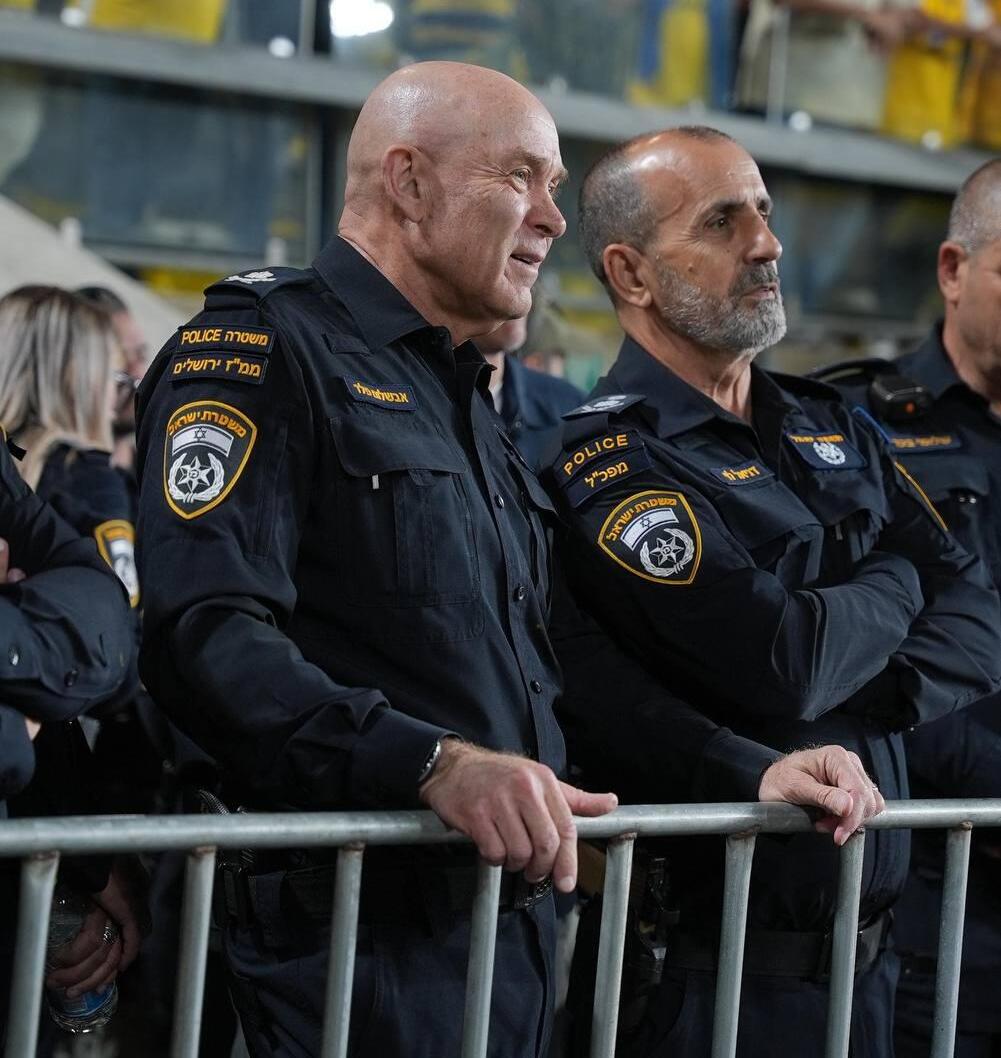
Peled and Police Commissioner Danny Levy
(Photo: Israel Police)
Today, do you think you were wronged?
“I don’t think I was wronged. That’s the nature of things.”
After Danny Levy was chosen as commissioner, Peled already saw himself on the way out of the police. “I planned to retire. Not out of bitterness or slamming the door. I thought that if I decided to stay, it would be like clinging to the altar, and that is a bad thing.”
Levy asked him to remain for a transition period and Peled agreed. Later, a retirement date was set — until the offer came to command the Jerusalem District.
“It was not in my dreams to think about an option like that. But when it was offered to me, I told myself that as an Israeli, a Jew and a senior police officer, you cannot say no to Jerusalem. I said yes.”
And is becoming commissioner still relevant?
“I don’t think becoming commissioner is relevant for me. I think Jerusalem is my final stop, and afterward I will have to focus on my own life.”
*****
In the 10 months since Peled became Jerusalem district commander, the capital has seen highly turbulent ultra-Orthodox demonstrations: Against military conscription, against the light rail, and in another case that he viewed as particularly significant, protests by extremist factions following the deaths of two toddlers and the intention to perform autopsies on their bodies.
“Those were extremely challenging events. There was not enough police manpower to deal with them. Personally, I found it difficult. It was hard to control. What bothers me most is that I cannot enable law-abiding citizens and residents who want to get from one place to another to move freely, that the entire city is blocked, because we simply did not have the force to deal with it due to a significant manpower shortage.”
His conclusion was surprising: Sometimes it is better to let a demonstration die down on its own, because a police assault only fuels it.
So when do you disperse a protest?
“If there is violence by protesters — the policy is uncompromising. We break up the demonstration. If there is no violence and they are blocking roads, then we close off the area, redirect traffic and let them hold their protest. It is a protest that has a time limit. Confrontation makes things worse. It very quickly reaches the point where police use batons, and protesters harass cars, residents and innocent civilians stuck in traffic.”
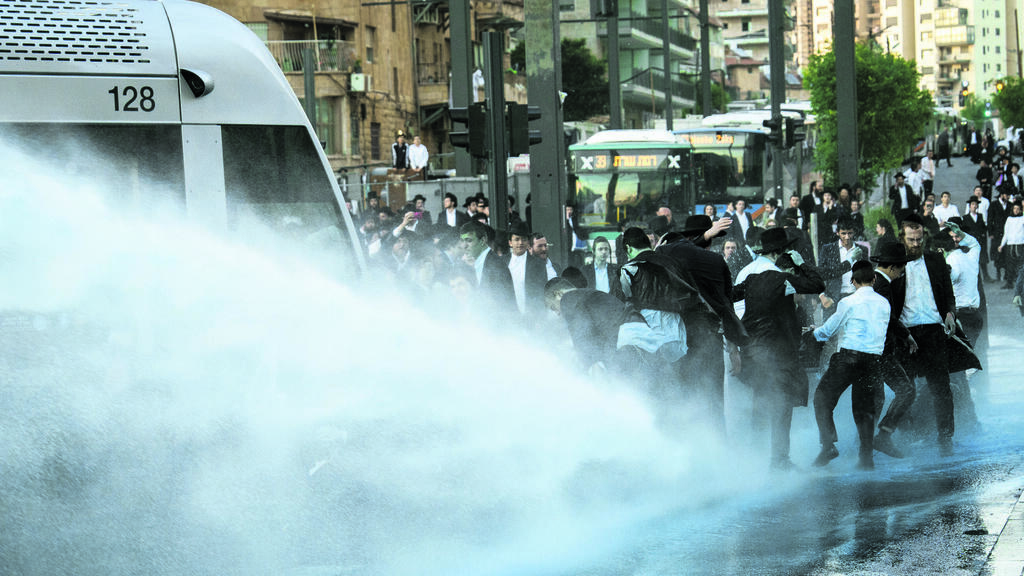
Ultra-Orthodox protesters block the light rail
(Photo: Shilo Shalom)
One ultra-Orthodox protest against the draft even reached the private home of Traffic Division Commander Maj. Gen. Haim Shmueli. “It was not far from what happened at Solberg’s,” he says, referring to Supreme Court Justice Noam Solberg. “They managed to get into the yard, but the Shefat station responded very quickly and managed to stop it before they entered the house. It was a dramatic event, no doubt.
“There are months when there is an ultra-Orthodox demonstration every day. Mentally, it is difficult for the police too. They shout ‘Nazis’ at them and throw things. These are the hardest demonstrations because the numbers are very large, and in the end there is restraint in the use of force. You cannot just go wild on them. You need judgment and to use force wisely.”
And does that approach to dispersing protests apply to every protest, regardless of who is demonstrating?
“We do not distinguish based on the identity of the protesters. The same rules and conduct apply to everyone. In these demonstrations we maintain neutrality, and we instruct officers to show restraint. That is part of police professionalism. You cannot take sides.
“I tell my officers: Do you have political views? No problem, keep them to yourself. When you come to serve as a police officer, the procedures are the same procedures. We don’t care who the protesters are affiliated with.”
Ahead of the elections in about a month, the police are also drilling for a scenario in which members of the public refuse to accept the election results and attempt to reach government institutions in Jerusalem, even break into them. A Jerusalem version of the January 6 riots on Capitol Hill.
You’re really preparing for that?
“Yes. We have those scenarios. We have held drills twice, reinforcing government institutions. At the Knesset, there is cooperation with the Knesset security officer.”
Isn’t that scenario a little far-fetched, maybe extreme?
“In the reality here, nothing is far-fetched.”
*****
Peled is also the police commander responsible for roughly 400,000 Arabs living in East Jerusalem and the surrounding area.
He says even places regarded as more hostile, such as Silwan, Isawiya and Shuafat, have become more accessible to police.
“People in East Jerusalem are trapped in a dilemma,” he says. “On the one hand, they want to receive services like any other resident, municipal services and police services, and they want to live normal lives.
“On the other hand, there is social pressure around the idea of ‘an Israeli occupier holding East Jerusalem.’ There is a complexity here that means things can never simply be quiet once and for all, certainly not in our generation.”
So what has changed in East Jerusalem?
“Deterrence. October 7 changed things. Israel’s fighting on several fronts contributes to deterrence. The basic premise is that this kind of quiet is created by deterrence, because the assumption is that the people in East Jerusalem have not completely changed. They view us as an occupation police force.”
Immediately afterward, he emphasizes: “Not all of them are like that. You must not say that. There are good people too.”
But the threat that preoccupies him in East Jerusalem is not only terrorism or public disorder. When he gets to it, his tone changes.
“On East Jerusalem, I’m going to say things that are chilling, in my opinion,” he says, using a term rarely heard in police briefings: “political subversion.”
What do you mean by 'political subversion'?
“When you talk about sovereignty and governance in Jerusalem, the meaning is completely different. There is an element here of political subversion. That is a very strong term. Subversion intended to erode and push back Israeli sovereignty in Jerusalem.”
Peled describes what he calls a “shadow struggle” taking place beneath the surface and points to the involvement of foreign actors.
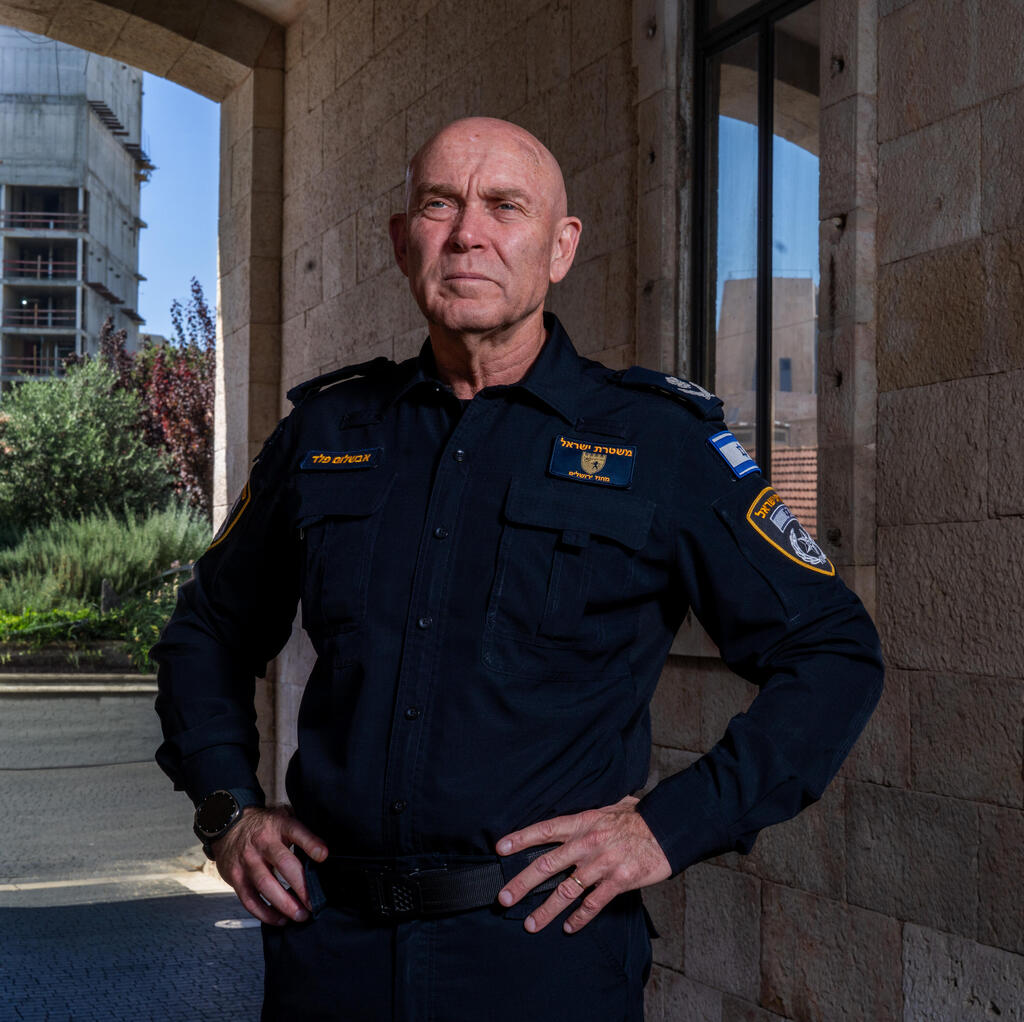
Jerusalem District Police Commander Maj. Gen. Avshalom Peled in front of a panoramic photograph of the city under his command
(Photo: Shilo Shalom)
“We are talking about state actors, Turkey and to some extent Morocco. There are organizations here fighting Israel. If they came under an aggressive military guise, we would crush them immediately. But the guise is humanitarian, religious. And the Palestinian Authority is constantly trying to conduct state activity inside our sovereign territory.”
What does such a struggle look like on the street?
“For example, holding their conferences here, or during Ramadan bringing food packages onto the Temple Mount stamped with Turkey. Helping renovate homes for people who are struggling, charity. It looks humanitarian, but it is a very sophisticated way to penetrate East Jerusalem.”
And what objective do you attribute to them?
“They want Jerusalem as a Muslim capital. Because Jerusalem is the symbol.”
And where is the red line?
“If the Palestinian Authority starts handling, just as an example — it is not happening here, but if it does — clan disputes and murder cases in Arab society, if they come in to mediate those disputes, then we have gone bankrupt.
Peled says the Jerusalem District Central Unit is fighting this “political subversion,” with assistance from the Shin Bet, but he is careful to stress that governance, in his view, is not only about enforcement.
If the state appears in East Jerusalem only in a police car and for arrests, someone else will fill the vacuum.
“Sultan Suleiman Street is no different from Jaffa Street. Not only enforcement, but also the services a resident in East Jerusalem receives. That is governance, because if we do not provide services, all kinds of people will enter that vacuum.”
According to the statistics he cites, the trend is positive. The district points to a 60% decline in public-order incidents and a 50% drop in nationalist crime against Jews compared with last year’s figures. During the month of Selichot, he says, the number of visitors to the city was double that recorded last year.
He does not take the credit himself. “It is all thanks to the police officers and the district command staff, who work day and night to maintain the situation in the city,” he stresses. “Without them, the role of district commander is empty of content.”
Still, Peled says again, he is not relaxed. Apart from the Temple Mount, the second strategic challenge he identified upon taking office lies at the other end of the city: the Jerusalem perimeter.
Those borders can also be seen clearly in the panoramic photograph opposite his desk. About 40% of the perimeter has no physical fence, creating routes for smuggling and illegal entry into Israel. In a worse-case scenario, weapons and terrorist operatives as well.
“The State Comptroller’s report on government decisions is an extremely harsh report. I don’t see anyone getting excited about it, but here we are emphasizing this issue. Previous district commanders did not place enough emphasis on it.”
So what is actually happening there?
“The Border Police units around Jerusalem are doing sacred work, but there are still nonstop attempts to infiltrate the country. Today, one of the most profitable things you can be economically is a smuggler of illegal entrants, and there isn’t a day when we are not fighting this phenomenon.”
And terrorism?
“Terrorist organizations use the platform of illegal entry to infiltrate the country, and that is our threat. It is a strategic challenge that affects the entire country. There are huge gaps and we are dealing with them.”
Other photographs hang in his office too, mementos from his past: from service in the Armored Corps, through the Yamam counterterror unit, command of the Gideonim unit, the Beit Shemesh police station, the Ramon Border Police district, the Hebron and Negev districts, deputy commander of Border Police, deputy commander of the Jerusalem District, head of the Training Division and deputy police commissioner.
On one wall are also photographs from an entirely different period of his life — the five years he lived abroad, two in Istanbul and three in Paris, while working as a Shin Bet security officer.
And there are other photographs that move him especially deeply.
In October 2023, when he was deputy police commissioner, Peled was not in Israel. He was in Poland with his 90-year-old father on a personal journey intended to fulfill one request: to find the grave of his father’s father — Peled’s grandfather — and visit it before it was too late.
Months earlier, he had located the grave in a small cemetery in Poland. Later he returned with a friend and personally restored the headstone, which had deteriorated over the years.
In early October, he took his father there. They lit candles and prayed. “It was very moving,” he says.
On Saturday, when they were supposed to leave Krakow and return to Israel, the horrific images from Israel began arriving. Their flight was canceled.
Peled bought tickets on three different flights and tried to find a way home. By the next day, he was back in Israel.
Those days — the transition from the cemetery in Poland to the massacre scenes in Israel — stayed etched in him. Perhaps that is why, throughout our conversation, he keeps returning to the sentence: “I am never relaxed for a moment.”
And what scenario frightens you most?
Peled does not hesitate. “The reference scenario is a terrorist attack on the Temple Mount, from any side.”