


The Lebanese newspaper Al-Akhbar, affiliated with Hezbollah, published Wednesday what it described as the final proposal by U.S. envoy Tom Barrack for a comprehensive resolution between Lebanon and Israel—including the disarmament of Hezbollah. The proposal, titled “Extension and Stabilization of the Ceasefire Declaration Between Lebanon and Israel, November 2024,” was reportedly circulated to Lebanese cabinet ministers during a tense government session in Beirut.
Gallery
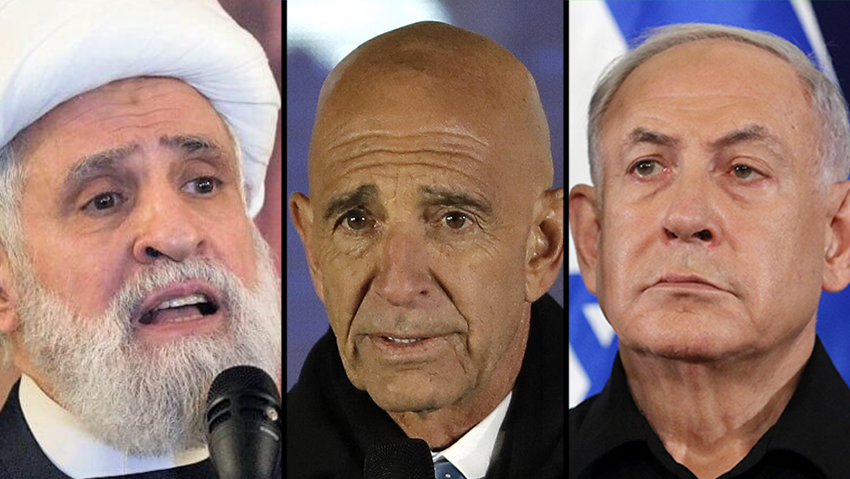
Hezbollah chief Naim Qassem, US envoy Tom Barrack and Prime Minister Benjamin Netanyahu
(Photo: Dana Koppel, AP Photo/Abdel Kareem Hana Hussein Malla, AP, ANWAR AMRO)
These are the requirements set forth in the proposal:
- Clause 1 outlines Lebanon’s commitment to implementing the 1989 Taif Agreement (which ended the Lebanese civil war), its own constitution, and UN Security Council resolutions—especially Resolution 1701 from 2006, which established a ceasefire between Israel and Hezbollah. Lebanon would also take the necessary steps to assert full sovereignty over its territory, strengthen legitimate state institutions, ensure exclusive decision-making authority over war and peace, and guarantee that all weapons remain under state control.
- Clause 2 mandates a cessation of hostilities—on land, in the air, and at sea—through organized measures leading to a comprehensive and lasting solution.
- Clause 3 calls for the phased dismantling of all armed non-state actors, including Hezbollah, both north and south of the Litani River, with appropriate international support for the Lebanese Army and Internal Security Forces.
- Clause 4 states that Lebanese military forces will be deployed to border areas and central interior regions, again with international support.
- Clause 5 requires Israeli withdrawal from five strategic points in the Lebanese security zone that remain under its control following the last war with Hezbollah.
- Clause 6 addresses the return of residents to their homes and properties in border towns and villages.
- Clause 7 includes Israel’s full withdrawal from Lebanese territory and the cessation of all hostile actions—whether by land, air, or sea.
- Clause 8 calls for permanent, clearly defined demarcation of the international border between Lebanon and Israel.
- Clause 9 stipulates permanent border demarcation between Lebanon and Syria.
- Clause 10 proposes an economic summit, with participation from the U.S., France, Saudi Arabia, Qatar, and others, to support Lebanon’s economy and reconstruction efforts.
- Clause 11 ensures international support for Lebanon’s security forces—particularly the army—through military assistance needed to implement the agreement and protect the country.
According to Al-Akhbar, the plan includes a 15-day preparatory phase during which the Lebanese government would formally approve and commit to the document’s goals through its constitutional process. This includes a pledge to fully disarm Hezbollah and other non-state actors by December 31, 2025. Compliance would result in increased IMF cooperation, greater international aid for reconstruction and economic investment incentives.
Hezbollah 'flexing' as Lebanese parliament discusses disarmament


During this 1st phase, Israel would halt all military activity on land, at sea, and in the air. Hezbollah’s military infrastructure—including underground tunnels, operational sites and weapons depots—would become accessible. The U.S. and France would apply pressure on Israel to fully implement the memorandum. Bimonthly supervisory meetings would also resume.
Additional steps include: submission of initial military position reports by both Israeli and Lebanese forces; the Lebanese military establishing approximately 15 initial border posts south of the Litani River, based on a deployment map prepared by Lebanon’s army command; and Israel informing Lebanon—via the International Red Cross—of the number, names and conditions of Lebanese prisoners held in Israeli jails to facilitate their release. Negotiations would also begin—under U.S., French and UN guidance—to resolve disputed areas and officially demarcate the border between the two countries.
The final item in the 1st phase states that President Joseph Aoun and Parliament Speaker Nabih Berri would collaborate with all Lebanese political factions, including Hezbollah, to ensure Lebanon’s formal commitment to the memorandum, the disarmament plan and its timeline. Particular emphasis would be placed on the immediate transfer of heavy weaponry—missiles and drones included—to the Lebanese Army from areas both north and south of the Litani, in accordance with the November 2024 declaration.
The 2nd phase, lasting 15 days to 60 days, involves initial implementation of the disarmament plan. It would be accompanied by formal declarations from friendly nations supporting the planned economic summit in fall 2025. During this stage, Israel would withdraw from three of the five strategic points, with Lebanese forces taking over the vacated areas and residents returning to their villages.
In the 3rd phase, 60 days to 90 days, Hezbollah would complete its full military withdrawal from south of the Litani River. Israel would then withdraw from the final two points, allowing Lebanese forces to take control.
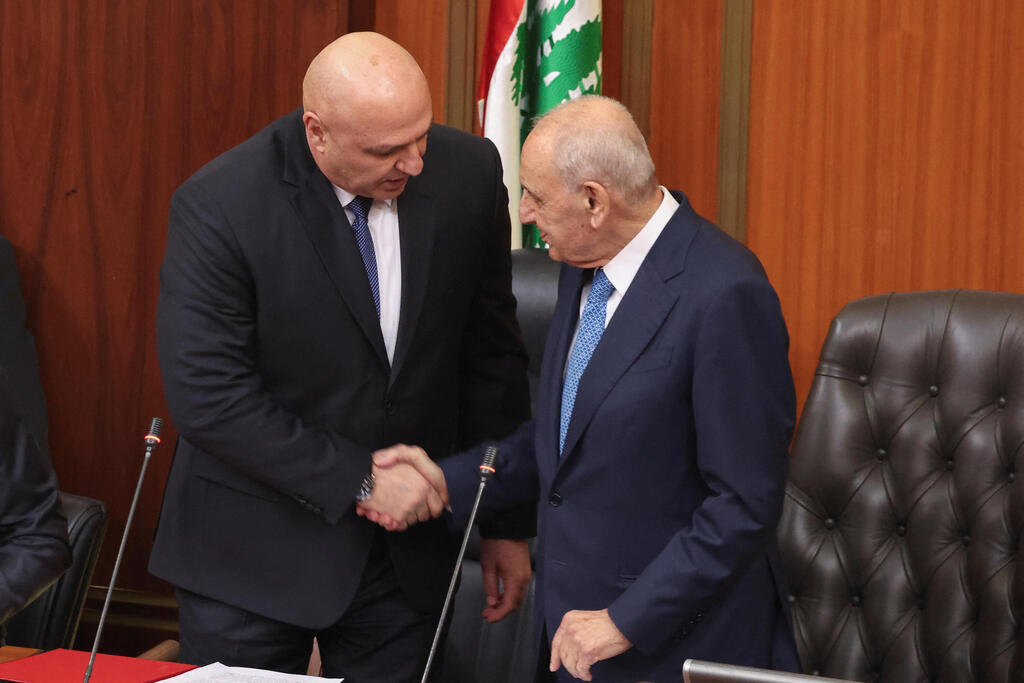
Speaker Berri and President Aoun
(Photo: REUTERS/Mohamed Azakir)
The 4th and final phase, spanning 90 days to 120 days, calls for the complete dismantling of Hezbollah’s remaining heavy weaponry, including mortars, rocket launchers, surface-to-air and surface-to-surface missiles, UAVs, and any weapons capable of causing mass casualties. This phase also covers the removal of Hezbollah’s military infrastructure—command centers, tunnels, and missile storage facilities. Israeli forces would fully withdraw from Lebanese territory, and Lebanese security services would assume complete control over all regions north and south of the Litani.
Get the Ynetnews app on your smartphone: Google Play: https://bit.ly/4eJ37pE | Apple App Store: https://bit.ly/3ZL7iNv
According to the report, Israeli violations of the agreement would trigger a reprimand from the UN Security Council. Lebanese violations would result in suspension of conditional military aid and the imposition of economic sanctions.
Meanwhile, the Israeli military announced that an airstrike in Lebanon—guided by Northern Command—eliminated Hezbollah operative Hossam Qasem Ghorab. He had been directing Hezbollah cells in Syria in an effort to launch rockets toward the Golan Heights. “His activity posed a threat to the State of Israel and its citizens,” said a military spokesperson. “IDF will continue to act to remove any threat to the State of Israel.”