

Among collapsed buildings, crushed cars and streets covered with shrapnel, bomb disposal officers from the Tel Aviv District police have been operating nearly without pause since the start of the war. While residents are still trying to understand what fell near their homes, they are the first to arrive at the impact site, equipped with protective gear, specialized equipment and years of experience.
In the first minutes after a missile or fragment lands, the scene often looks like complete chaos. Dust fills the air, shattered glass covers the ground, residents try to figure out what happened and rescue forces begin to arrive.
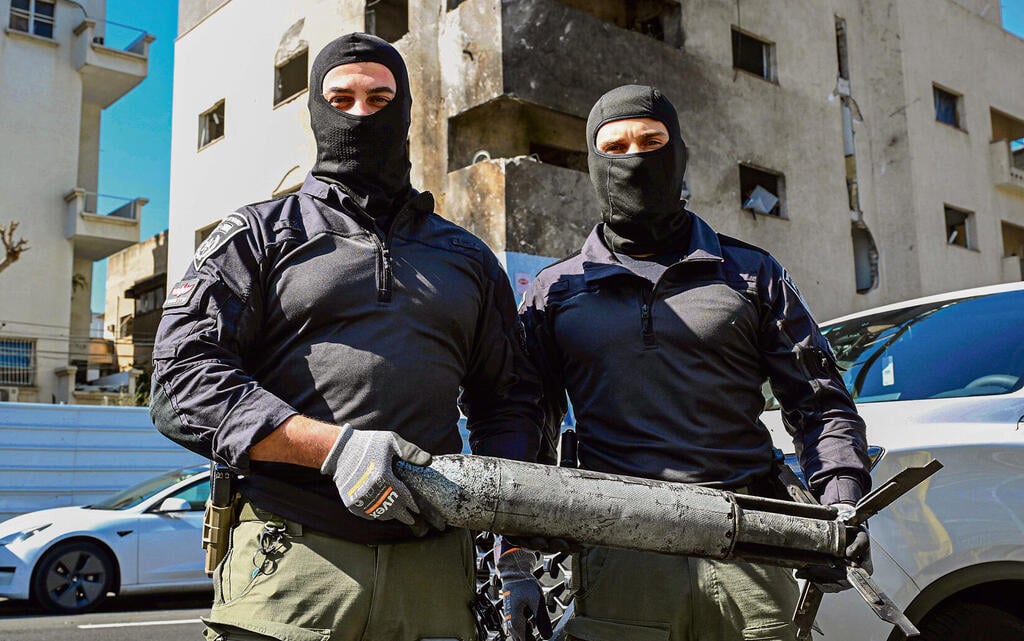
For the bomb technicians, however, even within the chaos there is clear order. First Sgt. R., a police bomb disposal expert in the Tel Aviv District, said preparation begins even before reaching the site. “Already on the way to the scene I more or less know what I’m going to see based on the reports coming in,” he said. “From that I can also assess the possible dangers to the public.”
R. says that the first steps at the scene are almost always the same: determine exactly what happened, whether the item exploded and what risks may still remain. “When I arrive at the scene, the first thing that goes through my mind is saving lives. That’s my profession,” he said simply. “My wife is a teacher, my brother works in high-tech. I save lives.”
The public usually sees the bomb squad from afar, behind caution tape and roadblocks. But the real work happens in the first minutes, when decisions must be made quickly and sometimes alone. “At the scene everyone is waiting for one person who can remove the threat,” R. said. “There may be hundreds of police officers there, but only a few dozen bomb technicians. In that moment the responsibility rests on our shoulders.”
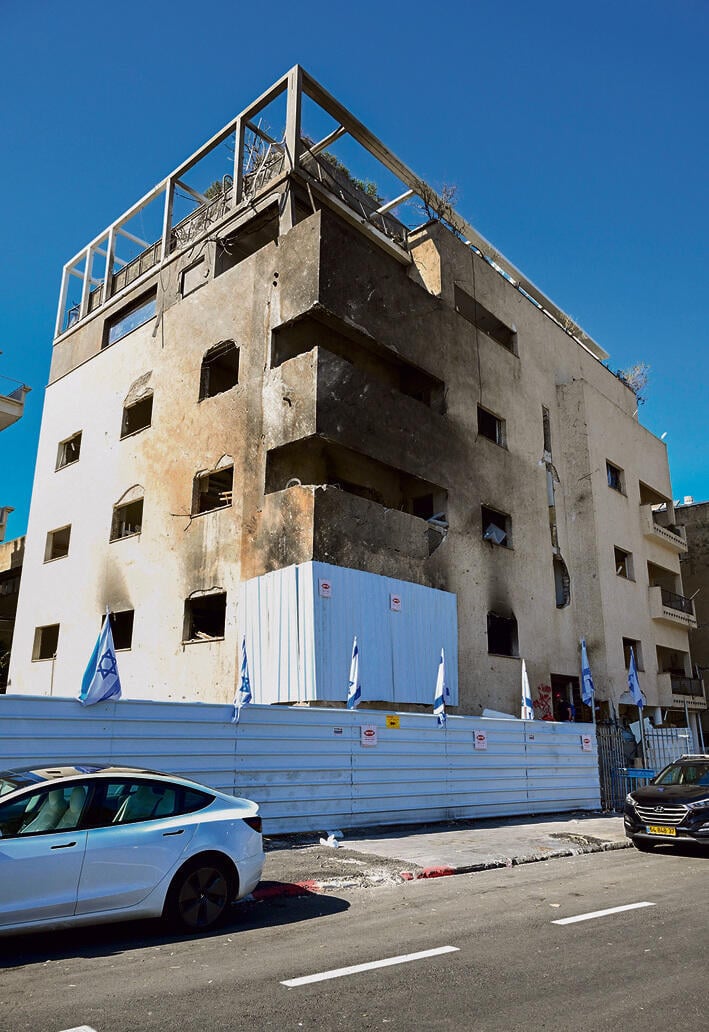
Missile impact sites in Tel Aviv
(Photo: Kobi Kuankas)
Since the war began, bomb disposal teams have had to deal with types of munitions and warheads far larger than those they were accustomed to in the past. Impact sites are often complex, especially when heavy missiles strike in the heart of residential neighborhoods.
Such a situation unfolded on Saturday night in central Tel Aviv. “In the first minutes it was a chaotic and unpleasant scene,” R. said. “But the danger to the public decreases once there are no extremely dangerous explosive components remaining.”
Still, he said, dealing with weapons striking from Iran, Lebanon and Yemen presents serious challenges. “Those launching these missiles at us possess extensive technical knowledge,” he said. “They require you to know everything. Each scene has its own characteristics, and that’s exactly the versatility of a bomb technician, who sometimes has to move like a cat around an explosive device and other times like a lion in a much larger scene.”
Master Sgt. S., another bomb technician in the Tel Aviv District, was present at the main missile impact site in the center of the city during Operation Rising Lion in June. He said the destruction he encountered at one of the first sites hit by an Iranian missile was unusual even for experienced professionals.
“There was an entire street that had been hit and buildings that were simply no longer standing,” he recalled. “It was different from what we were used to seeing until then in fighting against Gaza or Lebanon.”
Despite that, he emphasized that for bomb disposal units there are few real surprises. “We are familiar with all these items and train for them all year long,” he said.
Working in such environments also requires emotional control. Bomb technicians often approach items that may still explode, and even the smallest mistake can be fatal. “Fear is a natural thing,” S. said. “But thanks to our knowledge and training, we know how to control it. Emotion doesn’t manage us. We manage it.”
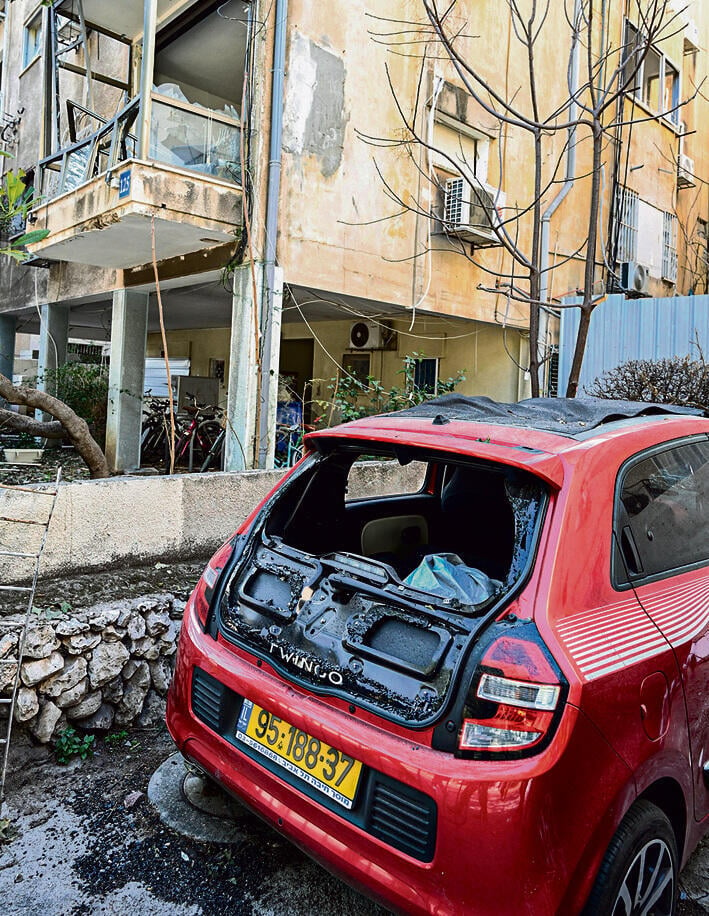
'Those launching these missiles at us possess extensive technical knowledge'
(Photo: Kobi Kuankas)
One of the biggest challenges they face, however, is public curiosity. Civilians sometimes arrive at impact sites to take photos or even collect fragments. In one case, S. said, a resident took home a relatively large warhead. “If that had exploded in his house or car, it could have ended in a major tragedy,” he said. “Fortunately we managed to reach him and remove the item safely.”
R. also has a clear message for the public. “Impact sites are not reality shows,” he said. “Don’t come with your phone to film and don’t touch anything. People need to stay away and let the rescue forces do their work to avoid disaster.”
Work at destruction sites can continue for hours. Since the fighting began, bomb technicians have been working almost nonstop, trying to restore a sense of safety to the streets.
At home, their families are waiting. “I’m a father of two,” R. said. “I have a wife who supports me like a fortress. That gives me the strength to keep working.” S., who married recently, said he tries to maintain a balance between work and home. “When I return home, I try to separate my work from my personal life,” he said. “I try to give my wife the time she deserves.”
As long as the war continues, their work will not stop. Behind the red caution tape, among shrapnel, broken concrete and crushed cars, they know exactly what their role is: arrive at the scene, identify the danger and ensure no additional victims beyond those caused by the initial missile strike.
“We will be at every scene,” R. said, “it may be a criminal scene, a missile impact site from Iran, Lebanon or Yemen, or any location where we are needed to save lives.”
First published: 12:08, 03.09.26