


Women across the Gulf states also serve in their countries’ armed forces in a variety of roles, whether in Kuwait, Bahrain, the United Arab Emirates, Qatar, Saudi Arabia or Oman. Their integration into Gulf militaries has taken place gradually over the years and, in some countries, has also raised religious sensitivities.
In every Gulf state, military service for women is entirely voluntary. Even in countries with mandatory military service, conscription applies only to men. Against the backdrop of regional tensions, Iran’s recent attacks on its neighbors and pressure on Gulf states to demonstrate their military capabilities in the face of growing threats, the question is also being raised about what role women should play in those forces.
Women in Arab militaries
(Video: Tal Azulay)


On July 5, the Kuwaiti military announced that the General Staff’s Human Resources Directorate was opening another recruitment round for women, allowing those interested to apply for voluntary service in the Kuwaiti armed forces. Registration was held July 6-13, with applicants required to be Kuwaiti citizens between ages 21 and 26, at least 1.5 meters, or about 4 feet, 11 inches, tall and medically fit. Candidates were also required to undergo a personal interview.
In June, Kuwait marked a historic milestone when Defense Minister Abdullah al-Ali appointed the military’s first-ever group of female officers. The women were university graduates whom the defense minister said would provide a high-quality addition to the armed forces.
Kuwait first opened military recruitment to women only in 2021, but the process was halted under pressure from religious figures. It later resumed under conditions that restricted, among other things, the areas in which women could serve and required the consent of a guardian or husband as well as adherence to a dress code.
In the United Arab Emirates, female military recruitment is not new, but on Aug. 13 the Emirati Defense Ministry invited women to apply for pilot training at Khalifa bin Zayed Air College. The announcement required applicants to be Emirati citizens between ages 18 and 22, at least 1.65 meters, or about 5 feet, 5 inches, tall, of good conduct and to have achieved a specified high school grade-point average. Applicants were also required to undergo a personal interview and medical examination.
The UAE was a pioneer in integrating women into the military. According to reports in the country, voluntary recruitment of women began in the early 1990s with the establishment of the Khawla bint Al Azwar Military School, the first academy to train women for military service.
One of the best-known women in the Emirati military is Mariam al-Mansouri, the first Emirati woman to fly a fighter jet, who also took part in strikes against ISIS in Syria. Born in Abu Dhabi in 1979, she studied at Khalifa bin Zayed Air College and graduated in 2007. Over the years, she has received widespread recognition both at home and abroad.
Qatar officially announced in 2018 that women age 18 and older could volunteer for national service. In Saudi Arabia, the Defense Ministry was reported in 2019 to have opened military positions to female applicants as part of the kingdom’s Vision 2030 program. Recruitment itself began in 2021. Women also volunteer in the armed forces of Oman, Bahrain and Iraq.
Gallery
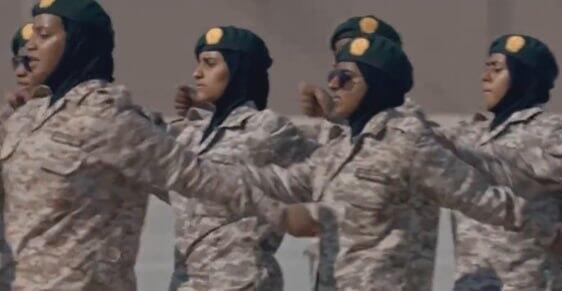
Female Emirati soldiers march in formation during a military ceremony in the United Arab Emirates
The recruitment of women in Gulf states is tied to the broader issue of military service in the region in recent years, with some countries introducing mandatory service for men while others have not.
According to Dr. Yoel Guzansky, a former National Security Council official and a senior researcher and head of the Gulf program at the Institute for National Security Studies, or INSS, military recruitment has expanded in Kuwait, Qatar and the UAE in recent years. One reason is the changing security environment in the Gulf. That trend predates the latest wars involving Iran, as threats in the Gulf are not new, but those threats are intensifying and forcing governments to make greater use of their populations.
In an INSS publication in February, Guzansky wrote: “Qatar, the United Arab Emirates and Kuwait have introduced conscription laws for men that include not only regular service but varying reserve obligations, depending on the country. Women, as noted, are not required to serve but may volunteer. The phenomenon is relatively common in the UAE, where female soldiers serve in a variety of roles, and less common in Qatar and Kuwait. Since 2014, mandatory service in the UAE for men with a high school diploma or higher education has lasted 11 months, while those who did not complete high school serve for three years. Voluntary service for women was set at 11 months.”
The publication added: “The motivations for conscription in the three countries fall along three main axes. Strategically, Qatar and the UAE seek to strengthen their military power and establish the ability to participate actively in conflicts, as was evident in the war in Yemen. Politically, military service serves as a tool to strengthen the connection between the citizen and the state, as it is easier to convey various national messages to young recruits, creating an opportunity to shape attitudes and generate loyalty. Socially, in wealthy rentier states such as Qatar, Kuwait and the UAE, there is a sense of alienation and lack of commitment among the younger generation toward a state that finances all aspects of life, and military service is seen as a way to demand a tangible contribution, increase discipline and strengthen cohesion.”
“Another reason discussed as a motivation for conscription is the deteriorating health of the young population in the Gulf states, based on the understanding that military service could contribute to young people’s physical fitness and health,” the publication said.
Guzansky told ynet that Gulf states are “trying to establish a new model of the state, an update to the rentier model that is gradually eroding in these countries.”
“Now, in the UAE and the other countries that recruit men and women, they are saying, ‘If you take part in this activity and enlist, only then will you receive benefits in housing, education and more,’” he said. “It is not an absolute condition, because those who do not enlist also receive these benefits, but those who do serve receive more. They are given priority as an incentive to enlist.”
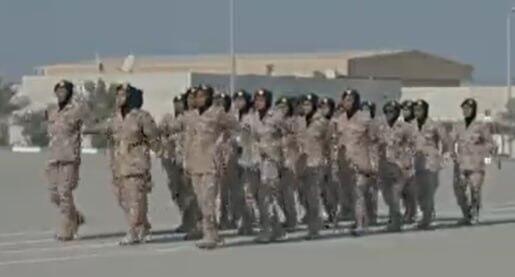
Female Emirati soldiers march in formation during a military ceremony in the United Arab Emirates
Guzansky said employment concerns are among the main factors discouraging young Gulf citizens from military service.
“They say, ‘We’ll enlist and then others will pass us in line and get better jobs. Maybe it will hurt our careers,’” he said. “The authorities are trying to address that as well through incentives to encourage people to enlist.”
The February publication also addressed other Gulf states.
“In the near future, identical conscription policies should not be expected in Bahrain, Saudi Arabia and Oman,” it said. “In Bahrain and Oman, demographic and sectarian constraints make such a step difficult to implement. Saudi Arabia, where there are internal voices calling for mandatory military service, has a large and diverse population, and it is doubtful whether the model used in Qatar or the UAE could be replicated there.”
Guzansky concluded: “The conscription that has begun in the Gulf is not merely a security measure but also a broad process of ‘citizenship engineering,’ serving as a school for discipline and life skills no less than as a military framework. To some extent, military service is a mechanism through which the monarchies seek to reshape military-society relations, strengthen the legitimacy of the regime and create loyalty among the younger generation.”
And returning to women, could the recent recruitment announcements reflect a need for additional personnel because of growing threats?
“Possibly. The timing indicates that security considerations are involved. In the UAE, as well as Qatar and Kuwait, the populations are very small. They have to squeeze the lemon for everything it’s worth because they don’t have much to work with. It’s not like Saudi Arabia. The threats facing the UAE are significant, and they want to make use of as much of the population as possible.”
“There is always the image issue as well,” he added. “They want to say, ‘Look, we have women serving, too,’ to project equality, even though that is not the reality.”